+84 9 75 46 33 10 (Whatsapp)
  info@horizon-vietnamtravel.com
  Français
  Español
  Português
  Deutsch

An Overview of Saigon’s History
Table of contents
Saigon is a young city in Vietnam. Yet the 300 years of Saigon’s history have been both rich and eventful. Today Saigon is considered Vietnam’s economic capital. Here are some highlights of Saigon’s history.
Before Being Called Saigon
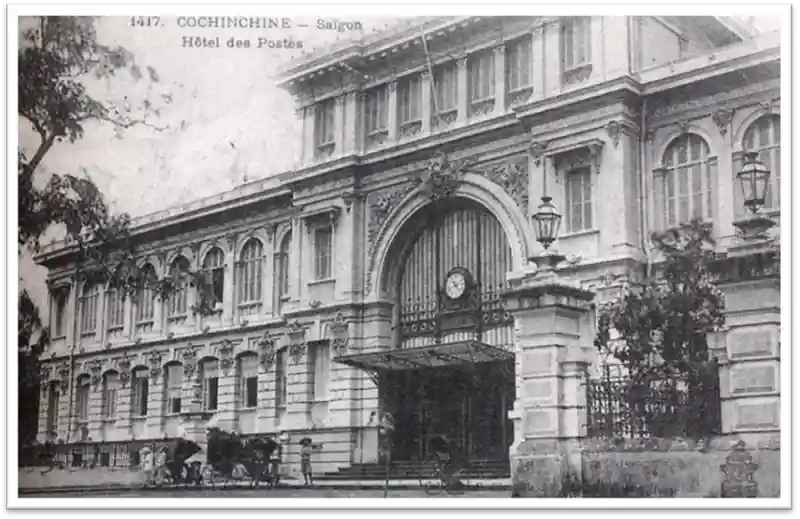
The site was inhabited since prehistoric times, as evidenced by artifacts found during the construction work of its cathedral. Several times throughout its history, the city came under Khmer influence. It assumed the Vietnamese name Saigon only in the 18th century. Saigon would mean kapok wood, a tree native to this region.
From the Early 15th to the 18th Century
At the dawn of Saigon’s history, from the end of the 15th century, the first Annamese settled voluntarily on this land known for its great fertility. A new wave of immigration intensified between 1623 and 1698. Then, right next to it, Cho Lon attracted the first foreign immigrants: Chinese fleeing the Ming dynasty who settled here, creating the region’s first vibrant commercial center.
The Annamese merchants called the upper city Phan-Yen and the riverside, more commercial part, Bên Thành. The city was also known as Prei Nokor, meaning “capital of the forest,” because of the vegetation that surrounded it.
In 1700, the city was only a small river port. However, it was beginning to gain recognition as a cosmopolitan land, where inhabitants of very diverse origins coexisted (Khmer, Cham, Chinese, Indian, Vietnamese). At the center of these southward movements, the Nguyen lords, based in central Vietnam, played an important role.
When the Nguyen dynasty unified Vietnam from north to south after overthrowing the rebellious Tay Son brothers, Saigon became, following a decree from the first emperor of the dynasty, the citadel of Gia Dinh.
Key Dates
– 1859
The citadel of Gia Dinh was occupied by French military forces, becoming the seat of the French colony in Cochinchina. The face of Saigon began to change. The French began to organize the city in a European style. The name “Ville de Saigon” dates to this period.
– 1867
An important event in Saigon’s history, Cochinchina became a French colony and Saigon then took on the role of important administrative, military, and economic center of the region.
Although French colonization brought architectural and environmental improvements such as draining marshes, plantations, and modern construction, Saigon experienced numerous periods of turmoil: the deposition of Emperor Bao Dai, the seizure of power by Ngô Dinh Diêm, and various incursions.
– From 1954 to 1975
Saigon entered a turbulent period, between pro-American forces under Diem, those of Bao Dai, the last king of Vietnam, and those favoring Ho Chi Minh, head of the Democratic Republic of Vietnam. In 1955, Ngô Đình Diệm, thanks to his pro-American stance, succeeded in ousting Bao Dai from power and governing Saigon. The capital of the Republic of Vietnam became a pro-American regime.
The Americans equipped the South with architectural works such as the Reunification Palace, the Palace Hotel, and the American Embassy. Despite the ambitions it always aroused and frequent bombings alternating with attacks, the city managed to preserve its heritage, which remained nearly intact.
– Between 1965 and 1975
Saigon was at the center of disputes and power changes. In 1973, following the Paris Accords, Saigon saw the withdrawal of American troops. The year 1975 marked the fall of the pro-American regime and the city adopted the name “Ho Chi Minh City,” in tribute to a man who embodied national salvation and territorial unity of the country.
– From 1975
Called Ho Chi Minh City since 1975, it is administered like other Vietnamese cities by a single regime. Over more than twenty years of renewal, Ho Chi Minh City and Hanoi have become the country’s two main economic centers. In the eyes of the Vietnamese, Ho Chi Minh City still embodies modernity, dynamism, and vitality, an engine of the national economy.
– Today
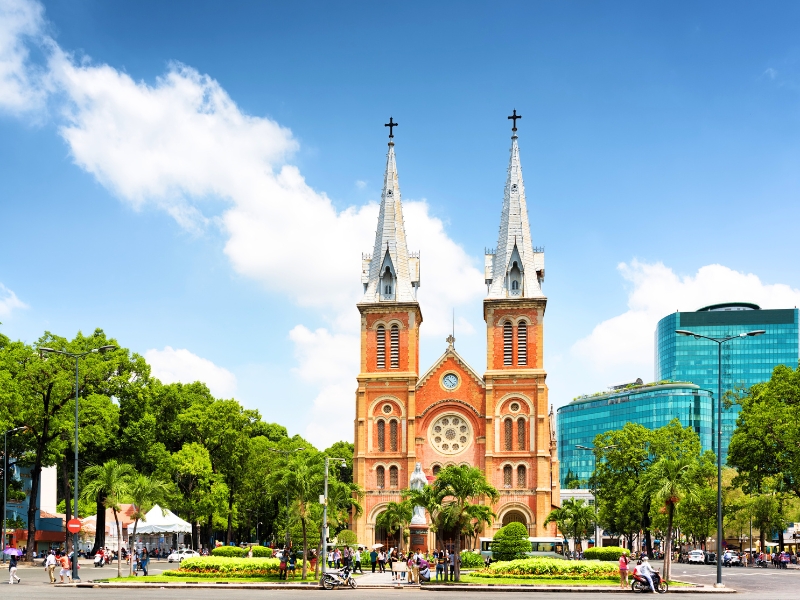
Notre-Dame Cathedral of Saigon
During rush hours, the city experiences chaotic traffic, swarming with motorcycles and ever-longer lines of cars. On Saturday evenings, the streets and parks are invaded by young people, for whom it is the day out. The city is full of overwhelming energy.
It is effervescent, vibrant, open to everything and everyone. Having rediscovered itself after opening up, it does not shy away from any change. The frenzy of greatness is beginning to make itself felt.
A sense of urgency has seized the city: it must catch up with its Thai and Singaporean neighbors…
With the provinces of the South, Ho Chi Minh City forms a “growth triangle” that plays a driving role in the country’s economic dynamism and contributes approximately 50% of Vietnamese GDP, 60% of industrial production, and 60% of exports. The GDP growth rate of this area is significantly higher than the national average.
Are you thinking of discovering this magnificent city? Here is our complete guide to answer all your questions about staying in Vietnam and to propose captivating itineraries in Saigon: 15-Day Vietnam Circuit – Complete Travel Guide.
And if you want to know more about the history of Vietnam, consult our dedicated article on Horizon Vietnam Travel.



Our recommended itineraries
 Nature and Active travel
Northern Vietnam Explorer in 9 days and 8 nights
About ten days
Hanoi - Ha Long Bay - Saigon - Mekong Delta - Siem Reap - Luang Prabang - Pak Ou Caves - Kuang Si Waterfall
 Classic
Vietnam Exclusive in 13 Days
About 2 weeks
Hanoi - Bai Tu Long - Hue - Da Nang - Hoi An - Saigon - Mekong Delta