+84 9 75 46 33 10 (Whatsapp)
  info@horizon-vietnamtravel.com
  Français
  Español
  Português
  Deutsch

Japanese Bridge of Hoi An: The Tranquil Soul of the Old Town
Table of contents
Among the quiet streets of Hoi An, a small wooden bridge catches the eye for its distinctive shape and nearly silent appearance. Built in the 16th century by the Japanese community, this covered bridge, called Chua Cau, connects the two banks of a canal with quiet elegance. It connects far more than two districts: it unites eras, cultures, and stories. Sheltered beneath its tile roof, one senses time flowing more gently. The Japanese Bridge remains one of Hoi An’s most emblematic places, at once familiar and laden with memory, always ready to welcome the slow steps of those who take time to cross it.
Practical Information about the Japanese Bridge
Location
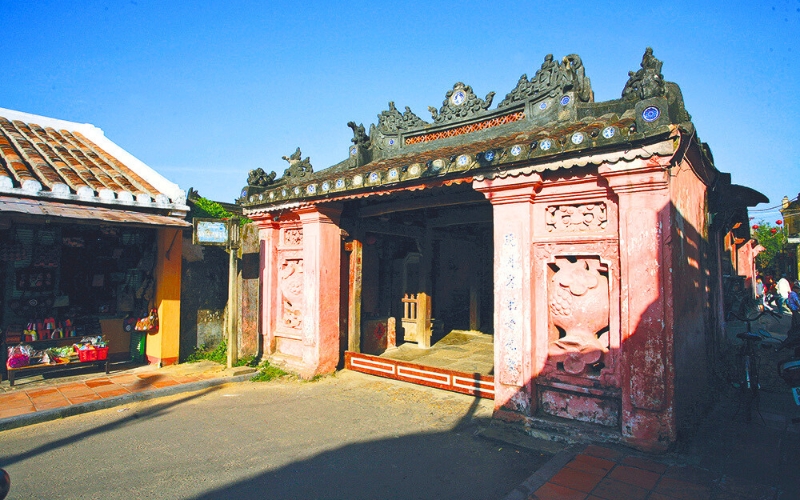
The west end of the Japanese Bridge joins Nguyen Thi Minh Khai Street.
The Japanese Bridge (Chua Cau) is located in the heart of Hoi An’s historic center, connecting Nguyen Thi Minh Khai and Tran Phu streets, along an arm of the Hoai River.
Visiting Hours
The bridge is accessible every day, during the opening hours of the ancient city, generally from 7:00 to 21:00. The best times to visit are early morning or late afternoon.
Entrance Fee
- Price: 120,000 VND (approximately 4.5 €) per person.
Access to the Japanese Bridge is included in the entrance ticket to the old town, required for foreign visitors. This ticket also allows you to visit several other historic monuments in Hoi An.
Practical Advice for Your Visit
When to Go?
The ideal time is to visit it early in the morning, when Hoi An awakens gently, or in the late afternoon, when the light becomes warmer and more enveloping. In these quiet moments, you can fully appreciate the serene atmosphere of the bridge, away from the crowds of the central hours.
How to Get There?
The Japanese Bridge is located in the heart of the pedestrian zone of the old town. It is accessed with a valid ticket for various historic monuments in Hoi An. It is an excellent opportunity to also discover the ancient houses, temples, and congregation halls that line the nearby streets.
A Place to Respect
Chua Cau is not just a background for photographs: it is a place of memory and spirituality for its inhabitants. It is therefore important to approach it with respect — speak softly, avoid touching or climbing on architectural elements, and remember that every stone tells a story. Respectful silence is, in a certain sense, the most beautiful way to dialogue with this bridge.
Photography
Photos are allowed. The bridge offers an ideal backdrop at dawn or sunset, when the light reflects on the water and the lanterns begin to illuminate.
A Monument Full of History
In the heart of Hoi An’s historic center, designated a UNESCO World Heritage Site in 1999, stands one of its most recognizable symbols: the Japanese Bridge, or Chua Cau in Vietnamese. This covered wooden bridge was built in the early 17th century by the Japanese community residing in Hoi An, to connect their neighborhood to that of Chinese merchants located on the opposite bank of the canal.
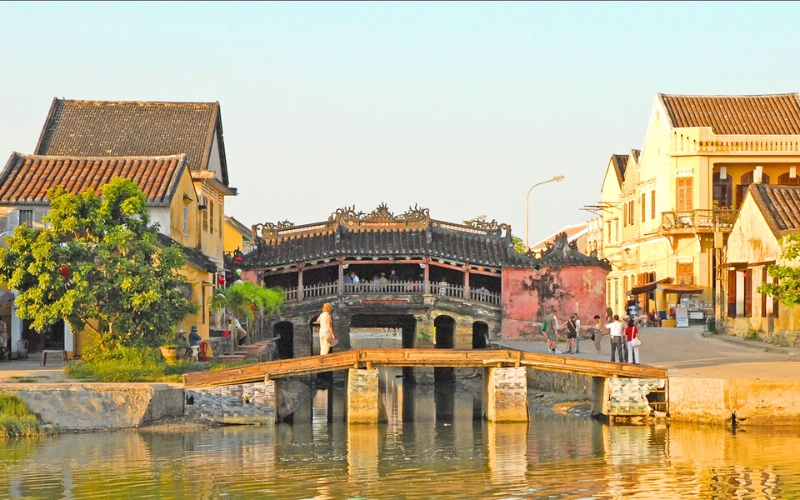
The Japanese Bridge, with its 18 meters of timeless charm, connects two ancient neighborhoods of Hoi An.
About 18 meters long, the bridge stands out for its singular architecture, in which Japanese, Chinese, and Vietnamese influences blend together. The curved tile roof, the delicate sculptures, and elegant lines reflect the refined cultural interweaving of this ancient port city open to the world.
A Unique Architecture
The Japanese Bridge fascinates for its quiet elegance and particular structure. Built entirely of wood, it is covered by a roof of ancient tiles, carefully arranged to protect pedestrians from the intense sun and tropical rains. This type of covered bridge, rare in Vietnam, draws directly from traditional Japanese construction, from which it derives much of its originality.
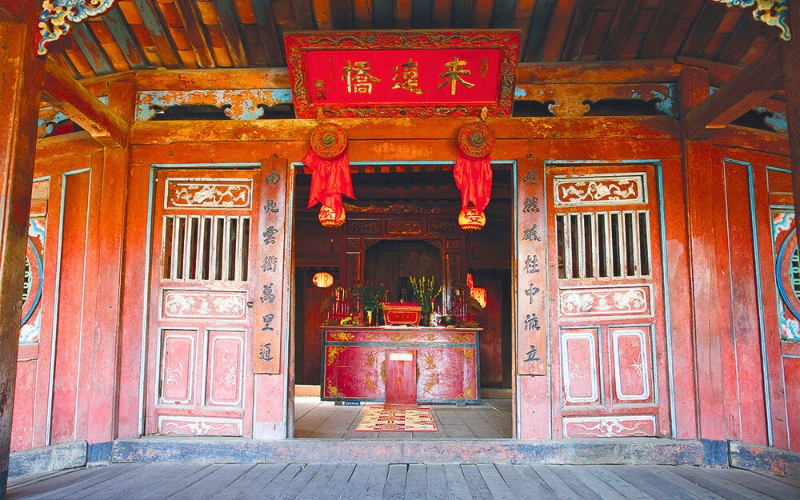
Yin-yang tile roof and blue ceramics: the quiet elegance of the Japanese Bridge
At each end of the bridge, two stone statues represent a monkey and a dog. These animals are not chosen by chance: they correspond to the years of the beginning and end of the bridge’s construction according to the lunar calendar. Beyond their chronological value, they also serve a symbolic function as guardians, protecting those who cross the passage.

At the center of the bridge is a small shrine, discreet yet deeply venerated, dedicated to Tran Vu, a Taoist deity of the North, often associated with stability and protection against destructive natural forces. This shrine, visible through an opening in the structure, gives the place a strong spiritual dimension. Once, people would come here to pray that natural calamities, such as floods and earthquakes, frequent in this region near the Thu Bon River, would be averted.
The whole, at once simple and refined, testifies to a subtle balance between aesthetics, function, and faith. Crossing the Japanese Bridge means passing from one bank to the other, but also from one culture to another, in a harmonious encounter between Japanese, Chinese, and Vietnamese traditions, united in a single architectural gesture.
A Living and Serene Place
The Japanese Bridge is not just an architectural curiosity: it is a place to walk through, but also a place to experience, even if only for a moment. Every day, visitors and residents cross here at a slow pace, almost suspended. Early in the morning, golden light reflects gently on the water, enveloping the bridge in an almost unreal calm. In the evening, the lanterns of the old town replace the sun, diffusing a warm and soft light, perfect for a romantic walk or a silent pause above the canal.
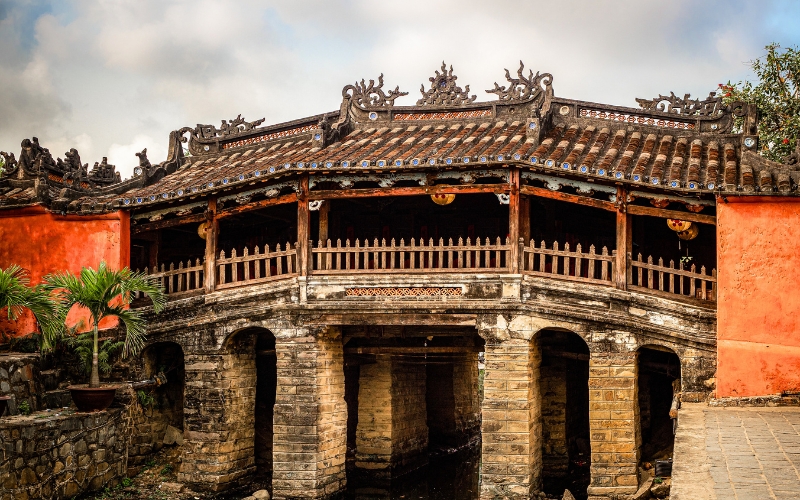
Photographers, dreamers, couples, and the curious stop here to capture the moment, but also to feel the history that emanates from every beam, every tile. Despite being heavily visited, the bridge retains a quiet and respectful atmosphere. It welcomes not only footsteps: it welcomes gazes, memories, and emotions. More than a simple tourist attraction, it is part of daily life and the collective memory of Hoi An. Residents are affectionate toward it and regard it not as a mere ornament, but as a silent witness to their identity.
The Japanese Bridge integrates naturally into the landscape of Hoi An. It does not seek to impress, but to exist with discretion, in harmony with the city that surrounds it. Its tile roof, wooden sculptures, the slowness of the steps that cross it… everything contributes to creating an atmosphere of calm and sobriety. This bridge connects two neighborhoods, but also two ways of experiencing the city: that of the residents, rooted in everyday life, and that of visitors, attentive to beauty, traces of the past, and simple gestures. It is at once a passage, a meeting point, and a place of pause. In Hoi An, there is no need to seek what strikes or dazzles: the essential lies in the silent details. The Japanese Bridge is one of the most beautiful examples of this.


Our recommended itineraries
 Nature and Active travel
Northern Vietnam Explorer in 9 days and 8 nights
About ten days
Hanoi - Ha Long Bay - Saigon - Mekong Delta - Siem Reap - Luang Prabang - Pak Ou Caves - Kuang Si Waterfall
 Classic
Vietnam Exclusive in 13 Days
About 2 weeks
Hanoi - Bai Tu Long - Hue - Da Nang - Hoi An - Saigon - Mekong Delta