+84 9 75 46 33 10 (Whatsapp)
  info@horizon-vietnamtravel.com
  Français
  Español
  Português
  Deutsch

My Son Sanctuary, a Mystical UNESCO-Classified Site
Table of contents
About 40 km from Hoi An, the My Son sanctuary is one of the most remarkable historical sites in Vietnam. Nestled in a valley surrounded by hills and jungle, it served as the religious center of the Champa Kingdom for nearly ten centuries. The site contains over 70 temples and brick towers, built between the 4th and 13th centuries, primarily to honor Hindu deities such as Shiva. Recognized as a UNESCO World Heritage site, My Son captivates with its natural setting, ancient ruins, and mystical atmosphere. Less famous than the temples of Angkor, it nonetheless offers a unique experience, far from mass tourism. In this article, discover how to visit the sanctuary, what to see on site, when to go, and why this place deserves a stop during your trip to Vietnam.
Where is My Son Located in Vietnam?
- Opening Hours : daily from 6:30 am to 5:00 pm
- Entrance Fee : approximately 150,000 VND (~6 €)
- Ideal Visit Duration : between 2.5 to 4 hours, depending on your pace
The My Son sanctuary is located in Duy Phu commune, Duy Xuyen district, Quảng Nam province, in central Vietnam. It sits about 40 km southwest of Hoi An and 50 km from Danang, or just over an hour’s drive from both cities. Nearby is Tra Kiêu, the former capital of the Champa Kingdom, which reinforces the historical importance of the site in this region.

My Son Sanctuary
Located in the heart of a recessed valley surrounded by mountains covered in dense vegetation, My Son is a complex of Cham temples built between the 4th and 13th centuries. This sacred complex, considered one of the masterpieces of Cham religious architecture, once contained over 70 structures in brick and stone, many of which have survived to this day despite the ravages of time and war.
When to Visit My Son?
The My Son sanctuary can be visited year-round, but some periods are definitely more pleasant than others. The best seasons to explore this outdoor site are spring (February to April) and fall (August to October). During these months, temperatures are mild to warm, humidity remains bearable, and rainfall is relatively scarce, allowing you to fully enjoy the natural landscape and visit without discomfort.
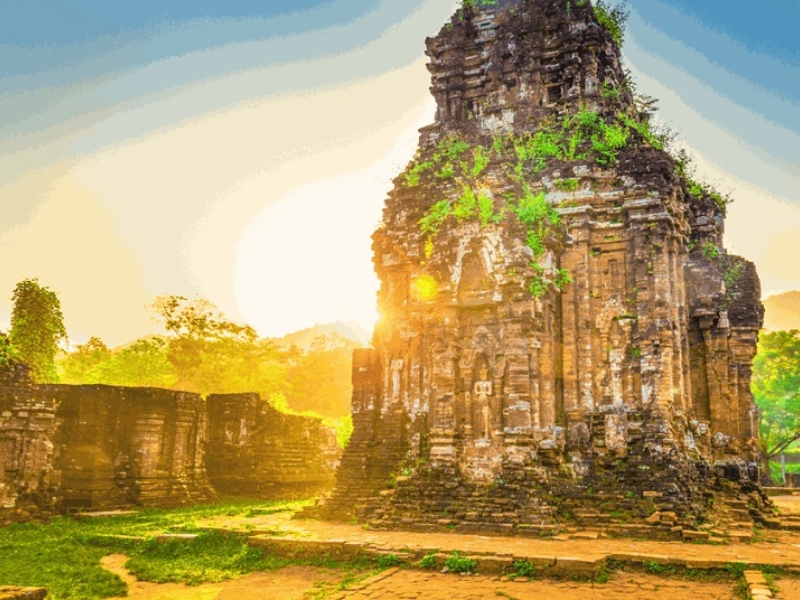
In summer, the heat overwhelms the ruins of My Son from sunrise onward. It’s best to arrive early to enjoy the calm and freshness.
Conversely, it’s best to avoid the summer months (June to August), when the heat becomes stifling, often exceeding 35°C (95°F). This makes walking around the site tiring, especially as there is little shade between the temples. Similarly, the rainy season (October to December) can make the trails difficult to access and less pleasant if you encounter heavy downpours.
At any time of year, the best time to visit My Son remains early morning, ideally from 6:30 am or 7:00 am, at the site’s opening. You’ll enjoy not only cooler temperatures but also a much more peaceful location before tour groups arrive around 9:00 am. It’s also when the light is most beautiful for admiring the ancient bricks and capturing evocative photographs in an atmosphere worthy of a sacred place.
How to Visit My Son Sanctuary?
Located about 40 km from Hoi An, the My Son sanctuary can be easily visited in half a day. Whether you’re a culture enthusiast, history lover, or simply curious, there are several ways to reach this extraordinary site. Ideally, start early in the morning, around 6:30 am or 7:00 am, to take advantage of the cool weather and avoid crowds.
By Scooter, for Independent Travelers
Renting a scooter is the most flexible and economical option. The journey takes about 1 hour 15 minutes to 1.5 hours on a generally well-maintained road, though somewhat dusty in places. GPS is essential, as signage is not always clear before the site entrance. Remember to bring water, sunglasses, and a hat. This option is perfect for travelers who want to enjoy the rural landscape at their own pace, with the freedom to stop along the way.
With an Organized Tour from a Tour Operator
If you prefer an organized solution, numerous local agencies offer group excursions departing from Hoi An. Transportation is by bus or minivan, often with an English-speaking guide, at a reasonable price. It’s a practical and accessible option, though it offers less flexibility in terms of duration or pace of the visit.
With Private Vehicle and French-Speaking Guide
For a comfortable visit, Horizon Vietnam offers you a private vehicle with driver: you’ll be picked up directly from your hotel without any logistical concerns. On site, a passionate French-speaking guide accompanies you and provides the keys to understanding the site: the history of the Champa Kingdom, Hindu beliefs, the peculiarities of brick architecture… An enriching, personalized, and serene approach, ideal for fully experiencing the visit.
History of My Son Sanctuary
The origins of My Sơn sanctuary date back to the 4th century, during the reign of King Bhadravarman I, who had a wooden temple built dedicated to Shiva and the linga, a symbol of fertility and divine strength in Hinduism. Considered the spiritual center of the Champa Kingdom, My Sơn progressively became an important sacred complex, where religious, funerary, and political practices intertwined.
After the destruction of the first sanctuary in a fire, King Sambhuvarman had a brick temple rebuilt in the 7th century, using a construction technique still mysterious today: no visible mortar, extraordinary solidity, and refined decorations inspired by Indian art. In the following centuries, Cham kings continued to build and restore over 70 temples and towers, making My Son the religious and cultural heart of Champa for over 1,000 years.
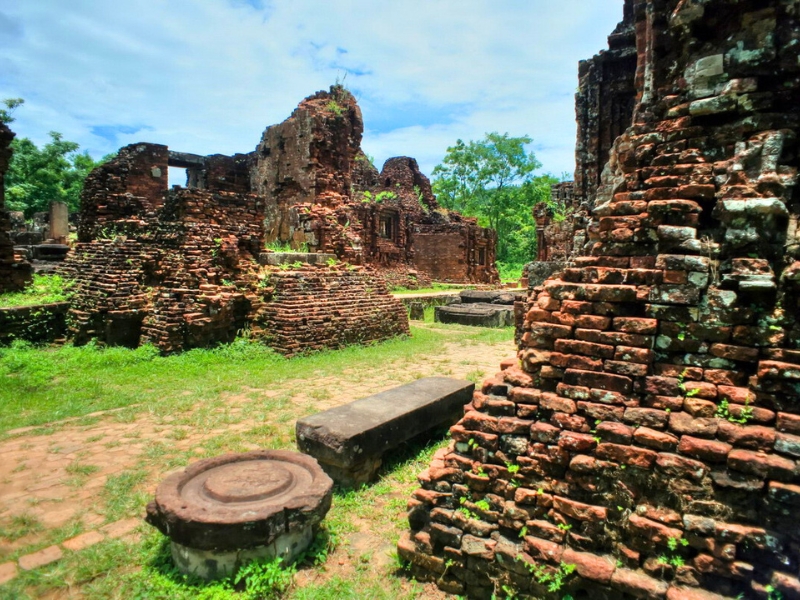
The extraordinary value of My Son sanctuary today lies in over 70 brick and stone architectural structures.
The site also served as a burial place for the most important rulers and priests, as evidenced by remains discovered by archaeologists. Sanskrit inscriptions carved on stelae tell the story of these kings and their beliefs, deeply influenced by Indian culture.
Rediscovered in the late 19th century by French explorers, Mỹ Sơn was systematically studied and catalogued by researchers such as Henri Parmentier, who identified over 60 structures and organized them into groups designated by letters (A through H, K, etc.). The site quickly became an emblematic example of Cham architectural and religious art, particularly with My Sơn A1 style, considered the pinnacle of Champa civilization’s art. Added to the UNESCO World Heritage List in 1999, My Son remains today one of the most fascinating symbols of Vietnam’s spiritual and architectural heritage.
Architecture of My Son Sanctuary
The architecture of My Son sanctuary reflects a rich and complex cultural interweaving, influenced by various Asian civilizations. According to numerous French, Polish, and Vietnamese scholars, the site’s architectural style bears traces of Indian, Indonesian, Malay, and even Arabic influences. But above all, Indian culture, transmitted through Hinduism, profoundly shaped the spiritual and symbolic aesthetics of the place.
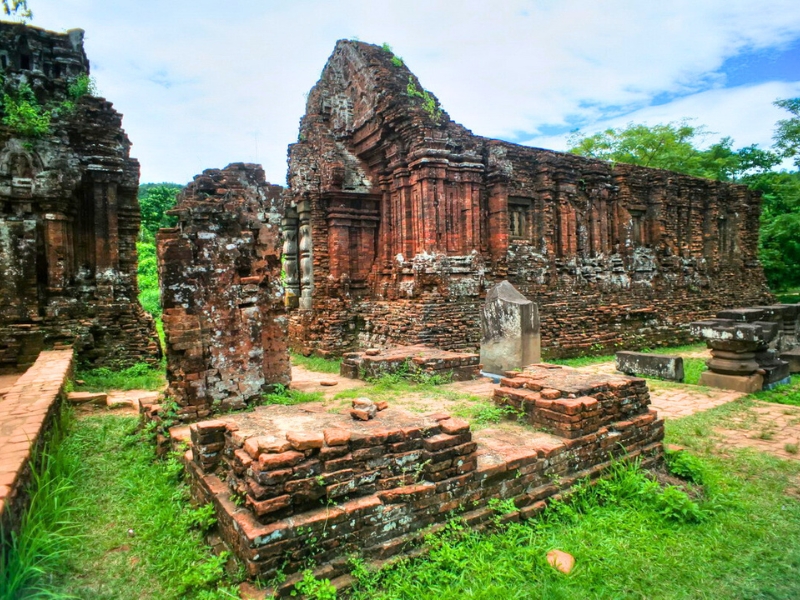
My Son sanctuary is divided into several groups identified by letters such as A, B, C, D… Depending on the periods, each set of temple-towers reflects a distinct architectural style.
The My Son complex represents a unique synthesis of Cham architectural styles that developed between the 7th and 13th centuries. Among these, the following stand out:
- the Ancient style and My Sơn E1 style (8th century – temples E1 and F1),
- the Hoa Lai style (late 8th – early 9th century, temples A2, C7, and F3),
- the Đông Dương style (late 9th – early 10th century, temples A10, A11–13, B4, B12),
- the My Sơn A1 style (10th century, temples B5, B6, B7, B9, C1, C2, C5, D1, D2, D4),
- the My Sơn A1 – Bình Định transition style (early 11th – mid-12th century, temples E4, F2, group K),
- the Bình Định style (late 11th – early 14th century, temples B1 and groups G, H).
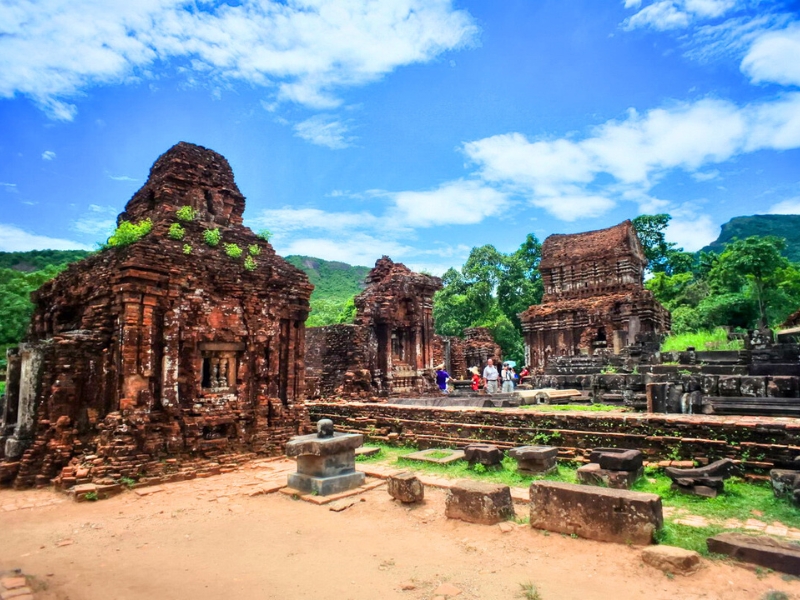
The art and architecture of the towers are heavily inspired by Indian Hinduism. Each complex comprises a main tower (Kalan), dedicated to the linga or the sacred image of Shiva, a gateway (Gopura), a vestibule (Mandapa) for offerings, and a building oriented northward, the Kósa Grha, intended to house sacred objects. The towers, pyramid-spire in shape, symbolize Mount Meru, the sacred mountain of Hinduism. Oriented toward the east, their facades decorated with refined bas-reliefs testify to the artistic excellence of Champa. The faithful performed ritual circumambulations around the sanctuaries in a clockwise direction.
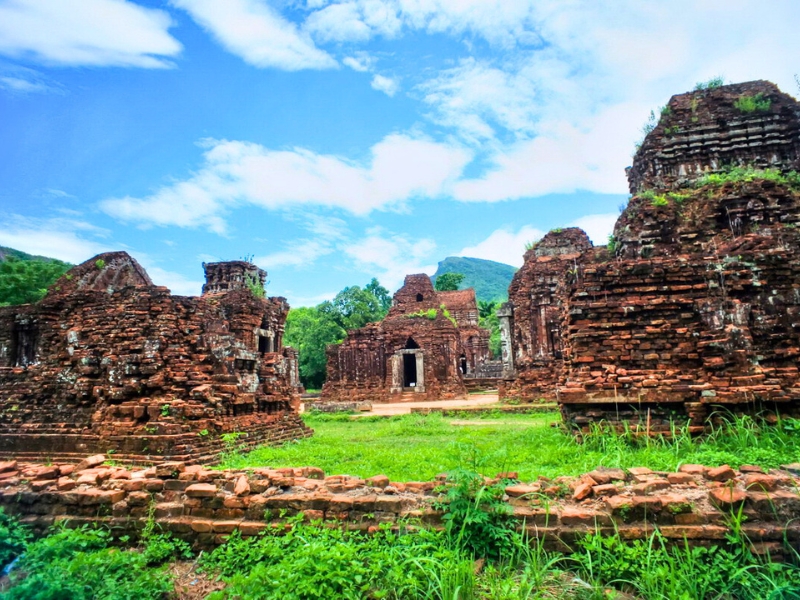
Group A (Kalan My Son A1) perfectly illustrates this cosmic organization: a central linga surrounded by six secondary towers (A2–A7), each dedicated to a guardian deity of the directions (Indra, Agni, Yama, Varuna, Vayu, Kuvera, Nairta, and Isána). Two main gates, oriented east and west, gave access to the sanctuary, completed by larger secondary towers (A8–A12) arranged in a square plan. Facing this group stands Group B (Kalan My Son B1), considered the spiritual heart of the site.
Despite being strongly marked by Hinduism, the sanctuary also retains traces of Mahayana Buddhism, introduced among the Cham in the 10th century, although some hypotheses regarding restorations dating to the 17th century remain subjects of discussion.
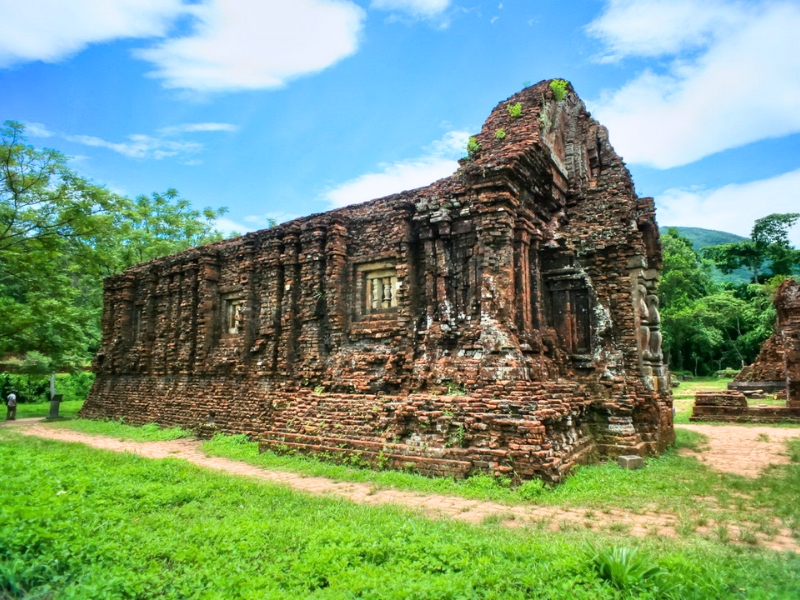
Cham towers built without mortar, with perfectly interlocking bricks: a mystery of ingenuity still unsolved.
My Son also houses a unique stone temple – a rarity in Cham architecture. An inscription found on the site mentions a restoration in 1234, but the building appears to have remained unfinished. Discovered under an enormous pile of bricks, this temple, now destroyed, would have exceeded 30 meters in height. It might correspond to the very first sanctuary built in the 4th century.
The first restorations date to 1937, conducted by French researchers. Between 1937 and 1943, several towers (A1, B5, C2, D1…) were consolidated. Unfortunately, American bombing in 1969 destroyed much of complex A, particularly tower A1 and its six satellites.
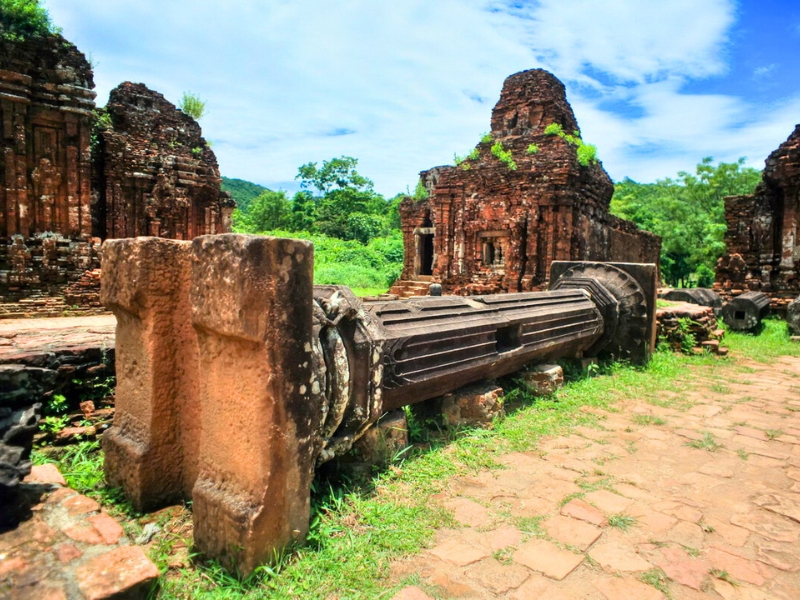
Today, My Son sanctuary is restored thanks to international support, preserving precious heritage despite the marks of time and conflict.
Numerous statues and ritual objects were transferred to France or preserved in Vietnamese museums: in Hanoi, Ho Chi Minh City, and especially in the Cham Sculpture Museum in Danang. A site museum, established with support from Germany and Poland, allows visitors to admire reproductions today. In 2005, a 5,400 m² exhibition center was inaugurated thanks to Japanese assistance. Restoration campaigns supported by UNESCO, Italy, Japan, and the World Monuments Fund now help safeguard this exceptional heritage, though some structures remain fragile.
What to Do at My Son Sanctuary?
My Son sanctuary is not simply an archaeological visit. It is a place where every stone, every sculpture, every relief tells a story over a thousand years old. To fully appreciate its richness, it’s not just about observing, but taking time to understand, feel, and listen. Between cultural discoveries, architectural contemplations, and moments of silence in the heart of the sacred valley, here are the essential stops to fully live your exploration of My Son.
Discover the Sanctuary Museum

My Son Sanctuary Museum
Before venturing among the towers and red stones of My Son, it is highly recommended to begin your visit at the small museum located near the site entrance. Little visited but particularly informative, this museum offers a permanent exhibition on the history of the Champa Kingdom, on religious and artistic influences from India, as well as on the symbolic foundations of Cham architecture.
Discover the Temples and Their Symbolic Architecture
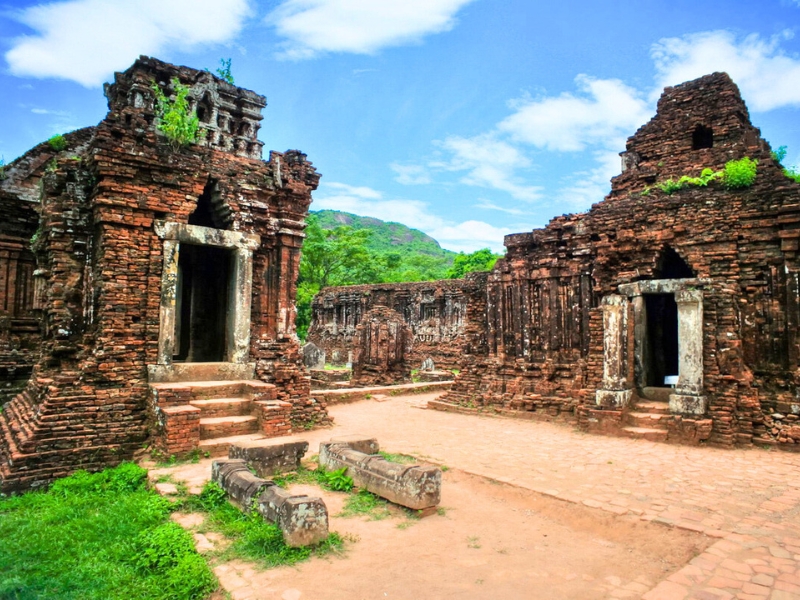
Once you arrive at the heart of the site, take time to contemplate the temples, built in fired bricks with no visible trace of mortar – an architectural feat still unexplained today. Each structure follows Hindu cosmological logic: a base representing the earthly world, a body for the soul, and a tower oriented toward the deities. Admire the bas-reliefs carved directly into the bricks, depicting deities (particularly Shiva), celestial dancers (apsaras), sacred animals, or floral motifs. Understand that here, architecture itself is a form of prayer.
Witness a Cham Ritual Dance

Every day (according to schedule), local artists perform a traditional Cham dance within the sanctuary. Inspired by rites dedicated to Shiva, this performance combines graceful movements, stylized Cham costumes, and traditional instruments. The dance of Shiva celebrates both creation and destruction, fundamental values of Hinduism. Sitting for a moment and watching bodies move among the temples means perceiving an ancient vibration, an ever-moving memory.
Participate in the Katê Festival
Each year, between late September and early October (month 7 of the lunar calendar), My Son sanctuary becomes the stage for the Katê festival, one of the most important celebrations of the Cham people. This religious festival pays homage to Hindu deities, particularly Shiva, as well as ancestors. In an atmosphere both sacred and festive, visitors can witness ritual ceremonies, admire traditional Cham dances, listen to ancestral songs, and discover typical folk games. It is an intense moment to immerse yourself in the spiritual and cultural universe of the Cham, right in the heart of their ancient sanctuary.
Discover the Gastronomy Around My Son Sanctuary
Exploring My Son sanctuary also means discovering a gastronomic richness typical of central Vietnam. Here are some local specialties not to miss to delight your palate:
Bê Thui Câu Mông (Roasted Beef from Câu Mông)

Bê Thui Câu Mông (Roasted Beef from Câu Mông)
This flame-roasted beef is one of the emblematic dishes of the region. Prepared from grass-fed young cattle, it is roasted slowly to keep the meat tender and the skin crispy. Served in thin slices with fresh herbs and a savory sauce based on lime, toasted sesame, garlic, chili, and nuoc-mam.
Mì Phú Chiêm (Phú Chiêm Noodles)

Mì Phú Chiêm (Phú Chiêm Noodles)
White noodles made from rice grown on the banks of the Thu Bôn River, served with caramelized pork, shrimp, and an assortment of crispy vegetables. A simple but unforgettable dish.
Bánh Bèo (Small Steamed Crepe)

Bánh Bèo (Small Steamed Crepe)
Different from southern or Huê versions, My Son’s bánh bèo stands out for its soft texture and fragrant filling of pork, mushrooms, or shrimp, served with a spicy sauce.
Bánh Xèo (Vietnamese Crepe)

Bánh Xèo (Vietnamese Crepe)
This crispy crepe filled with shrimp, pork, and bean sprouts is a true explosion of flavors. Served with fresh herbs and sweet and sour sauce.
Practical Tips for Your Visit
To fully appreciate the timeless beauty of My Son sanctuary, it’s best to organize your visit carefully. This site, designated a UNESCO World Heritage site, deserves time, attention… and some preparation.
- Choice of Ideal Time : Prefer an early morning or late afternoon visit to enjoy pleasant light, mild temperatures, and fewer crowds.
- Appropriate Clothing : Opt for light but covering clothes, a hat, sunglasses, sunscreen, and good shoes. Respectful dress is recommended.
- Respect for the Sacred Site : The sanctuary is a place steeped in spirituality. Maintain a discreet attitude, do not touch the ruins, and avoid inappropriate poses for photographs.
- Hydration : Bring water with you, especially in summer. Some stands are available at the entrance, but few within the site.
- Practical Information : The site is open daily (typically from 6:30 am to 5:00 pm). Your ticket also includes entry to the My Son museum.
My Son is not just an archaeological site; it is a place alive with memory and spirituality. Immersed in lush nature, this Cham sanctuary fascinates with the harmony between sacred architecture, Hindu symbolism, and wild beauty. Recognized among the most precious cultural treasures of Vietnam, it bears witness to the richness of Cham civilization and its profound connection to the sacred. Whether you are a history lover, enthusiast of ancient civilizations, or simply seeking calm and meaning, My Son offers a rare experience: that of a journey outside of time, in which every stone still whispers the echoes of a glorious past.


Our recommended itineraries
 Nature and Active travel
Northern Vietnam Explorer in 9 days and 8 nights
About ten days
Hanoi - Ha Long Bay - Saigon - Mekong Delta - Siem Reap - Luang Prabang - Pak Ou Caves - Kuang Si Waterfall
 Classic
Vietnam Exclusive in 13 Days
About 2 weeks
Hanoi - Bai Tu Long - Hue - Da Nang - Hoi An - Saigon - Mekong Delta