+84 9 75 46 33 10 (Whatsapp)
  info@horizon-vietnamtravel.com
  Français
  Español
  Português
  Deutsch

Quan Thanh Temple: Historic Pillar of Spiritual Life in Hanoi
Table of contents
On the tranquil shores of West Lake, in the heart of Hanoi, lies a place steeped in calm and mystery: the Quan Thanh temple. Far from the bustle of the streets, this ancient sanctuary offers a moment of silence and spirituality to those who venture there. Erected over a thousand years ago, this Taoist temple is dedicated to Trấn Vũ, one of the most revered protective spirits in Vietnam. Through its architecture, its imposing statues, and the legends passed down from generation to generation, Quan Thanh tells an essential story of the Vietnamese soul. For travelers curious to understand Hanoi beyond its bustling streets, Quan Thanh temple offers a peaceful immersion into Vietnam’s spiritual and cultural universe. In this article, we set out to discover this emblematic place that continues, even today, to watch over the city of Hanoi.
General presentation of Quan Thanh temple
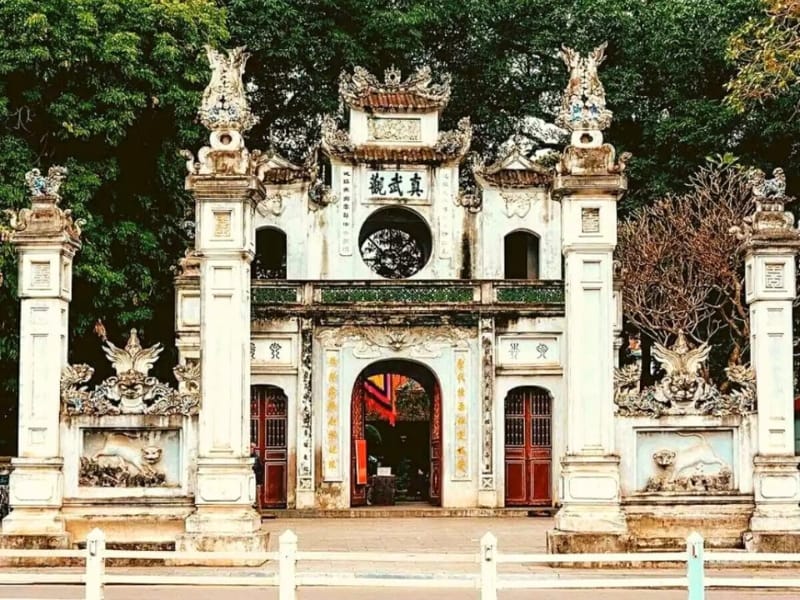
Quan Thanh Temple
Location:
190 Quan Thanh Street, Ba Dinh District, Hanoi
Opening hours:
- Every day: 8:00 AM – 5:00 PM
- Lunar New Year’s Eve: All day
- 1st and 15th lunar days: 6:00 AM – 8:00 PM
Admission fee:
- Adults: 10,000 VND per ticket (less than €0.50)
- Students and children: 5,000 VND per ticket
Tips for visiting Quan Thanh temple
Visiting Quan Thanh temple means entering a place steeped in spirituality and meditation. Here are some tips for experiencing this visit with respect and curiosity.
- Plan your visit for morning or late afternoon to enjoy a peaceful atmosphere, away from crowds.
- Wear respectful clothing, with shoulders and legs covered, especially inside the main sanctuary.
- Walk slowly, observe in silence, and respect the spiritual atmosphere of the place.
- Avoid touching statues and ritual objects, even if some appear accessible.
- Remove your hat or cap inside the temple buildings.
- Ask permission before taking photographs, particularly of worshippers in prayer.
- Keep your voice low, even if you are in small groups.
- Bring some cash (in Vietnamese dong) for the admission ticket, often modest.
- Combine the visit with a walk around West Lake: it is an ideal time to extend your discovery of Hanoi gently.
- Take time to read the inscriptions and contemplate the architectural details: each sculpture, each door tells a story.
History of Quan Thanh temple
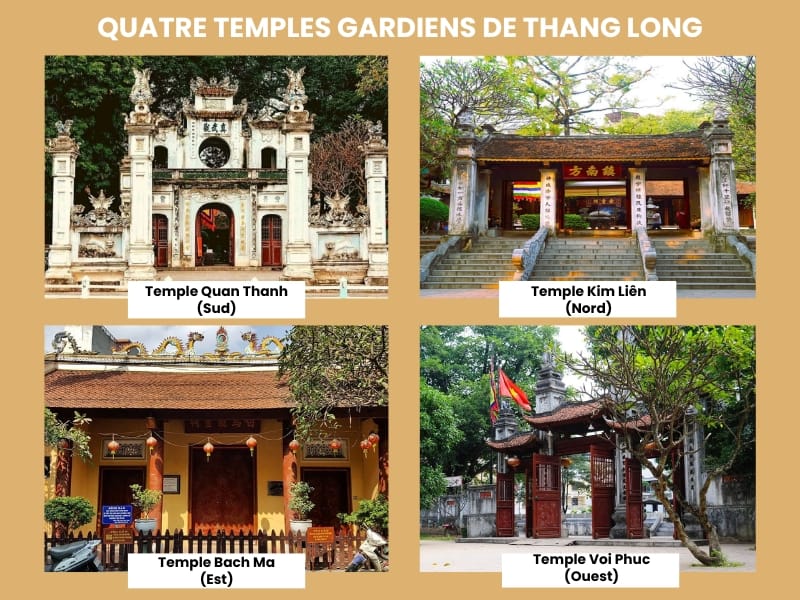
Quan Thanh temple occupies a unique place in Hanoi’s spiritual landscape. Dedicated to Huyen Thien Tran Vu, a powerful Taoist deity tasked with protecting the North, this sanctuary is one of four sacred temples built to guard the ancient gates of the imperial capital Thang Long, today’s Hanoi. This unique spiritual ensemble, called Tu Tran Thang Long, formed a kind of symbolic bulwark around the city:
- Quan Thanh temple, guardian of the North
- Kim Lien temple, guardian of the South
- Voi Phuc temple, guardian of the West
- Bach Ma temple, guardian of the East
Among these four, Quan Thanh is undoubtedly the most impressive for its symbolic power and the richness of its history. According to ancient inscriptions preserved on site, the temple was founded in the 11th century, during the Ly dynasty, at a time when the city was asserting its imperial and spiritual identity.
Over the centuries, the temple has been restored many times, particularly in 1677, 1768, 1838, 1841, 1856, and 1893. One of the most significant events occurred in 1677, when Lord Trinh Tac asked his son Trinh Can to have a monumental bronze statue of Tran Vu created to replace the ancient wooden one. This project was entrusted to master craftsman Vu Cong Chan, who oversaw the casting of an imposing statue nearly four meters tall. This work is today one of the temple’s treasures and one of Vietnam’s most remarkable bronze statues.
In 1794, Admiral Le Van Ngu had a large bronze bell installed in the main sanctuary. Later, during a visit to Hanoi, Emperor Minh Mang officially renamed the temple Chan Vu Quan, an inscription still visible above the main portal in traditional Chinese characters. Inside, however, the ancient name Tran Vu Quan can still be read.
In 1842, Emperor Thieu Tri visited the temple and offered gold to ornament the statue with a symbolic ring, imperial testimony of respect and devotion.

Quan Thanh Temple in former times
Today, the temple is known by two names: Den Quan Thanh and Tran Vu Quan. The term “quan” designates in Vietnamese a place of Taoist worship, thus underlining the religious affiliation of the sanctuary.
Since 1962, Quan Thanh temple has been classified as a national historic monument, alongside the famous Tran Quoc pagoda located nearby. This classification testifies to its patrimonial importance, but also its spiritual value for all those seeking to understand Hanoi’s ancient soul.
Architecture of Quan Thanh temple
Behind its discreet facade on Thanh Nien avenue, Quan Thanh temple reveals a world of architectural harmony, spiritual symbols, and ancestral knowledge. Its layout respects the principles of traditional Vietnamese architecture of Chinese influence, articulated around several spaces: the entrance portal, the tam quan (three-opening portal), the central courtyard, prayer pavilions, and the main sanctuary.
From the very entrance, visitors are greeted by a monumental gate adorned with sculpted pillars. Each is topped by mythical animals: phoenixes back-to-back and an nghe, a protective creature half-lion half-dog, placed on top. The finely carved bas-reliefs on the pillars represent carp transforming into dragons, tigers descending from mountains, and poetic phrases in red calligraphy. Impressive decoration, both aesthetic and laden with symbolism.

Tam Quan Gate (Three-Entrance Gate)
Passing through this gate, you access the Tam quan, an imposing two-level structure that constitutes one of the highlights of the site. This portal guards a rare and fascinating detail: a bas-relief of the god Rahu, a figure from Hindu mythology. This presence testifies to the cultural and religious openness of ancient Vietnam, where different beliefs naturally intertwined. Suspended above, a bronze bell from 1677, offered by King Le Hy Tong, still resonates in the memory and popular poetry of Vietnam, particularly in the famous verses evoking the “sound of Tran Vu’s bell”.
Inside, visitors can discover the stele house, where numerous inscriptions are preserved that trace the major phases of the temple’s restructuring over the centuries. Immediately behind, a commemorative altar dedicated to soldiers who fell in the region reminds us that this spiritual place is also a place of memory.
The prayer courtyard, calm and open, welcomes believers and visitors in a soothing atmosphere. Two large stone incense burners mark the entrance to the central pavilion, where offerings and rituals are prepared.

The black bronze statue of Huyên Thiên Trân Vu, 3.96 meters high and weighing 4 tons, is located in Quan Thanh temple
But it is in the main sanctuary that the temple’s treasure is found: a monumental bronze statue of Huyen Thien Tran Vu, nearly four meters tall. Created in the 17th century by master craftsman Vu Cong Chan, this sculpture is considered one of Vietnam’s masterpieces of bronze art. The fineness of the features, the solemn posture, and the symbolism of the work impress both art lovers and spirituality enthusiasts.
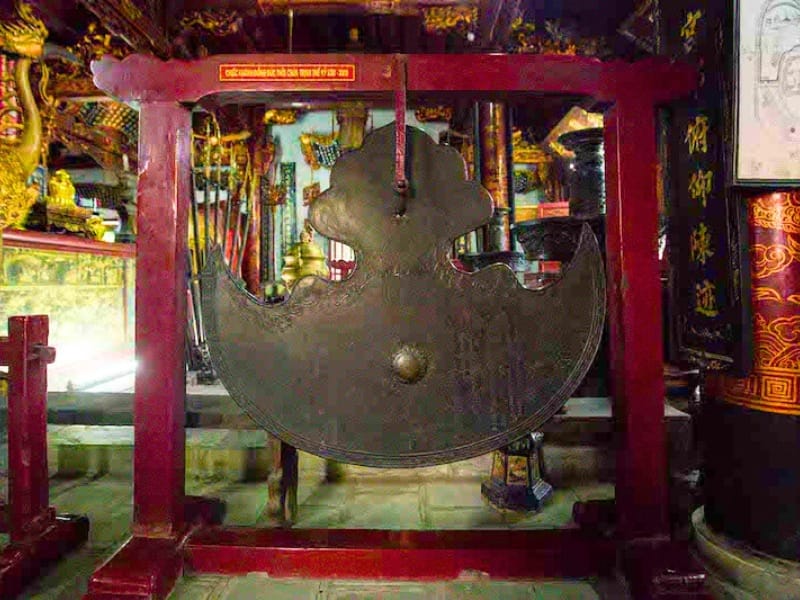
Bronze gong of Quan Thanh temple
Beside this main statue is another, smaller black bronze sculpture, as well as a large ritual bell dating from the era of the Trinh Lords. Every object, every sculpture in the temple reflects the artistic richness of the Le dynasty and invites silent contemplation.
What to see near Quan Thanh temple?
Located in a quiet neighborhood between West Lake (Ho Tay) and Truc Bach lake, Quan Thanh temple is surrounded by several interesting places to discover on foot or within a few minutes’ travel.
Tran Quoc Pagoda

Tran Quoc Pagoda
Just five minutes’ walk from Quan Thanh temple, this Buddhist pagoda dating from the 6th century is considered Hanoi’s oldest. Installed on a small peninsula of West Lake, it captivates with its slender stupas, the relaxing setting, and the spiritual atmosphere that reigns there.
West Lake (Hồ Tây)
A true blue lung of Hanoi, West Lake is the city’s largest lake, covering over 500 hectares. Bordered by gardens, ancient temples, and peaceful residences, it offers a surprising contrast to the hustle and bustle of the historic center. The shores of the lake are ideal for a walk on foot or by bicycle, especially at sunrise or sunset, when golden light reflects on the water.

West Lake (Hồ Tây)
It is also a gathering place appreciated by Hanoi’s residents, where you can drink cold coffee, enjoy a local dish, or simply sit facing the water to enjoy the calm. Numerous cafes, restaurants, and tea rooms offer an unobstructed view of the lake, perfect for a gentle break during the day.
Ba Dinh District
About one kilometer south of Quan Thanh temple, Ba Dinh district is a must-visit place for anyone wishing to immerse themselves in the modern history of Vietnam. Here lies the mausoleum of Ho Chi Minh, where the founder of the Republic rests. Directly opposite, Ba Dinh Square remains a powerful symbol, as it was here that Vietnam’s independence was proclaimed in 1945.

Ho Chi Minh Mausoleum
The district is also home to the famous one-pillar pagoda, a masterpiece of Buddhist architecture dating from the 11th century, built on a single stone pillar. Surrounded by manicured gardens and official buildings, Ba Dinh unites spirituality, history, and political power, offering a unique perspective on contemporary Vietnamese identity.
Quan Thanh temple is not just an ancient place of worship, it is a living fragment of Hanoi’s soul. Through its majestic sculptures, its mystical symbols, and its centuries of history, it invites each person to slow down, observe, and feel this discrete but well-present spirituality in Vietnamese daily life. Whether it is its imposing bronze statue, its finely carved architectural details, or its role at the heart of the Tu Tran Thang Long, every element of the temple tells part of the city’s history and of those who believed, prayed, and lived there. Visiting Quan Thanh, you discover not just a monument, but a place that continues, even today, to connect past and present, visible and invisible, individual and sacred. Take time to stop. Listen to the silence. And let the ancient breath of Hanoi speak to you.




Our recommended itineraries
 Nature and Active travel
Northern Vietnam Explorer in 9 days and 8 nights
About ten days
Hanoi - Ha Long Bay - Saigon - Mekong Delta - Siem Reap - Luang Prabang - Pak Ou Caves - Kuang Si Waterfall
 Classic
Vietnam Exclusive in 13 Days
About 2 weeks
Hanoi - Bai Tu Long - Hue - Da Nang - Hoi An - Saigon - Mekong Delta