+84 9 75 46 33 10 (Whatsapp)
  info@horizon-vietnamtravel.com
  Français
  Español
  Português
  Deutsch

Ha Giang: Practical Guide to Prepare Your Trip
Table of contents
Ha Giang, located in northern Vietnam, is an ideal destination for travelers seeking authenticity, nature and culture. Although the region attracts a growing number of visitors, it remains largely off the beaten tourist path, allowing it to preserve its natural charm and authentic atmosphere. Its majestic mountains, terraced rice paddies and traditional villages offer a unique landscape, perfect for those who want to immerse themselves in pristine nature. Ha Giang captivates more and more travelers seeking adventure and uncommon experiences. It is an essential destination for exploring spectacular mountainous landscapes and meeting ethnic minorities such as the H’mong, Dao and Tay people. The region offers a true immersion in authentic Vietnam, where ancestral traditions endure in the heart of the mountains.
Why Choose the Ha Giang Loop?
Traveling the Ha Giang loop means giving yourself a true escape into the heart of the wild and majestic landscapes of northern Vietnam. Throughout the journey, karst mountains, deep valleys, terraced rice paddies and dizzying passes compose a spectacular scenery that changes at every turn. Places like the Ma Pi Leng pass or the Tu San gorges offer breathtaking panoramas, among the most impressive in the country.
This itinerary also fascinates for its authenticity. Unlike other more frequented regions, Ha Giang remains largely unspoiled. Here there are no large infrastructure or crowds of tourists: you mainly encounter smiling residents, children playing along the road and a few travelers seeking simple encounters and nature.

Meeting the children of ethnic minorities during your trip to Ha Giang
It is also an opportunity to discover unique cultural wealth. The road crosses the lands of different ethnicities: Hmong, Dao, Tay, Lo Lo… Each stop is a wonderful opportunity to exchange a few words, observe traditional clothing, stroll through colorful markets or even sleep at a local family, in a wooden house or on stilts.
Finally, the loop offers great freedom. Whether you travel it by motorcycle, by car with a driver or accompanied by a local guide, you will travel at your own pace, stopping where you wish and fully enjoying every moment. The itinerary is accessible to all, with simple but welcoming accommodations along the entire route. For many travelers, this adventure remains one of the most meaningful memories of a trip to Vietnam.
Where is Ha Giang Located?
Ha Giang is located at the far north of Vietnam, on the border with China. It is a mountainous province renowned for its spectacular landscapes, its winding roads perched on cliffs, terraced rice paddies and the great ethnic diversity that characterizes it.
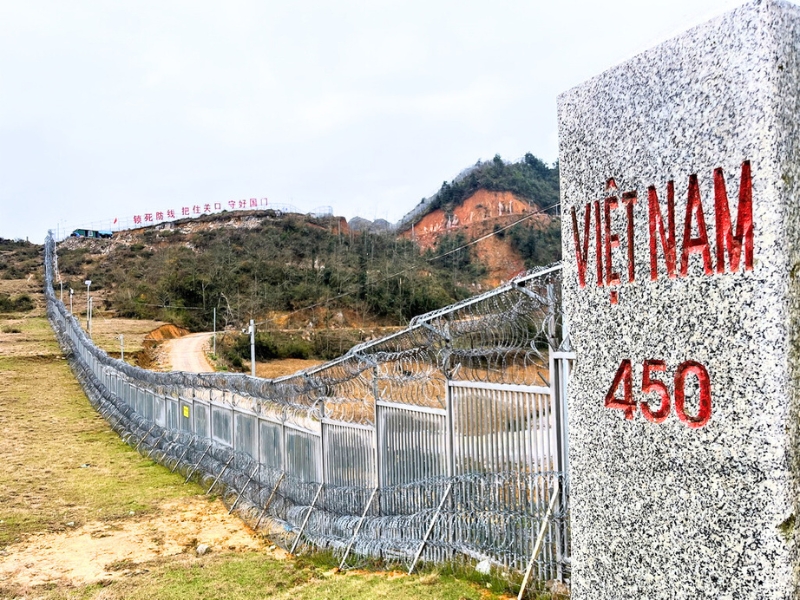
Ha Giang, at the far north of Vietnam, shares a border with China.
Here are some landmarks to better locate Ha Giang:
- Distance from Hanoi: approximately 300 km north (between 6 and 8 hours of travel by car or bus).
- Borders: shares a long border with Yunnan province (China).
- Nearby regions: Cao Bang to the east, Tuyen Quang to the south and Lao Cai to the west.
Ha Giang is also famous for the Dong Van karst plateau, classified as a UNESCO World Geopark, and for the Road of Happiness (the famous “Ha Giang Loop”), which crosses breathtaking landscapes. It is a perfect destination for travelers seeking authenticity, wild nature and cultural discoveries.
How to Get to Ha Giang?
By Bus or Minivan
Taking a bus or minivan is one of the most practical and economical ways to reach Ha Giang from Hanoi. The journey takes on average between 6 and 8 hours, depending on traffic and the type of vehicle. Several companies operate daily from My Dinh bus station or directly from Hanoi’s Old Quarter. Sleeper buses are ideal for traveling at night, while minivans or limousines, more comfortable, are preferred for daytime departures. Fares generally range from 10 to 20 USD. This solution is perfect for independent travelers or those on a tight budget, while still guaranteeing a relatively comfortable travel experience.
By Private Car
For a trip focused on comfort and freedom, Horizon Vietnam Travel offers a private car or air-conditioned minivan transfer service, with a professional driver. The vehicle will pick you up directly from your accommodation in Hanoi for a journey of approximately 6 hours to Ha Giang. This formula allows you to travel at your own pace, with the possibility of making stops to admire the scenery or visit villages along the road. Upon request, you can be accompanied by a French-speaking or English-speaking guide to enrich your experience from the very beginning of your trip. It is the ideal option for couples, families or groups who want a personalized, safe and comfortable experience.
By Motorcycle

Conquering the breathtaking landscapes of Hà Giang by motorcycle
Venturing by motorcycle to Ha Giang is an option particularly appreciated by travelers seeking freedom and strong emotions. The journey, lasting approximately 7-8 hours, crosses winding roads and spectacular landscapes. However, this choice requires solid driving experience and an international driving license, as some sections can be slippery or narrow, especially during the rainy season. Several agencies in Hanoi offer the rental of motorcycles suitable for mountain roads, as well as guided itineraries. Traveling by motorcycle allows total immersion in the natural environment and offers the freedom to explore the famous “Ha Giang Loop” at your own pace.
By Train

Overnight trains from Hanoi to Lao Cai
It is important to note that Ha Giang currently has neither an airport nor a railway station. There are no direct flights or trains to this mountainous province. Although it is possible to take a train to Lao Cai (near Sapa) and then continue by car, this option remains long and impractical. Consequently, road travel is the only solution for reaching Ha Giang, whether with public transportation or a private vehicle.
When to Travel to Ha Giang?
Ha Giang, a mountainous province in northern Vietnam, enjoys a cool climate year-round, with an average annual temperature between 21 and 23°C. Each season reveals a particular charm, making the region attractive at any time of year.
January to March – Nature’s Rebirth
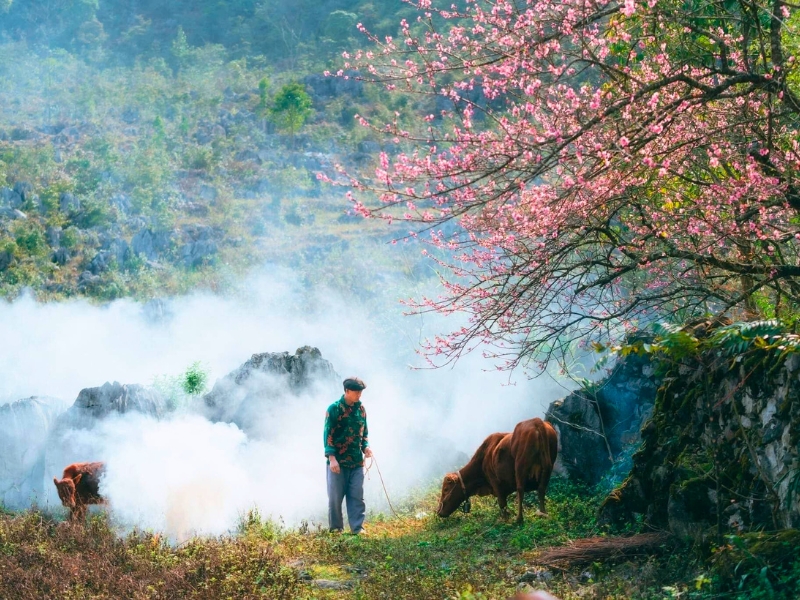
Plum blossoms reveal the peaceful beauty of Ha Giang in spring
During this period, temperatures range from 15°C to 20°C, offering cool but pleasant weather. The mountains awaken from their winter sleep and peach and plum blossoms bloom on the hillsides. Their delicate shades of white and pink transform the valleys into true spring paintings, while the air fills with floral scents. In March, the sun gradually returns, bringing milder days.
April – The Ideal Month for Exploration

Lô Lô Chai Village
April marks a sunny, dry and bright period, with average temperatures around 24°C. It is one of the best times to hike, travel by motorcycle or explore ethnic villages perched at high altitude. The clear sky and moderate temperatures create ideal conditions for admiring the spectacular views of Ha Giang.
May to Early June – The Season of Water and Reflections

Ha Giang during the flooded rice paddies season – When the mountains reflect the sky
With the arrival of the first rains, the terraced rice paddies begin to fill with water. Water flows down the slopes, transforming the fields into huge mirrors in which the sky and clouds are reflected. It is also the period of rice transplanting, in an atmosphere unique to authentic rural life.
June to August – Summer Between Beauty and Climate Caprices
Although the landscapes remain green and lush, this period coincides with the rainy season. Temperatures can reach 31°C and rainfall sometimes makes roads difficult to traverse. However, for travelers seeking lush nature and strong emotions, summer offers spectacular contrasts.
September to October – The Harvest Festival
As autumn approaches, the rice paddies turn golden and the valleys take on a warm and vibrant light. The villages of ethnic minorities come alive with scenes of harvesting and traditional festivities. It is one of the most poetic seasons in Ha Giang, ideal for both photographers and lovers of local culture.
November to December – Year-End Flowers
With the arrival of cold weather, especially in Đông Văn where frost can appear, the landscape changes face. But Ha Giang loses nothing of its beauty: buckwheat and mustard fields bloom, clothing the mountains in brilliant shades of purple, white and yellow. Winter light adds a touch of mystery to this tranquil atmosphere.
Where to Stay in Ha Giang?
Ha Giang, still preserved from mass tourism, offers simple but authentic hospitality. Although luxury hotels are rare, there are options for all types of travelers: from budget guesthouses in town to stays with local families in mountain villages. Here is an overview of the main places to stay in the region.
In Town
The town of Ha Giang is peaceful and most experiences take place outside its borders. It nonetheless remains a convenient stop for resting after a long journey from Hanoi, especially if you arrive late in the evening.
You will find a good selection of guesthouses and small hotels on the main streets, such as Nguyen Trai, Tran Hung Dao, Nguyen Thai Hoc or Minh Khai. It is ideal for a recovery night before starting the famous Ha Giang loop.
With Local Families
For a more authentic experience, choose to spend a night with a local family in a nearby village. Villages such as Ban Me or Thon Tha, located just a few kilometers from Ha Giang, welcome you in traditional houses on stilts run by families of the Tay ethnicity.

Staying with locals in Ha Giang
Further north, in Quan Ba, you will find several family homes distributed in the surrounding villages. A local association brings together numerous such facilities, contributing to tourism that is both solidarity-based and respectful of local cultures.
In Dong Van
Approximately 150 km from the town of Ha Giang, Dong Van is an essential stop along the loop. Here you will find numerous rooms and small hotels at very affordable prices, especially in the vicinity of the town center. For those who love getting up early, staying here allows you to visit the ethnic market on Sunday from the early morning hours.
In Meo Vac
The last major stop on the loop, Meo Vac offers a variety of accommodations ranging from simple guesthouses to higher-end options.
Although the town is small, it welcomes travelers with accommodations suitable for all budgets, in a peaceful atmosphere often surrounded by spectacular landscapes.
And if you travel with Horizon Vietnam, you won’t need to worry about these details: we select quality accommodations for you, based on your wishes and budget. Whether you prefer to sleep in a traditional house in the heart of a village or in a small comfortable hotel in the town center, we ensure that your stay is as pleasant as it is authentic.
What to See in Ha Giang?
Ha Giang is a land of surprising contrasts, where wild nature blends with millennial traditions. From dizzying passes to sculpted rice paddies, from ethnic villages to lively markets, each stop offers a new facet of northern Vietnam. Here are the unmissable places and experiences during your visit.
The Lung Cú Flag Tower
Dominating proudly the heights of Dong Van district, the Lung Cu flag tower is much more than just a monument: it represents a strong symbol of Vietnamese sovereignty. Located at the northernmost point of the country, it marks the border between Vietnam and China.
Built on the summit of Rông mountain (the Dragon Mountain), the tower proudly displays a large red flag with a yellow star, visible from afar and fluttering in the wind. To reach the summit, visitors must climb several hundred steps: a challenging ascent, but one that offers, at every level, spectacular views of the surrounding landscapes.
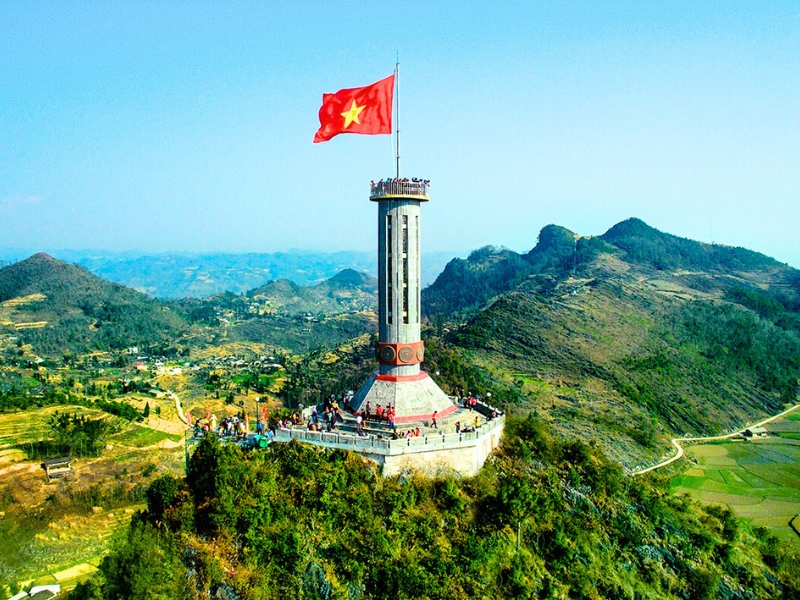
The Lung Cu Flag Tower
From the upper platform, the eye embraces a spectacular panorama: the green valleys, the karst mountains typical of Ha Giang, the villages of ethnic minorities and, in the distance, the thin line of the Chinese border. This place, laden with significance, offers not only an exceptional view but also a moment of reflection on the history and identity of Vietnam.
For many travelers, the visit to Lung Cu tower represents an unmissable stop during the discovery of the Dong Van karst plateau and a memorable symbol of their journey to the far north of the country.
The Dong Van Karst Plateau
Classified as a UNESCO World Geopark, the Dong Van karst plateau is a geological and cultural treasure located at the far north of Vietnam. This vast territory, which extends over several districts, is shaped by limestone formations over 400 million years old, creating a mineral landscape that is as harsh as it is spectacular.

The Dong Van Karst Plateau
The gray mountains, with jagged shapes, alternate with deep valleys, narrow gorges and winding roads that seem to defy gravity. But this harsh landscape is also full of life: small villages nestled, as if suspended among the mountains, are inhabited by Hmong, Lô Lô and Dao communities, who continue to pass down their traditions in simple and authentic isolation.
Beyond its impressive reliefs, the plateau is also an important center of biodiversity and intangible cultural heritage. Here you encounter colorful mountain markets, cornfields carved into the slopes, rammed earth houses and scenes of timeless life.
The Ma Pi Leng Pass
Considered one of the most spectacular passes in Vietnam, Ma Pi Leng connects the towns of Dong Van and Meo Vac, winding along the mountainside at over 1,500 meters in altitude. From its heights, the eye plunges into the vertiginous Tu San gorges and follows the sinuous course of the emerald-green Nho Quế river.
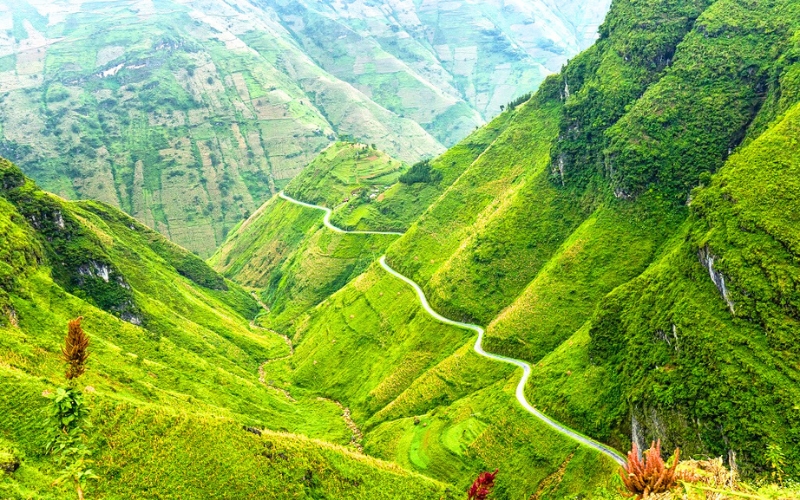
The Ma Pi Leng Pass
Each curve reveals a new breathtaking viewpoint, with sheer cliffs, jagged peaks and deep valleys of wild beauty. The road itself, carved into the rock by workers in the 1960s, is a masterpiece of engineering and a symbol of courage.
Even today, crossing Ma Pi Leng remains one of the most intense moments of the Ha Giang loop, whether by motorcycle, car or simply on foot — as much for the emotions it offers as for the silent majesty of the landscapes.
The Nho Quê River and Tu San Gorges
At the foot of the Ma Pi Leng pass flows the Nho Quê river, whose emerald-green waters flow silently between the rocky walls. This waterway passes through the Tu San gorges, an impressive canyon considered the deepest in Vietnam, with cliffs that can reach almost 800 meters in height.

The Nho Quê River
Navigating the river by boat is an unforgettable experience: along the water you discover a landscape that is both majestic and intimate, sculpted by time and elements. The Tu San gorges, called Hẻm Tu Sản in Vietnamese, form a narrow, wild and spectacular passage, framed by the mountains of the Dong Van karst plateau.
From the river, the silence and verticality of the cliffs amplify the feeling of grandeur. It is one of the most emblematic natural jewels of Ha Giang, best discovered in the early morning or late afternoon, when the light highlights the reliefs.
The Thôn Tha Village

The Thôn Tha Village
A few kilometers from the town of Ha Giang, the village of Thôn Tha is an oasis of peace nestled among the mountains. Inhabited by the Tay ethnicity, this small village is known for its traditional wooden houses on stilts, peaceful rice paddies and the smiling welcome of its inhabitants. Here life follows the rhythm of the seasons and ancestral rituals. Spending a night with a local family, sharing a meal around the fire or simply strolling along the bamboo-lined paths allows you to savor sincere hospitality and experience something of great simplicity… and great beauty.
Local Markets
The local markets of Ha Giang are much more than simple places of commerce. They are the beating heart of the social and cultural life of mountain communities. Each week, inhabitants belonging to different ethnic minorities — Hmong, Dao, Tày, Nùng and others — gather to sell their agricultural products, crafts, traditional clothing or even livestock.

The Meo Vac Market
Among the most renowned, the Meo Vac market attracts both local inhabitants and curious travelers. In a lively and colorful atmosphere, you find stalls of fresh fruit, hand-embroidered fabrics, bamboo objects and even buffalo. But beyond commercial exchanges, these markets are above all places of encounter and conviviality: news is exchanged, events of the week are commented on and sometimes small community festivities are celebrated. For visitors, strolling through these markets is an authentic experience that offers a living glimpse of the traditions and daily life of mountain populations.
>> Discover even more recommended activities in Ha Giang to experience authentic and unforgettable experiences in the heart of the mountains of northern Vietnam.
Practical Tips for Your Visit to Ha Giang
- Choose your travel period well: travel between September and November to admire the golden landscapes and dry climate, or in spring for the blooming flowers.
- Dress in layers, with warm clothes for the evening and light clothes for the day, and don’t forget a raincoat if you travel in summer.
- Bring good hiking shoes, especially if you want to visit villages or hike among the terraced rice paddies.
- Book a vehicle with a driver if you want a comfortable and carefree journey, or rent a motorcycle if you are comfortable on mountain roads.
- Withdraw cash before leaving the town of Ha Giang, as villages often do not accept card payments.
- Respect local cultures: greet the inhabitants, dress modestly and always ask permission before taking photos in villages.
- Prepare to disconnect: some remote areas have no internet connection, but mobile networks work in most places.
Traveling to Ha Giang means discovering another face of Vietnam: wilder, quieter, more authentic. Here the landscapes take your breath away, but it is the encounters, the small daily gestures, the peaceful villages and the dirt paths that leave the most lasting memories.
To best prepare your stay, choose the right season, adapt the itinerary to your pace and prioritize human experiences: sleeping with a local family, strolling through a Sunday market or simply watching how the mountains change light throughout the day. And if you want to travel without worries, our team at Horizon Vietnam is ready to accompany you. We organize customized circuits, respectful of places and people, so that your discovery of Ha Giang is as authentic as it is unforgettable.



Our recommended itineraries
 Nature and Active travel
Northern Vietnam Explorer in 9 days and 8 nights
About ten days
Hanoi - Ha Long Bay - Saigon - Mekong Delta - Siem Reap - Luang Prabang - Pak Ou Caves - Kuang Si Waterfall
 Classic
Vietnam Exclusive in 13 Days
About 2 weeks
Hanoi - Bai Tu Long - Hue - Da Nang - Hoi An - Saigon - Mekong Delta