+84 9 75 46 33 10 (Whatsapp)
  info@horizon-vietnamtravel.com
  Français
  Español
  Português
  Deutsch

Hoan Kiem Lake (Restored Sword): A Treasure Chest of Legends and Hanoi’s History
Table of contents
Hoan Kiem Lake, located in the heart of Hanoi, is one of the most emblematic places of Vietnam’s capital. With an area of 12 hectares and an average depth of 1.2 meters, it is surrounded by a tranquil environment that contrasts with the hustle and bustle of the city. This lake lies at the center of Hoan Kiem District, which bears its name, and connects two of Hanoi’s most important quarters: the old traditional district and that of French colonial architecture. Over the centuries, the lake has witnessed the city’s evolution, serving both as a meeting point for Hanoi’s residents and as a place of relaxation. Its natural environment and green banks make it much appreciated by both residents and tourists. Hoan Kiem Lake continues to be a living symbol of Hanoi’s history and culture, a place where calm, beauty and collective memory converge.
Historical and Geographical Overview
Origins and Evolution
The Hoan Kiem Lake is an essential element of Hanoi’s landscape and has a history dating back several centuries. Although its exact origin is difficult to pinpoint, it is mentioned in ancient maps, particularly in the Trung Do Do map of 1490. At that time, the region around the lake was still largely immersed in a water area that was part of the Red River system.
The lake is actually the result of a bulge in a tributary of the Red River, which passed through streets such as Hang Dao, Hai Ba Trung and Ly Thuong Kiet, before flowing back into the river through Hang Chuoi. This connection with the river played a crucial role in the capital’s development, contributing to its transportation and commerce system. The lake, once fed by this river network, was part of a system of canals and rivers that crossed the city and allowed inhabitants to navigate and trade.
Over the centuries, the lake has undergone various transformations. Its partial drainage and reorganization works during successive dynasties modified its outline. Urbanization efforts starting from the 15th century gradually transformed the surrounding area, but the lake managed to maintain its central role in the city, becoming a symbol of Hanoi’s heart.
Name and Meaning: The Legend of Hoan Kiem Lake
Hoan Kiem Lake, which literally means “Lake of the Restored Sword”, is deeply linked to a 15th-century legend, one of the most celebrated in Vietnam. The story tells that, during the war against the Ming, King Lê Lợi received a magical sword from a giant turtle that inhabited the lake. With this sword, Lê Lợi was able to repel the invasion. Once the war was over, the king went to the lake, where the turtle reappeared to claim the sword. It immersed it in the waters, returning the weapon to its rightful owner, the Dragon King, symbolizing the end of the conflict and the return of peace.

The legend of Hoan Kiem Lake
The name Hoan Kiem refers to this symbolic gesture of the turtle returning the sword, an act that represents far more than a simple return of an object: it embodies justice and the return to order. The sword, a symbol of victory and resistance, represents the struggle for independence, while the turtle, a sacred animal in Vietnamese culture, is a messenger of wisdom, divine protection and justice.
This legend, deeply rooted in Vietnamese culture, is a symbol of victory, justice and divine protection. The lake, which bears the name Hoan Kiem today – “the restored sword” – continues to be a place imbued with mystery and spirituality. The turtle that inhabits it, of the rare species Rafetus Leloii, adds further sacredness to the site, constituting a living link between legend and nature.
Monuments Around Hoan Kiem Lake
Turtle Tower
The Turtle Tower, situated on a small island in Hoan Kiem Lake, is one of Hanoi’s most symbolic monuments. Built in 1886, it is a unique blend of French Gothic architecture and traditional Vietnamese elements. The first floor of the tower features pointed arch doors, typical of Gothic architecture, while the second floor, shaped like a belvedere, adopts a roof style typical of Vietnam.
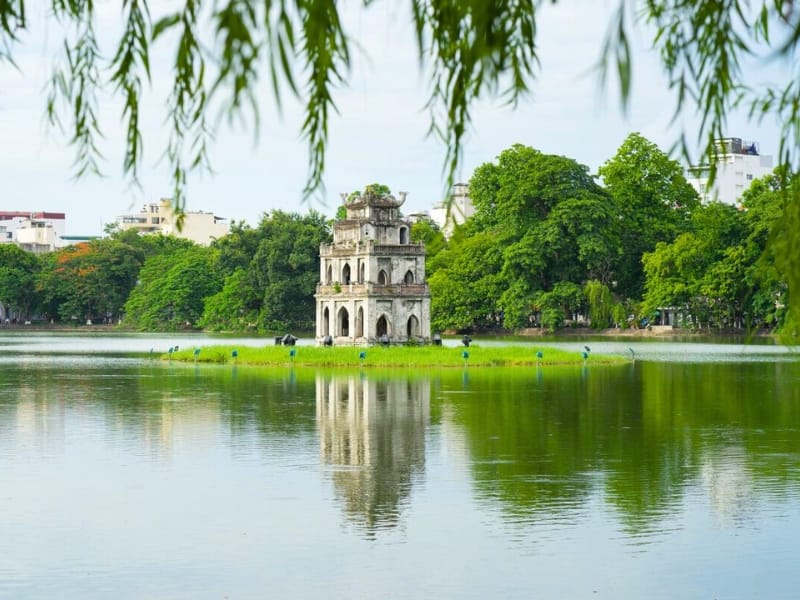
Turtle Tower
This tower pays homage to the giant turtle of the legend, a symbol of wisdom and divine protection. It is often considered an emblem of the city, a meeting point for Hanoi’s residents and a place of contemplation for visitors.
Ngoc Son Temple (Jade Mountain Temple)

Ngoc Son Temple (Jade Mountain Temple)
Ngoc Son Temple (Jade Mountain Temple) is an important spiritual place in the capital. Dedicated to various religious figures, including Emperor Văn Xương (Taoist god of literature) and Trần Hưng Đạo (national hero), it is renowned for its architectural beauty and tranquility, which contrasts with the hustle and bustle of the city. This temple is not only a place of prayer, but also an important cultural center for residents.
The Thê Húc Bridge

The shimmering charm of the Thê Huc Bridge at night
The Thê Huc bridge, which connects the temple to the lake shore, is a bright red footbridge, a symbol of concentrated radiance. Built in 1865, this bridge, with its wooden pillars and elegant design, is a heavily frequented passage by visitors. It is an integral part of the Ngoc Son Temple, connecting this sacred place to the heart of the lake and thus strengthening the spiritual bond between the lake and Vietnamese traditions.
Other Monuments and Historical Sites Around the Lake
The Statue of Lý Thái Tổ

The statue of Lý Thái Tổ
Installed in 2004, the statue of Lý Thái Tổ, founder of Hanoi and emblematic figure of Vietnamese history, stands proudly near the lake. The monument is a gathering place for city residents and a symbol of the strength and perseverance of the Vietnamese people. The statue pays homage to Lý Thái Tổ, who moved the country’s capital to Hanoi in the 11th century, a decision that marked the beginning of the city’s greatness.
Hoa Phong Tower
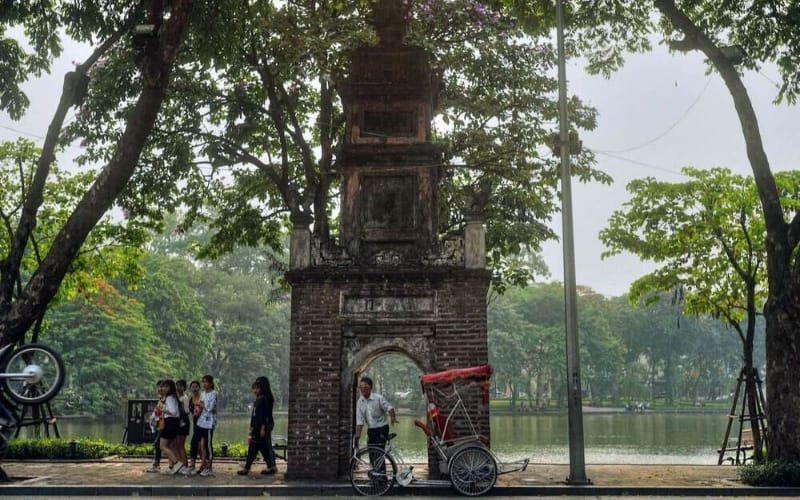
Hoa Phong Tower
Not far from the lake, Hoa Phong Tower is a remnant of the Bao An Pagoda, destroyed by French colonizers to build a post office. Today the tower is a testament to the religious architecture of the era and a symbol of Vietnamese resistance. This three-story monument offers breathtaking views of the surroundings, while also reminding us of the historical and cultural importance of the site.
Ba Kiêu Temple

Ba Kiêu Temple
Ba Kiêu Temple, located northeast of the lake, is dedicated to Liêu Hanh Công Chua (Princess Liêu Hanh), a mythological figure venerated in the Vietnamese spiritual pantheon. Built under the Lê Dynasty, this temple is also known as Thiên Tiên điện (Sanctuary of the Heavens). It is a place of prayer for Hanoi’s residents and a site where important ceremonies are held, particularly during the annual lunar March festival. This temple, with its architectural richness and spiritual atmosphere, is a true center of Vietnamese culture and popular beliefs.
Hoan Kiem Lake today remains an essential destination, not only for Hanoi residents, but also for visitors from around the world. Located in the heart of the city, it offers an oasis of peace amid urban hustle and bustle. This lake has become a living symbol of the city, where residents come to relax, stroll or simply appreciate the beauty of the place. With its green banks and historical monuments, such as the Turtle Tower and Ngoc Son Temple, it offers a perfect blend of nature and culture. The lake also attracts tourists seeking tranquility and historical discovery, and is at the same time a gathering place for cultural events. The preservation of the site is a priority for Hanoi authorities, who make constant efforts to protect its natural environment and biodiversity, particularly the rare turtle species that inhabits it. Today Hoan Kiem Lake remains the heart of Hanoi, a place where history, legend and daily life meet.



Our recommended itineraries
 Nature and Active travel
Northern Vietnam Explorer in 9 days and 8 nights
About ten days
Hanoi - Ha Long Bay - Saigon - Mekong Delta - Siem Reap - Luang Prabang - Pak Ou Caves - Kuang Si Waterfall
 Classic
Vietnam Exclusive in 13 Days
About 2 weeks
Hanoi - Bai Tu Long - Hue - Da Nang - Hoi An - Saigon - Mekong Delta