+84 9 75 46 33 10 (Whatsapp)
  info@horizon-vietnamtravel.com
  Français
  Español
  Português
  Deutsch

Hue Emperors: Legacy of the Nguyen Dynasty (1802–1945)
Table of contents
The imperial city of Hue, classified as a UNESCO World Heritage Site, was the capital of Vietnam during the Nguyen dynasty, the country’s last monarchy (1802–1945).
This dynasty encompasses 13 emperors over seven generations. Their reign shaped the politics, culture, and architecture of modern Vietnam.
Here are the most significant emperors of this fascinating period.
Gia Long (1762–1820) – The Founder of the Nguyen Dynasty
Born Nguyen Phuc Anh, Emperor Gia Long was the first sovereign of the Nguyen dynasty and founder of unified Vietnam.
Following the civil war that pitted the Trinh lords (North) against the Nguyen lords (South), the country was shaken by the Tay Son uprising, led by Emperor Quang Trung. Gia Long, nephew of one of the last Nguyen lords, waged a 25-year war to restore his dynasty’s power, with the help of French advisers such as Pigneau de Behaine.
In 1802 he took power, unified the country, and made Phu Xuan (Hue) the new capital. He renamed the country Vietnam and introduced a centralized government strongly inspired by Confucianism.
Under his reign, relations with France strengthened, opening the door to Western influence in the following decades.
Minh Mang (1791–1841) – Reformer and Rigorous Administrator
Son of Gia Long, Minh Mang (born Nguyen Phuc Dam) reigned from 1820 to 1841.
A visionary emperor, he continued the centralization of power, renaming the country Dai Nam (Great South). He created new institutions: a ministerial cabinet, an imperial secret council, and reorganized the territory into 31 provinces.
- On the domestic front, he encouraged agriculture and Confucian education, but severely prohibited the spread of Christianity, viewed as a threat to national culture.
- On the foreign front, he maintained an isolationist policy, refusing any contact with the West.
Under his reign, Dai Nam achieved its maximum expansion, temporarily incorporating territories from Laos and Cambodia.
Minh Mang is also known for his immense progeny: 142 children, born to approximately 500 concubines.
Tu Duc (1829–1883) – The Last Emperor of Independent Vietnam
Tu Duc, born Nguyen Phuc Hong Nham, was the fourth Nguyen emperor, reigning from 1847 to 1883.
His long reign marked the beginning of the monarchy’s decline in the face of French colonization.
In 1858, Franco-Spanish troops landed in Da Nang, initiating the Indochina War.
Despite appeals from some reform-minded mandarins, Tu Duc refused to adopt Western innovations. The imperial court, divided between reformists and conservatives, remained paralyzed.
In 1883, upon Tu Duc’s death, France imposed protectorate status on Annam and Tonkin, reducing Hue’s power to a symbolic role.
His mausoleum, today a site of great interest to visit, reflects the nostalgia and melancholy of his reign.
Ham Nghi, Thanh Thai, and Duy Tan – The Patriot Emperors
These three emperors marked history with their resistance to French colonialism.
Ham Nghi (1871–1944)
Ascending to the throne at merely 13 years old (1884), he was deposed after supporting the Can Vuong movement (Aid to the King), which called for revolt against the French.
Exiled to Algeria, he lived there until his death in 1944.
Thanh Thai (1879–1954)
Known for his independent spirit, he openly criticized French domination and was also exiled to Reunion Island.
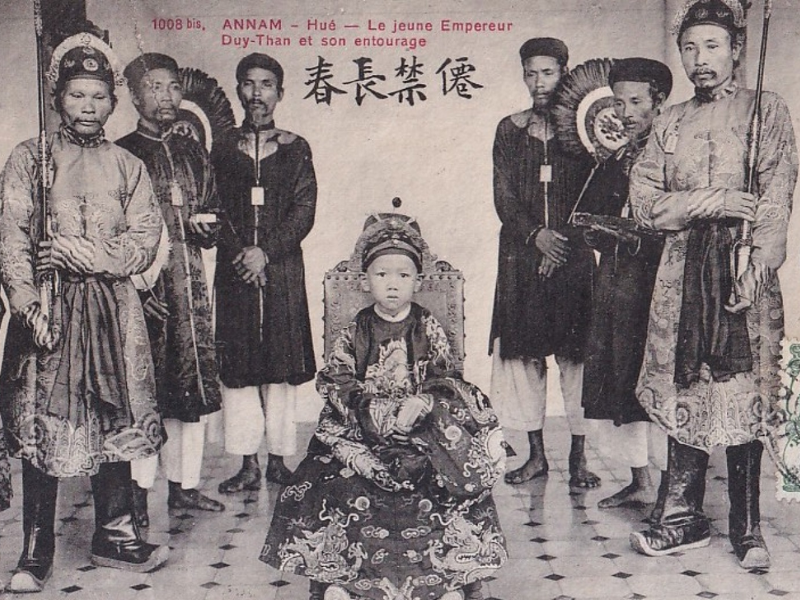
Duy Tan (1900–1945)
Son of Thanh Thai, he participated in a plot against colonial administration in 1916. In turn exiled to Reunion Island, he became a radio-telegraphist and poet there.
During World War II, he joined the Free French Forces of General De Gaulle and died in an air accident in 1945.
Bao Dai (1913–1997) – The Last Emperor of Vietnam
Born Nguyen Phuc Vinh Thuy, Bao Dai was the 13th and last emperor of the Nguyen dynasty.
He ascended to the throne in 1926, at the age of 12, under the guardianship of French colonial administration.
During World War II, Japan occupied Vietnam but maintained Bao Dai as a symbolic head of state.
On August 30, 1945, following the August Revolution led by Ho Chi Minh, he abdicated, stating:
“It is better to be a citizen of a free country than king of a slave country.”
He then became Supreme Adviser to Vietnam, then briefly head of state (1949–1955) before being replaced by Ngo Dinh Diem.
Bao Dai subsequently lived in exile in France, where he died in 1997.
Legacy of the Hue Emperors
Today, their imperial tombs along the Perfume River are among the most visited sites in central Vietnam.
Their architecture – a blend of Vietnamese, Chinese, and European art – symbolizes the transition between tradition and modernity.
From Gia Long to Bao Dai, the Nguyen dynasty embodies the soul of Hue, the imperial capital and cultural heart of the country.




Our recommended itineraries
 Nature and Active travel
Northern Vietnam Explorer in 9 days and 8 nights
About ten days
Hanoi - Ha Long Bay - Saigon - Mekong Delta - Siem Reap - Luang Prabang - Pak Ou Caves - Kuang Si Waterfall
 Classic
Vietnam Exclusive in 13 Days
About 2 weeks
Hanoi - Bai Tu Long - Hue - Da Nang - Hoi An - Saigon - Mekong Delta