+84 9 75 46 33 10 (Whatsapp)
  info@horizon-vietnamtravel.com
  Français
  Español
  Português
  Deutsch

The Imperial City of Hue: Historic Heart of Imperial Vietnam
Table of contents
Classified as a UNESCO World Heritage Site, the Imperial City of Hue is the living symbol of Vietnam’s history. Located in the heart of the Citadel, it once housed the royal palaces, ancestral temples of the Nguyễn dynasty, and the mysterious Forbidden Purple City, the residence of the emperor and his family.
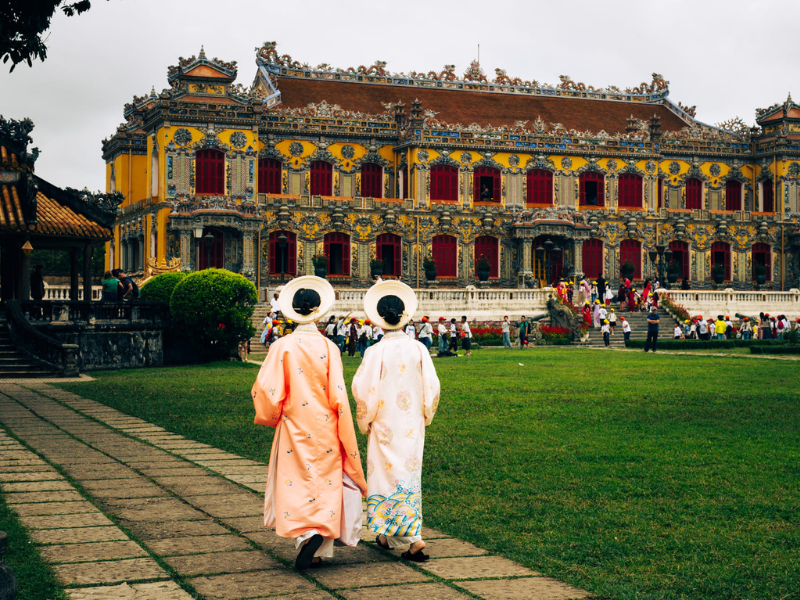
A Majestic Construction
The construction of the Imperial City began in 1804 under Emperor Gia Long’s reign and concluded in 1833 under Minh Mạng.
This vast complex contained 147 monuments, arranged with impressive symbolic and aesthetic rigor.
The City adopts the form of a perfect square, with each side measuring approximately 600 meters. The brick walls, 4 meters high and one meter thick, were protected by a wide moat.
Four monumental gates open toward the cardinal points:
- Gate of the South (Ngo Mon) – to the South, the main entrance reserved for the emperor;
- Gate of Hien Nhon – to the East, for civil mandarins;
- Gate of Chuong Duc – to the West, for military mandarins;
- Gate of Peace (Hoa Binh) – to the North, for special ceremonies.
The surrounding moats and bridges all bore the same poetic name: Kim Thủy, literally “Golden Water”.
Harmony Between Power and Nature
The architectural ensemble of the Imperial City follows a symmetrical axis connecting the most important monuments.
Each building was carefully distributed: men on the left, women on the right; East side for the civil, West for the military.
Despite its defensive and ceremonial function, the Imperial City remains a place steeped in poetry. Flowering gardens, tranquil basins, stone bridges, and centuries-old trees create an atmosphere of serenity and majesty.
The Main Areas of the Imperial City
Defense Region
Comprises the walls, moats, fortified gates, and observation posts. It is the first line of protection for the imperial residence.
Ceremony Region
- The Gate of the South (Ngo Mon): the main entrance to the City and the site of great ceremonies such as the Lunar New Year or royal parades.
- The Palace of Supreme Harmony (Dien Thai Hoa): the throne room where imperial council meetings, coronations, and the emperor’s birthday celebrations were held.
Temple Region
Located on the sides of the Gate of the South, this sacred area honors the ancestors of the Nguyễn dynasty:
- Temple of Trieu To – dedicated to Nguyen Kim, ancestor of the first Nguyen lord;
- Temple of Thai To – for the first Nguyen lords;
- Temple of Hung To – for Nguyen Phuc Luan, grandfather of Gia Long;
- Temple of Worship of the Nguyễn Emperors (The Mieu) – where the sovereigns of the dynasty are honored.
Queen-Mothers’ Region
On the right are found the residences of the queens and queen-mothers, including the Palace of Dien Tho and the Palace of Longevity, true havens of peace decorated with porcelain and gardens.
Princes’ Region
On the left, the Palace of Kham Van and the Garden Co Ha served as places of study and leisure for the young imperial princes.
Internal Service Region
Here were located the workshops and warehouses where objects for the court were manufactured: clothes, porcelain, musical instruments, and official documents.
The Forbidden Purple City
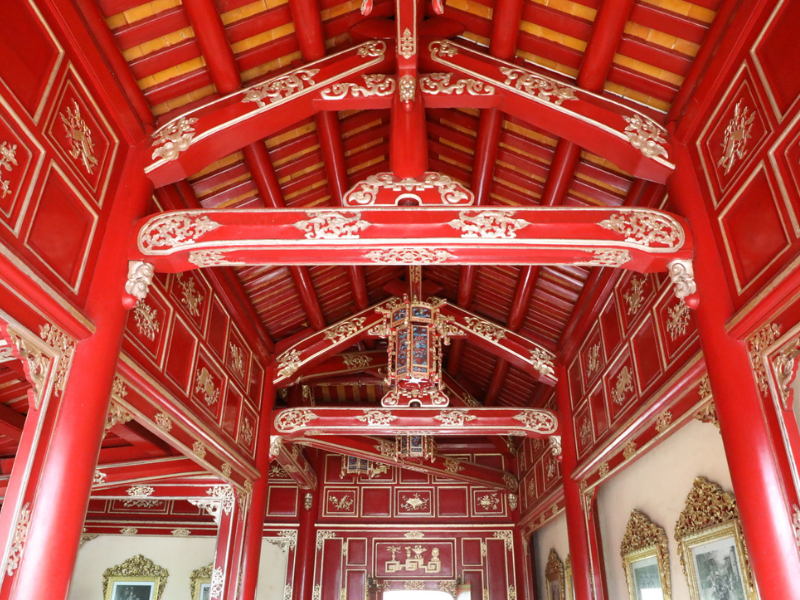
The true heart of the Imperial City, the Forbidden Purple City was strictly reserved for the emperor, his family, and his servants.
It housed several important palaces:
- Palace of Can Chanh – hall for banquets and official audiences (destroyed in 1947);
- Palace of Can Thanh – the emperor’s personal residence;
- Palace of Khon Thai – residence of the vice-queen;
- Palace of Kien Trung – residence of Bao Dai and his wife Nam Phuong;
- Royal Theater (Duyet Thi Duong) and Royal Library – for culture and imperial entertainment.
The Nine Dynastic Urns: Symbols of Power
In front of the Temple of Worship of the Nguyễn Emperors stand nine immense bronze urns, cast between 1835 and 1837 on the orders of Minh Mạng.
Each represents an emperor of the Nguyen dynasty and symbolizes the strength and perpetuity of the kingdom.
They are engraved with motifs representing nature, animals, mountains, weapons, and the riches of Vietnam, offering a true symbolic map of the country in the imperial era.
Visiting the Imperial City of Hue Today
Despite wars and time, the Imperial City of Hue retains its timeless charm.
Visitors can still perceive the aura of the ancient emperors, stroll among lotus basins, and admire finely carved architectural details.
Each stone, each door tells the story of a refined, spiritual Vietnam, deeply connected to its traditions.



Our recommended itineraries
 Nature and Active travel
Northern Vietnam Explorer in 9 days and 8 nights
About ten days
Hanoi - Ha Long Bay - Saigon - Mekong Delta - Siem Reap - Luang Prabang - Pak Ou Caves - Kuang Si Waterfall
 Classic
Vietnam Exclusive in 13 Days
About 2 weeks
Hanoi - Bai Tu Long - Hue - Da Nang - Hoi An - Saigon - Mekong Delta