+84 9 75 46 33 10 (Whatsapp)
  info@horizon-vietnamtravel.com
  Français
  Español
  Português
  Deutsch

Ngoc Son Temple: Spirituality and Legend in the Heart of Hanoi
Table of contents
In the heart of Hoan Kiem Lake, on a peaceful islet connected by a brilliant red bridge, stands Ngoc Son Temple, a timeless symbol of Vietnamese spirituality. Between ancient legends, national heroes and Confucian, Taoist and Buddhist influences, this unique place embodies the deep soul of Hanoi. Built in the 19th century, the temple pays tribute to Tran Hung Dao, the illustrious general of the Tran dynasties, and also welcomes other important figures of Vietnamese culture and faith. But what makes Ngoc Son Temple magical is as much its history as the emotion it stirs in every visitor. In this article, discover why this temple is not simply a monument, but a true experience to live, between architecture, symbolism and spirituality suspended over the water.
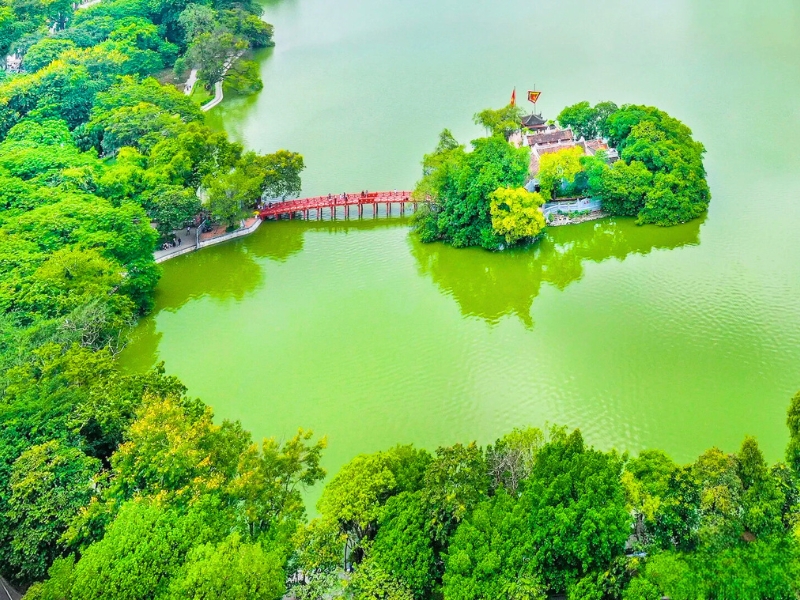
Aerial view of Ngoc Son Temple rising in the heart of Ho Guom Lake (Lake of the Returned Sword)
Where is Ngoc Son Temple Located?
Admission fees:
- Adults: 50,000 VND per person (approximately 1.80 €)
- Children under 16 years old: free entrance
Opening hours:
- Monday to Friday: from 7:00 AM to 6:00 PM
- Saturday and Sunday: from 7:00 AM to 9:00 PM

Ngoc Son Temple (Jade Mountain Temple)
Ngoc Son Temple, also known as the Jade Mountain Temple, stands on a small islet located in the northeast part of Hoan Kiem Lake, in the heart of Hoan Kiem District in Hanoi, Vietnam. To access the temple, visitors cross the famous The Huc Bridge, a wooden walkway lacquered red built in 1865, which connects the shore to the sacred islet.
The exact address is Dinh Tien Hoang Street, Hoan Kiem District, Hanoi. This emblematic site is easily accessible on foot from the Old Quarter and is one of the most visited monuments in Vietnam’s capital.
History of Ngoc Son Temple
The construction of Ngoc Son Temple dates back to the 19th century, a period when Hanoi sought to reassert its cultural and spiritual identity.
Originally, the site was known as Ngoc Son Pagoda, but it was soon renamed a temple, since in Vietnamese culture a pagoda is dedicated to Buddhist worship, while a temple honors historical or divine figures. The name change aimed to faithfully reflect the purpose of the place.
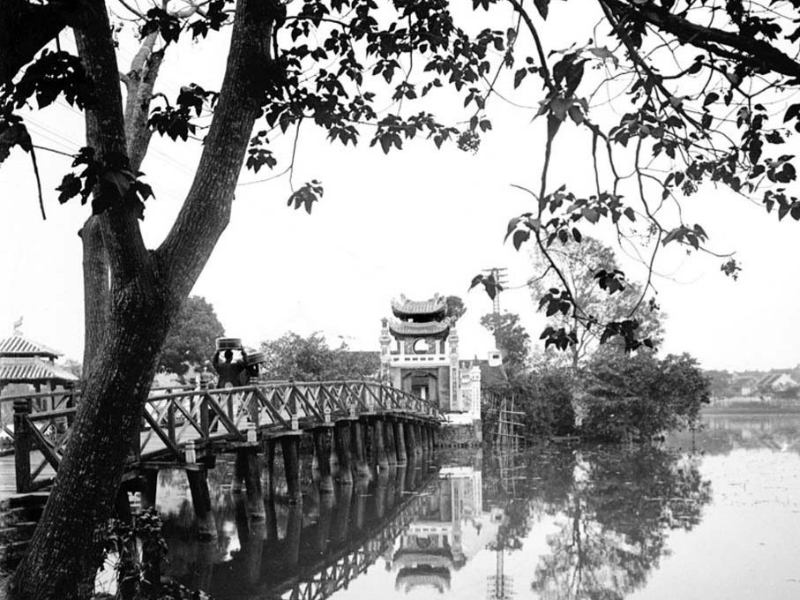
Ngoc Son Temple of old
The temple was erected in honor of Tran Hung Dao, one of Vietnam’s greatest military heroes. This legendary general of the Tran dynasty repelled multiple Mongol invasions in the 13th century, particularly during the battles on the Bach Dang River. His image embodies patriotism, strategic cunning and loyalty. However, the site also pays tribute to other important figures such as:
- Van Xuong De Quan, Taoist deity of literary success and imperial examinations;
- Amitabha, the Buddhist representation of infinite wisdom and benevolence.
In 1865, under the Nguyen dynasty, the scholar Nguyen Van Sieu undertook a major restoration of the site. He added several iconic elements that today form an integral part of the temple landscape:
- The Thê Húc Bridge (light of dawn), which leads to the islet;
- The But Thap Tower (the Pen), a symbol of knowledge;
- The Dai Nghien Stone (the Inkstone), which represents the intellectual foundation;
- The Tran Ba Pavilion, erected against “foreign waves” to protect Vietnamese culture.
Today, Ngoc Son Temple is a space where history, spirituality, art and national identity intertwine. It testifies to the harmonious fusion of the three great philosophies that shaped Vietnamese thought: Confucianism, Taoism and Buddhism.
What to See at Ngoc Son Temple?
It is no exaggeration to say that Ngoc Son Temple, with the structures surrounding it, represents one of the most emblematic architectural complexes in Hanoi. Each element possesses its own symbolic and aesthetic significance, but it is the unity of the whole that creates a harmonious experience, between spirituality, culture and landscape. To fully appreciate the beauty of the site, it is recommended to start from the Thê Húc Bridge, then to cross the various structures that gradually lead to the main sanctuary.
The Pen Tower (Bút Tháp) and the Inkstone Slab (Đài Nghiên)
Even before crossing the Thê Húc Bridge, the visitor is greeted by one of the strongest symbols of Ngoc Son Temple: the Bút Tháp Tower, or Pen Tower. Built in 1865 by scholar Nguyen Van Sieu, this elegant structure of 9 meters in height rises on a rocky base called Độc Tôn, which represents stability and grandeur.
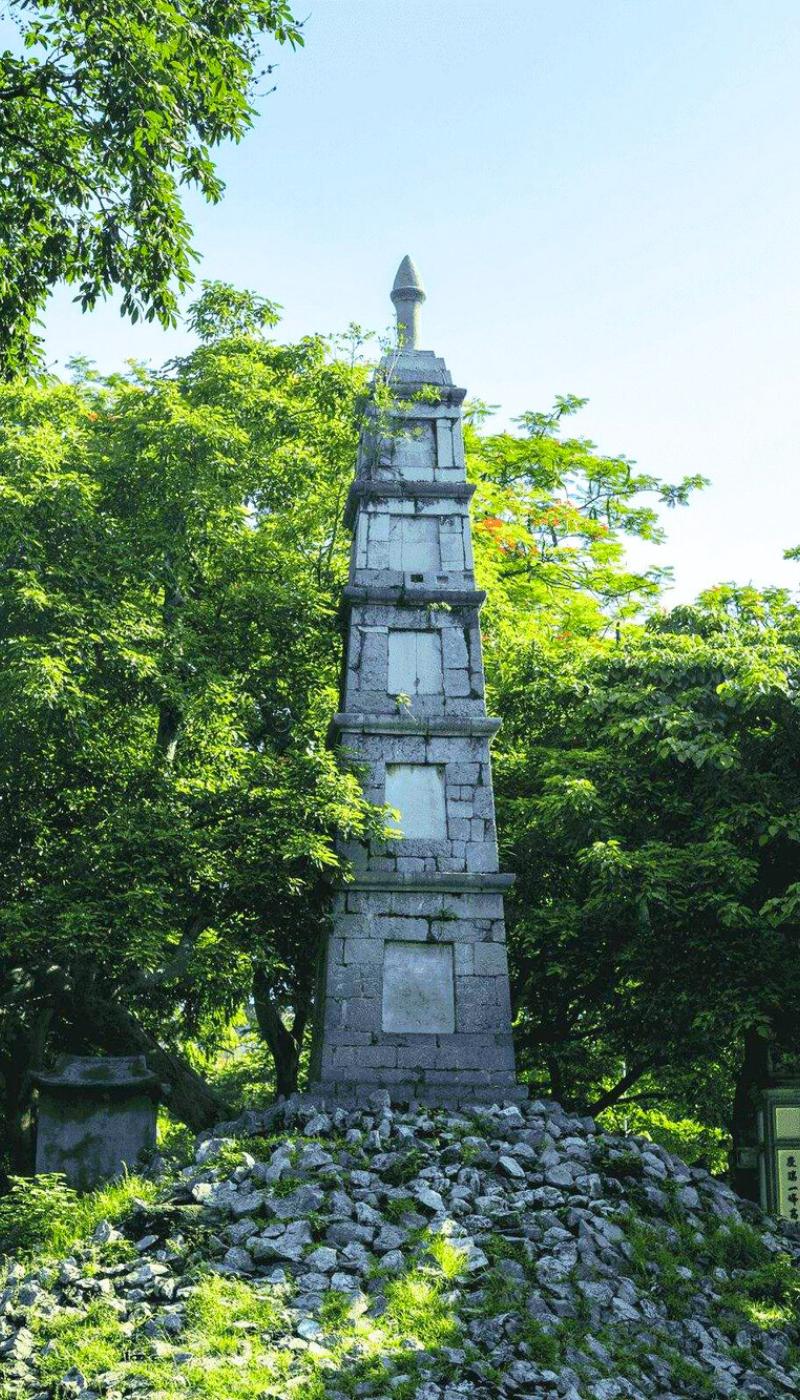
The Pen Tower (Bút Tháp)
With its slender form reminiscent of a calligraphy brush pointing toward the sky, the tower embodies intellectual aspiration and the power of letters. It is adorned with three ideograms: “Tả Thanh Thiên,” which can be translated as “Writing in the Blue Sky.” A poetic metaphor that reflects the nobility of spiritual and literary ambitions.
Just below lies the Inkstone Slab (Đài Nghiên), carved into a stone shaped like half a peach, resting on the backs of three sacred toads. This symbolic base completes the ensemble by evoking the concrete foundations of knowledge, nourished by tradition, study and perseverance. A local legend tells that at noon, when the sun is at its zenith, the shadow of the tower touches exactly the center of the inkstone — a moment both rare and symbolic, illustrating the perfect union between sky and earth, between dream and discipline.
The Thê Húc Bridge
To reach the sacred islet of Ngoc Son Temple, one must cross the Thê Húc Bridge, one of Hanoi’s most emblematic symbols. Its poetic name can be translated as “the place where the light of dawn rests” — an evocative image of peace, hope and rebirth. Completely built in wood and painted a brilliant red, this slightly arched bridge resembles the shape of a shrimp, according to Vietnamese popular imagination. It incorporates traditional elegance and the bond between the earthly world and the spiritual space of the temple.

The radiant beauty of the Thê Húc Bridge illuminated at night
Crossing the Thê Húc Bridge is not simply a passage: it is a rite of transition toward serenity, an entrance into a space of contemplation, between the tranquil waters of Hoan Kiem Lake and the sacred symbols of the site.
At nightfall, the bridge lights up and reflects on the lake like a suspended line of fire, adding to the magic of the place. It is also an essential photo spot for visitors and lovers of Hanoi.
The Dac Nguyet Pavilion (Pavilion of the Moon)
Crossing the Thê Húc Bridge, one accesses the Dac Nguyet Pavilion, literally Pavilion of the Moon. This building marks the solemn entrance into the sacred enclosure of the temple, like a symbolic door between the external world and the spiritual one.
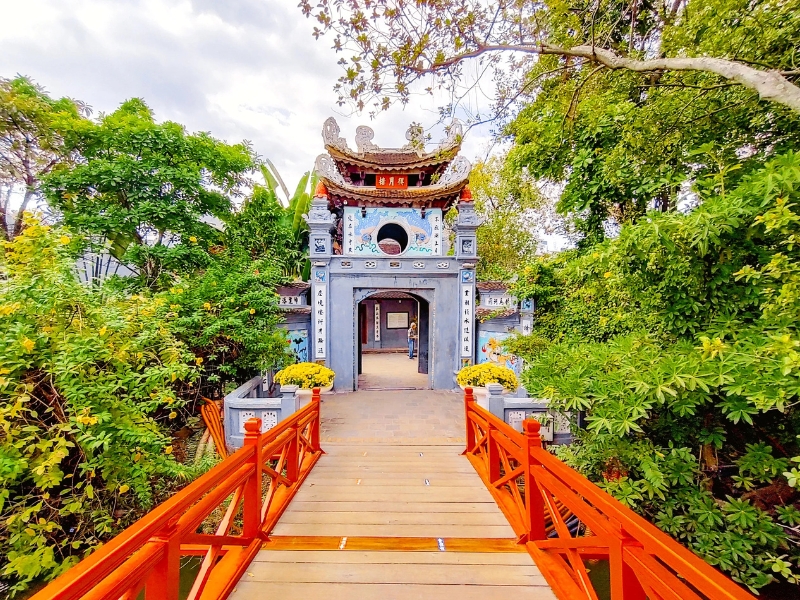
The Dac Nguyet Pavilion (Pavilion of the Moon)
Built in the protective shadow of an ancient banyan tree, the pavilion stands out for its refined two-story architecture topped by curved roofs. At the corners, cloud-shaped carved motifs add a dreamlike touch, evoking the elevation of the spirit in Oriental tradition.
Two bas-reliefs decorate its walls:
- On the right, Long Mã Hà Đồ (Dragon and Horse carrying the heavenly charts);
- On the left, Thần Quy Lạc Thư (Sacred Turtle and divine scriptures).
These mythological representations, drawn from Taoism and Confucianism, embody the fundamental principles of cosmic order: yin and yang, the balance between sky and earth, strength and wisdom.
The Dac Nguyet Pavilion is thus not simply an architectural passage, but an invitation to meditation, contemplation and understanding of the universe, as expressed in Vietnamese tradition.
The Trấn Ba Pavilion
Built to the south of the complex, the Trấn Ba Pavilion, literally “Pavilion of defense against the waves,” stands as a symbolic barrier between the spiritual world and external disturbances. Its square structure rests on eight columns — four external ones in stone and four internal ones in wood — and is topped by two overlapping roofs, according to classical Vietnamese aesthetics.

The Trân Ba Pavilion
This pavilion does not only protect the temple from the elements. It also represents, on the spiritual plane, the defense of Vietnamese cultural integrity in the face of external influences, recalling the struggles for independence and the preservation of traditions.
The Sacred Turtles of Hoan Kiem Lake
Inside the Trấn Ba Pavilion, in Ngoc Son Temple, visitors can admire two giant preserved turtles, displayed side by side in glass cases. These rare specimens of Rafetus swinhoei, a freshwater turtle species now in critical danger of extinction, are intimately linked to the founding legend of Ho Guom Lake, or Lake of the Returned Sword.
According to tradition, in the 15th century Emperor Lê Lợi, after freeing Vietnam from Ming invaders, returned to a golden turtle that emerged from the lake the magical sword that had helped him triumph. The mythical creature then disappeared into the waters, returning the sacred weapon to heaven. Since then, the lake has become a place of national memory, and its turtles are revered as guardians of Vietnamese sovereignty and spirit.

The first specimen of the sacred turtle
The first turtle, found dead in 1967, measures almost two meters and weighs over 200 kilograms. The second, which died in 2016, is the last known to have lived in the lake. Its extraordinary preservation is the result of a collaboration between the Vietnamese Academy of Sciences and Technologies and the Berlin Museum of Natural History, conducted using a German plastination method that lasted nearly two years. Symbols of wisdom, longevity and protection, these turtles watch silently over visitors, reminding us that courage, justice and loyalty are at the heart of the Vietnamese soul.

The second specimen of the sacred turtle
The Main Sanctuary
The main sanctuary of Ngoc Son Temple consists of three aligned pavilions, reflecting traditional Vietnamese architecture:
- Bái Đường (Ceremony Hall): a place of welcome for visitors and offerings.
- Trung Đường (Central Hall): dedicated to Văn Xương Đế Quân (god of literature and imperial examinations), Quan Vũ (symbol of loyalty and rectitude) and Lã Động Tân (Lü Dongbin), one of the eight immortals of Taoism, protector of scholars.
- Hậu Cung (Rear Sanctuary): dedicated to Trần Hưng Đạo, the general revered for his victories against the Mongol invasions of the 13th century.

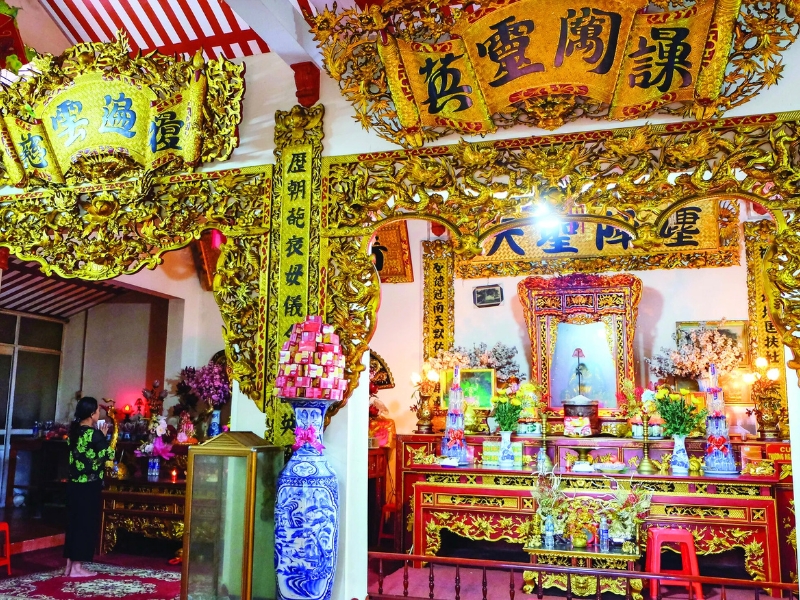
Inside, the imposing and finely sculpted statues embody the harmonious coexistence of the three great philosophical and religious traditions of Asia: Confucianism, Taoism and Buddhism. This syncretism gives the temple a unique spiritual depth, reflecting the tolerant and cultured soul of Vietnam.
Practical Tips for Visiting Ngoc Son Temple
Before discovering this emblematic place on Hoan Kiem Lake, here are some useful suggestions for a serene and respectful experience:
1. Bring cash for tickets: admission is paid only in cash (VND). It is advisable to prepare the exact amount (50,000 VND for adults, 30,000 VND for students).
2. Wear appropriate clothing: the temple is a place of worship — avoid clothes that are too short (miniskirts, shorts, tank tops) and remove hats or caps inside the sanctuaries.
3. Respect the silence and tranquility of the place: avoid loud conversations, phone calls in sacred areas or disrespectful behavior in prayer spaces.
4. Take photographs discreetly: photography is permitted inside the temple, but it is best not to use flash or take overly intrusive photos, especially when people are praying.
5. Do not touch sacred objects: avoid touching statues, offerings or altars. Some objects are considered sacred and must not be handled.
6. Respect the environment: do not leave garbage. The site is clean and serene, and everyone contributes to preserving its atmosphere.
Main Attractions near Ngoc Son Temple
Around Ngoc Son Temple opens a rich cultural and heritage diversity. Here is a selection of visits not to be missed just a few steps away:
Thang Long Water Puppet Theater

Thang Long Water Puppet Theater
Just a few meters from the temple, this theater offers a form of spectacle typical of Vietnam, in which wooden puppets move on the surface of the water. Accompanied by a live traditional orchestra, each performance tells legends, scenes of rural life or historical tales in an atmosphere that is both poetic and lively. An activity ideal for all ages.
St. Joseph Cathedral

St. Joseph Cathedral Hanoi
Moving just a few streets away, you discover this majestic cathedral in Neo-Gothic style, built at the end of the 19th century. Inspired by Notre-Dame de Paris, it is one of the finest testimonies to French colonial architecture in Hanoi. Its peaceful atmosphere contrasts with the hustle and bustle of the nearby Old Quarter.
Hanoi’s Old Quarter
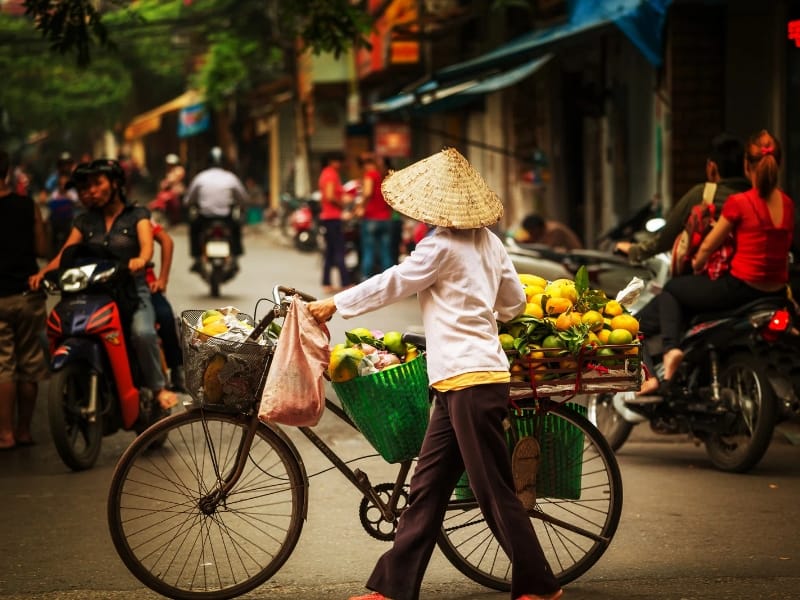
A corner in the old quarter of Hanoi
Just a few steps from Hoan Kiem Lake, the Old Quarter is one of the most emblematic and authentic places in the capital. This labyrinth of narrow alleyways, divided according to ancient trades, reveals a vibrant world where one encounters small discreet temples, ancient houses with faded facades, colorful markets and fragrant street food stalls. Here, every street tells a story, every smell awakens a memory. It is in this warm bustle that the popular soul of Hanoi is grasped: alive, loud, animated, profoundly human.
For every traveler passing through Hanoi, Ngoc Son Temple is an essential stop. In the heart of Hoan Kiem Lake, this emblematic place reflects the deep spirit of Vietnam’s capital: a subtle interweaving of spirituality, history and poetic beauty. Whether crossing the Thê Húc Bridge, admiring the Pen Tower or discovering local legends, every moment spent here allows one to better understand Vietnamese culture and its timeless values. A place to visit, to feel… and to cherish in memory.


Our recommended itineraries
 Nature and Active travel
Northern Vietnam Explorer in 9 days and 8 nights
About ten days
Hanoi - Ha Long Bay - Saigon - Mekong Delta - Siem Reap - Luang Prabang - Pak Ou Caves - Kuang Si Waterfall
 Classic
Vietnam Exclusive in 13 Days
About 2 weeks
Hanoi - Bai Tu Long - Hue - Da Nang - Hoi An - Saigon - Mekong Delta