+84 9 75 46 33 10 (Whatsapp)
  info@horizon-vietnamtravel.com
  Français
  Español
  Português
  Deutsch

Pagoda of the Celestial Lady (Thien Mu) – The Spiritual Jewel of Hué
Table of contents
Dominating the tranquil Perfume River, the Pagoda of the Celestial Lady (Chùa Thiên Mụ or Chùa Linh Mụ) is one of the most emblematic symbols of Hué, the ancient imperial capital of Vietnam. With its slender silhouette visible from the city’s shores, it embodies at once Buddhist faith, Vietnamese poetry, and imperial memory.
A Pagoda Rich in History
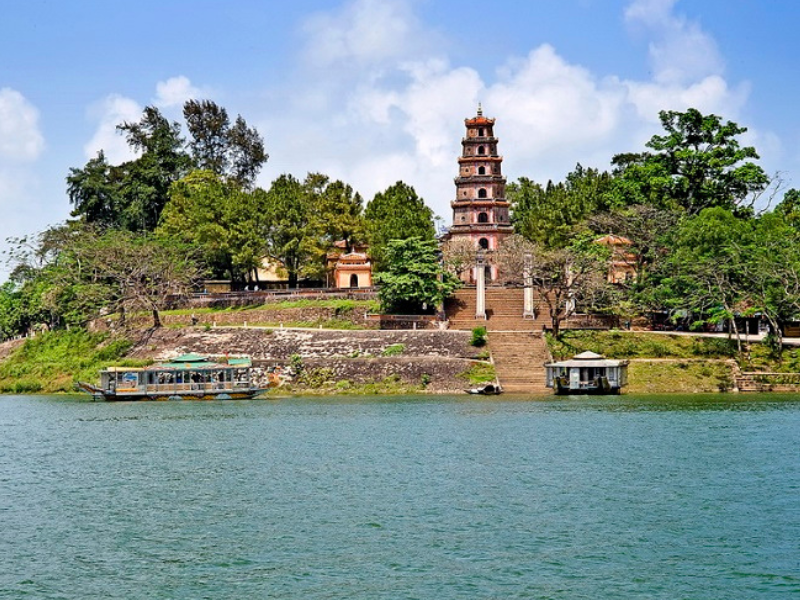
Built in 1601 by Lord Nguyễn Hoàng, the Pagoda of the Celestial Lady is the oldest in Hué.
According to legend, an old woman in a red robe appeared on Ha Khe hill. She would have predicted that a lord would build a pagoda there to ensure the prosperity of the kingdom. Moved by this prophecy, Nguyễn Hoàng immediately ordered its construction. Thus was born Thiên Mụ, literally “the Celestial Lady”.
The Great Phases of Construction and Restoration
During the reign of Lord Nguyễn Phúc Chu (1710–1714), the pagoda experienced its first golden age. He had the bell Đại Hồng Chung erected, a work of two tons whose inscriptions evoke Buddhist wisdom and the peace of the kingdom. He also ordered more than a thousand Buddhist texts from China and had several attached temples built, now disappeared.
A century later, in 1844, Emperor Thiệu Trị had the famous Phuoc Duyen Tower built for his grandmother’s birthday, giving the pagoda its current appearance.
The Phuoc Duyen Tower: Eternal Symbol of Hué
Standing at 21 meters high and composed of seven floors, the Phuoc Duyen Tower (or Tower of the Source of Happiness) is the spiritual and visual landmark of the city.
Each floor is dedicated to a different Buddha, representing a level of elevation toward enlightenment. Once, a spiral staircase led to the summit where a golden Buddha statue stood. In front of the tower stood the Huong Nguyen pavilion, decorated with a Dharma Wheel that turned in the breeze — a strong symbol of the circulation of Buddhist teaching.
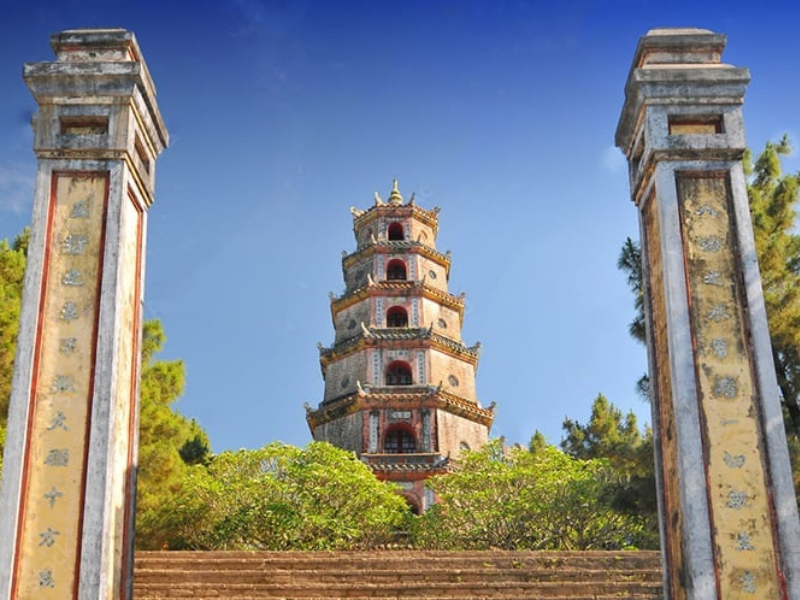
Unfortunately, a devastating storm in 1904 damaged the pagoda. Emperor Thanh Thai undertook repairs three years later, but the building never regained its original splendor.
Architectural and Spiritual Treasures
Today, Thien Mu pagoda remains an important pilgrimage site and hosts numerous historical treasures:
- Statues of Maitreya Buddha, the Ten Kings of the Underworld, and Guardian Spirits sculpted with surprising precision.
- Imperial stelae, bell pavilions, and parallel phrases that testify to the artistic refinement of the Nguyen era.
- A peaceful flowering garden, decorated with a hòn non bộ (miniature stone garden) attributed to Dao Tan, the founder-master of classical Vietnamese theater Tuồng.
A Shocking Relic: The Car of Thich Quang Duc
One of the most significant objects in the pagoda is undoubtedly the Austin automobile of the venerable Thich Quang Duc. It was aboard this vehicle that the monk traveled to Saigon in 1963, where he immolated himself by fire to protest the repression of Buddhism by the Ngo Dinh Diem regime. This gesture, immortalized in a photograph that became a worldwide symbol, embodies the spiritual power and peaceful resistance of Vietnamese monks.
The Pagoda Today: Between Prayer and Contemplation
The Pagoda of the Celestial Lady is not only a historical monument: it is an important meditation site still active today. Monks recite sutras there every day. They welcome visitors in a peaceful atmosphere steeped in spirituality.
From the top of Ha Khe hill, the view of the Perfume River is splendid. At sunset, the Phuoc Duyen Tower is bathed in a golden and mystical light, an unforgettable spectacle.
In Brief: Why Visit the Thien Mu Pagoda?
- For its fascinating history that blends legends, dynasties, and spirituality.
- For its unique architecture and its symbolic role in Vietnamese culture.
- For its exceptional panorama of the Perfume River.
- And for the emotional power of the place, a living memory of Vietnamese Buddhism.
Expert Tip from Horizon Vietnam Travel: Combine your visit to Thien Mu Pagoda with the Imperial City and Tu Duc Tomb for a complete immersion in the royal and spiritual history of Hué.



Our recommended itineraries
 Nature and Active travel
Northern Vietnam Explorer in 9 days and 8 nights
About ten days
Hanoi - Ha Long Bay - Saigon - Mekong Delta - Siem Reap - Luang Prabang - Pak Ou Caves - Kuang Si Waterfall
 Classic
Vietnam Exclusive in 13 Days
About 2 weeks
Hanoi - Bai Tu Long - Hue - Da Nang - Hoi An - Saigon - Mekong Delta