+84 9 75 46 33 10 (Whatsapp)
  info@horizon-vietnamtravel.com
  Français
  Español
  Português
  Deutsch

Top 10 Must-See Sites in Hanoi
Table of contents
Hanoi, the ancient capital of Vietnam, captivates with its timeless charm and rich cultural heritage. A city of contrasts, it elegantly blends the vibrant energy of its bustling streets with serene gardens, temples, and pagodas steeped in history. Its ancient alleyways, often grouped under the traditional name of the 36 Streets and Corporations, still testify today to the artisanal and commercial dynamism inherited from centuries of history. From its peaceful lakes to historic monuments, and passing through cultural sites located both in the heart of the city and in its outskirts, Hanoi is abundant with treasures. For those wishing to discover the must-see places of Hanoi, the capital offers a journey where centuries-old traditions and modern life meet at every moment. Exploring these places means perceiving the profound soul of Vietnam, among spirituality, history, and hospitality.
1. Hoan Kiem Lake (Lake of the Returned Sword)
In the heart of Hanoi, Hoan Kiem Lake is much more than a simple body of water. It is the living soul of the capital. Surrounded by century-old trees whose branches gently curve over its emerald-green waters, this lake forms a soothing mirror in which past and present reflect in harmony. A true connection point between the old 36 Streets quarter and more modern arteries, it silently unites different eras and styles. According to the most widespread legend, Emperor Le Loi received a magical sword from a sacred turtle that allowed him to repel invaders. Once peace was restored, the turtle reappeared to reclaim the sword and return it to the spirits of the lake, thus giving the place its name, Hoan Kiem, the Lake of the Returned Sword. A symbol of the city and a privileged meeting place for residents, Hoan Kiem Lake is naturally one of the must-see sites in Hanoi, both for its beauty and for its historical and legendary value.

Hoan Kiem Lake (Lake of the Returned Sword)
But beyond the legend, the lake also plays a symbolic and spiritual role in the lives of Hanoi’s residents. Strongly influenced by the philosophy of yin and yang, residents consider this lake as the yin, the calm force that balances the city’s frenetic energy. At dawn, groups practicing tai chi gather, solitary walkers or simple passersby come to seek a bit of serenity before returning to the urban bustle. At dusk, the place transforms into a poetic refuge, where the murmur of wind through leaves and the light of lanterns invite contemplation. Around it, colonial-style buildings, legacies of the French era, gently blend with the oriental atmosphere of the site, offering a picturesque and profoundly moving scene.
2. Ngoc Son Temple (Temple of the Jade Mountain)
Located on a peaceful island in Hoan Kiem Lake, Ngoc Son Temple, literally the Temple of the Jade Mountain, is one of the most emblematic places in Hanoi. It is accessed via the elegant vermilion-red The Huc bridge, the Bridge of the Rising Sun, and the sanctuary emanates a serene and poetic atmosphere. Built in the 18th century, it is dedicated to General Tran Hung Dao, a national hero who repelled the Mongol invasions, and to other revered figures such as Van Xuong, god of literature, and La To, protector of physicians.
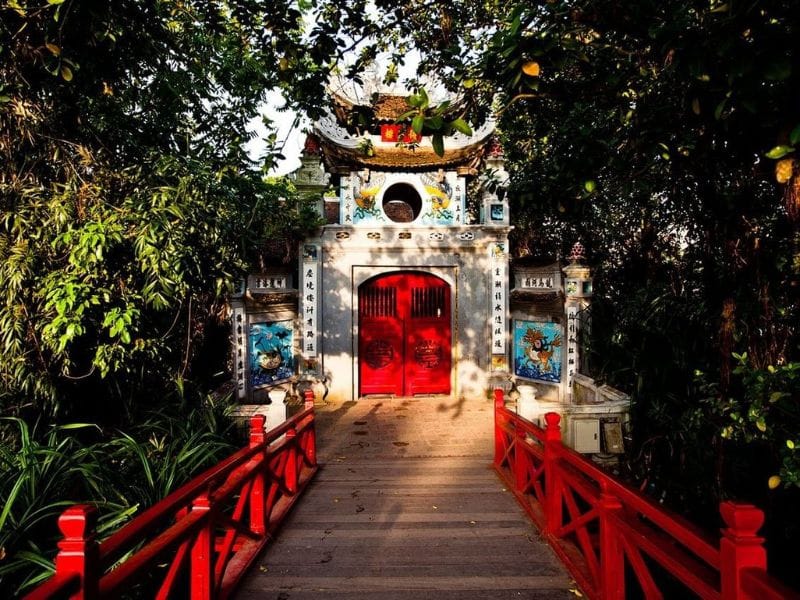
Ngoc Son Temple (Temple of the Jade Mountain)
The temple stands out for its traditional architecture, typical of Vietnamese art, with curved roofs, red pillars, and refined sculptures. Inside are altars, urns, and numerous votive objects that testify to the devotion of Hanoi’s residents. Visitors come here to gather in silence, offer incense, or simply enjoy the enchanting setting of the lake. At dawn or dusk, the reflection of the temple and bridge in the emerald-green waters of Hoan Kiem Lake offers a spectacle of timeless beauty.
3. Hanoi’s Temple of Literature
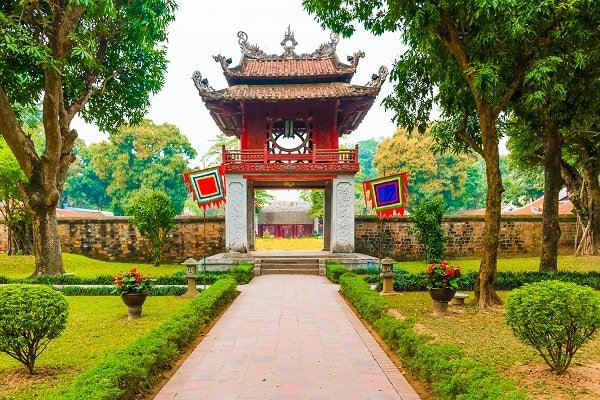
Among Hanoi’s must-see sites, the Temple of Literature holds a special place. A true architectural jewel, it is one of the rare witnesses that has crossed the centuries and the vicissitudes of the capital’s history. Founded in the 11th century, this majestic temple was Vietnam’s first national university, dedicated to Confucius and to the education of scholars destined to serve the Empire. Behind its discrete walls, the visitor discovers a vast complex of courtyards, pavilions, and pools arranged in harmony, typical of traditional Vietnamese architecture. All of it is magnificently shaded by century-old trees, creating an atmosphere of calm and reflection.

Hanoi’s Temple of Literature
The temple offers a journey into the universe of knowledge and Confucian values. Every corner reveals symbols of great refinement. One discovers in particular the famous Garden of Stone Steles, where the names of over a thousand graduates of the most prestigious mandarin exams are engraved, testimony to the intellectual excellence of past centuries. The Pavilion of the Constellation of Literature, which has become one of Hanoi’s visual symbols, stands proudly at the center of this peaceful complex, while the Lake of Celestial Clarity adds a poetic note to the whole. Although the buildings of the ancient university no longer exist, altars dedicated to Confucius and the great master Chu Van An, revered for his integrity and wisdom, still diffuse the discreet fragrance of incense into the air, inviting reflection and serenity.
4. One-Pillar Pagoda
Among the spiritual gems of Hanoi, the One-Pillar Pagoda stands out for its unique architecture and profound symbolism. This small pagoda seems to float on water. A sanctuary with a curved roof, inspired by the shape of a lotus flower, rests on a single pillar erected in the center of a small square pool. Originally the pillar was made of wood, then rebuilt in stone to resist the passage of time better. A discreet staircase allows the faithful to access the altar, where they leave offerings and prayers to Quan Am, the Goddess of Mercy, protector of souls.
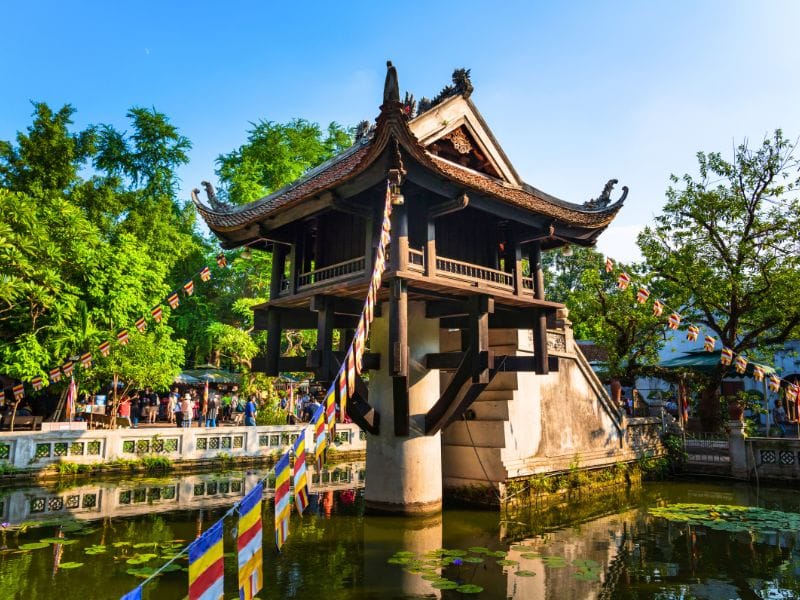
One-Pillar Pagoda
According to legend, this deity appeared in a dream to the second king of the Ly dynasty, promising him a long-awaited heir. Shortly after, his wish was granted. In gratitude, the sovereign had this pagoda built in 1049, giving it the shape of a lotus flower that peacefully emerges from the water, a symbol of purity in Buddhism. A rare testimony to the golden age of Vietnamese Buddhism under the Ly dynasty in the 11th century, the One-Pillar Pagoda has withstood the passage of time. Even today it attracts pilgrims and travelers, fascinated by the harmony of this place steeped in spirituality. Its singular history and unique architecture naturally make it one of Hanoi’s must-see sites.
5. Vietnam Museum of Ethnography
Located a few kilometers from the center of Hanoi, the Vietnam Museum of Ethnography is an essential stop for those wishing to understand the richness and cultural diversity of the country. Opened in 1997, this museum offers a fascinating overview of the 54 ethnic groups that make up Vietnam’s human mosaic. Through everyday objects, traditional costumes, agricultural tools, musical instruments, and works of art, the visitor immerses themselves in the traditions, rituals, and lifestyles of Vietnam’s diverse communities.

Vietnam Museum of Ethnography
The museum is divided into two complementary sections. The first, inside a modern building with a sober design, presents permanent and temporary exhibitions that tell the story and material and immaterial culture of the ethnic groups. The second part, outdoors, is undoubtedly the most impressive. Authentic traditional houses, faithfully reconstructed or transferred from their regions of origin, allow visitors to discover the unique architecture of the Tay, Muong, Dao, Ede, or Bana peoples. Every detail, from the thatched roof to wooden sculptures, illustrates the ingenuity and diversity of local knowledge. For its richness and lively museography, the Museum of Ethnography stands out as one of Hanoi’s must-see sites for those wishing to better understand Vietnam’s cultural diversity.
>> To learn more about the museum’s exhibitions and activities, feel free to consult its official website: Vietnam Museum of Ethnography
6. Hanoi Opera House
A symbol of refinement and elegance inherited from the colonial period, Hanoi’s Opera House is one of the most majestic monuments in the capital. Built between 1901 and 1911 by French architects Broyer and Harley, it is directly inspired by Paris’s Opéra Garnier, but adapted to Vietnam’s climate and context. Located at the southeastern tip of the Old Quarter, facing August Revolution Square, the theater strikes with its neoclassical facade adorned with Corinthian columns, balconies, and finely sculpted pediments.

Hanoi Opera House
The interior is in no way inferior to the great European halls. Decorated with gilding, frescoes, and imposing chandeliers, it hosts a hall with remarkable acoustics, where concerts, operas, ballets, and theatrical performances are held. During the colonial era, the Opera House was reserved for French high society and local elites. Today it has become a cultural space open to all, playing a central role in the city’s artistic life. In the evening, discreetly illuminated, the building reveals all its beauty and recalls the elegance of a bygone time, while remaining anchored in modernity.
7. Vietnam Museum of Fine Arts

Vietnam Museum of Fine Arts
Housed in an elegant colonial-inspired building, formerly a girls’ college, the Vietnam Museum of Fine Arts is one of the richest in the country. Located not far from the Temple of Literature, it offers a fascinating immersion into the history of Vietnamese art, from prehistory to the contemporary era. In its harmonious and well-appointed halls, the visitor discovers a remarkable collection of Cham sculptures, wooden and stone Buddhist statues, ancient ceramics, traditional lacquers, and modern and contemporary paintings. A must-see for every art lover, the museum is part of Hanoi’s essential sites both for the quality of its collections and for its elegant atmosphere.

Each room tells an aspect of Vietnamese artistic heritage, from refined sacred art to the emergence of modern painting in the 20th century. The works, sometimes marked by Chinese and French influences, nevertheless testify to a distinctive identity that is profoundly Vietnamese. The museum is not simply an exhibition space, but also a living place where temporary exhibitions, workshops, and cultural events are regularly held. For art lovers and simple curious visitors alike, it is the ideal place to understand Vietnam’s creative richness through centuries of history and aesthetic evolution.
8. Ho Chi Minh Mausoleum Complex
A place of fundamental memory for the Vietnamese people, the Ho Chi Minh Mausoleum Complex occupies a central position in Hanoi’s historical and political landscape. Located in the vast Ba Dinh Square, where President Ho Chi Minh proclaimed Vietnam’s independence in 1945, the mausoleum houses his remains today, preserved in a glass sarcophagus, according to a solemn and rigorous visitation ritual. Built between 1973 and 1975, the massive gray granite and marble building was inspired by the monumental lines of Lenin’s Mausoleum in Moscow, while also incorporating Vietnamese architectural elements.

Ho Chi Minh Mausoleum
Around the mausoleum extends a vast complex where the visitor discovers several emblematic places linked to President Ho Chi Minh’s life. Among these, the modest stilt house in which he lived, simple and sober, always arouses admiration. The surrounding gardens, carefully tended, are crossed by tranquil paths bordered with tropical trees and water basins. Nearby, the Presidential Palace, former seat of the Governor of Indochina, and the One-Pillar Pagoda complete this ensemble laden with history.
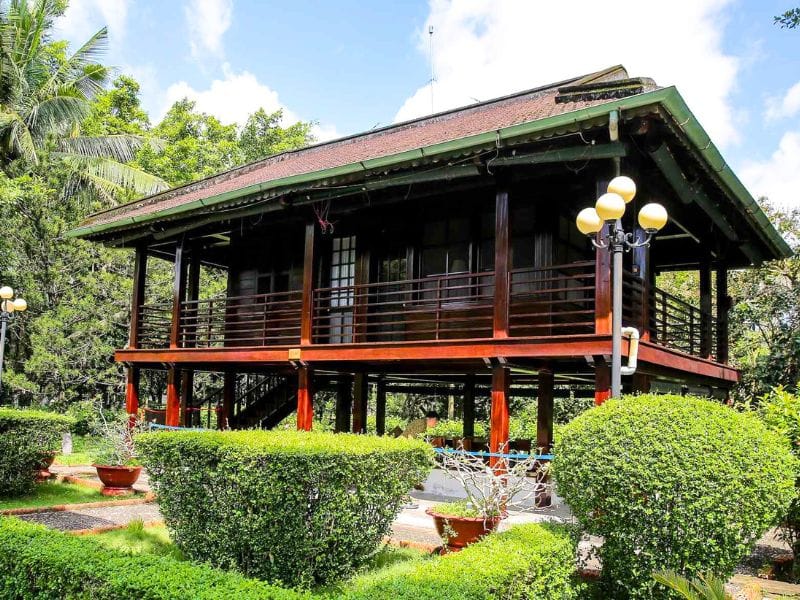
Ho Chi Minh’s Stilt House
A place of reflection, national memory, and history, the Mausoleum Complex represents both the Vietnamese people’s attachment to their contemporary history and an essential stop on every visit to Hanoi.
9. Long Bien Bridge (Paul Doumer Bridge)
A true witness to Hanoi’s troubled history, the Long Bien Bridge, once called the Paul Doumer Bridge, is one of the capital’s most emblematic symbols. Inaugurated in 1902, this metal bridge, inspired by Eiffel style, was the first to span the Red River, connecting Hanoi to the delta region and the port of Hai Phong. Its steel structure, audacious for its time, impressed with its dimensions, with over 1,600 meters in length and 19 main spans, allowing the passage of trains, vehicles, and pedestrians.

Long Bien Bridge
Over the decades, the bridge has witnessed the passage of the country’s history, from convoys of the colonial era to military transport during the Indochina and Vietnam wars, to the massive bombings of the 1960s and 1970s, of which it still bears scars today. Despite everything, Long Bien Bridge continues to connect the two banks of the Red River, faithful to its vital role for residents. Today it attracts both Hanoi’s residents and travelers seeking authenticity, standing out as one of Hanoi’s must-see sites, laden with history and memory.

Splendor of Long Bien Bridge at Dusk
At dawn and dusk, the bridge offers one of the most poetic views over the Red River and the surroundings of Hanoi. Crossed today by pedestrians, cyclists, and some two-wheeled vehicles, it has become an appreciated place for walks, where nostalgia, daily life, and authentic beauty blend together. For Hanoi’s residents, Long Bien Bridge is not simply a work of engineering, but a bridge laden with soul and memories.
10. Perfume Pagoda
Located approximately 60 kilometers southwest of Hanoi, immersed in a mountainous and verdant landscape, the Perfume Pagoda is one of the most celebrated and sacred Buddhist pilgrimage sites in Vietnam. This spiritual complex, composed of several temples and pagodas scattered along the Yen River and up to the peak of Huong Tich Mountain, attracts thousands of pilgrims and visitors each year, especially during the Perfume Pagoda’s spring festival. Although located on the outskirts, it remains one of Hanoi’s must-see sites for travelers seeking spirituality and grand landscapes.
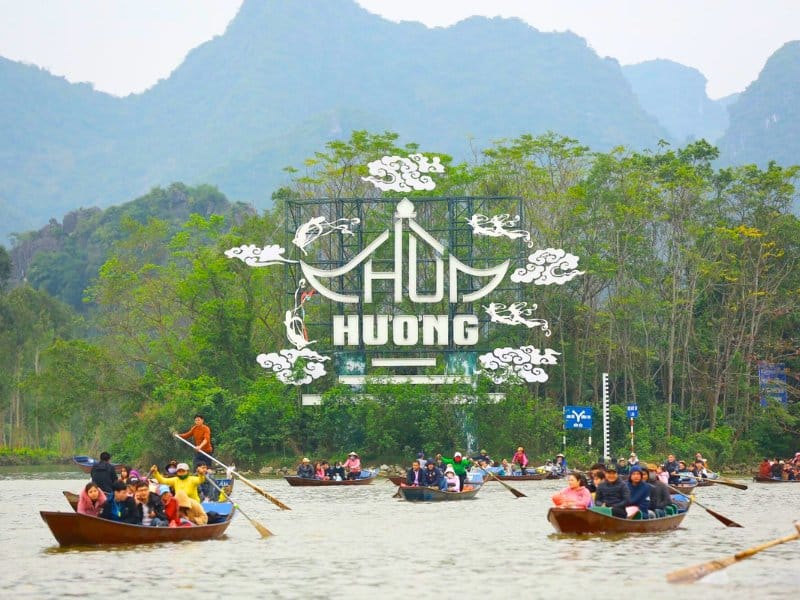
Perfume Pagoda
Access to the pagoda is in itself a true journey. From the landing, visitors board small boats that glide gently on the river, flanked by karst mountains and lush forests, offering an enchanting panorama. After the crossing, a winding path, dotted with secondary temples, leads to the Huong Tich cave, the heart of the sanctuary and main pagoda. Its monumental entrance bears the inscription Nam Thien De Nhat Dong, the most beautiful cave in the Southern Heaven.
Inside, stalactites and stalagmites are revered for their symbolic forms associated with fertility, prosperity, or longevity. The atmosphere, laden with incense and prayers, creates a profound sense of contemplation. The Perfume Pagoda is not only a place of worship, but also a true natural sanctuary where spirituality and the beauty of the landscape merge into a single experience.
Hanoi, with its thousand years of history and timeless charm, reveals at every corner a unique facet of its identity. From the quiet of Hoan Kiem Lake to the bustle of the Old Quarter, passing through temples, pagodas, and museums, the Vietnamese capital knows how to move, surprise, and captivate. Hanoi’s must-see sites, whether historical, spiritual, or simply picturesque, represent only a taste of the city’s cultural and heritage richness. Walking through its alleyways, tasting its street food, or exchanging a few words with its residents, you will discover that Hanoi’s true treasure lies in its authentic atmosphere and way of life. Whatever the length of your stay, Hanoi will surely leave you with an unforgettable memory, made of poetry, spirituality, and life.


Our recommended itineraries
 Nature and Active travel
Northern Vietnam Explorer in 9 days and 8 nights
About ten days
Hanoi - Ha Long Bay - Saigon - Mekong Delta - Siem Reap - Luang Prabang - Pak Ou Caves - Kuang Si Waterfall
 Classic
Vietnam Exclusive in 13 Days
About 2 weeks
Hanoi - Bai Tu Long - Hue - Da Nang - Hoi An - Saigon - Mekong Delta