+84 9 75 46 33 10 (Whatsapp)
  info@horizon-vietnamtravel.com
  Français
  Español
  Português
  Deutsch

Tran Quoc Pagoda: Eternal Story of a Sacred Place in Hanoi
Table of contents
In the hustle and bustle of the Vietnamese capital, the pagoda of Tran Quoc stands silently on the tranquil waters of the Western Bay, offering a spiritual pause and an immersion into the country’s history. With over 1,500 years of existence, this pagoda embodies the wisdom and religious traditions of Vietnam. Its elegant architecture, venerated statues, and serene atmosphere make it a sacred place and an unmissable cultural treasure, to be discovered by anyone wishing to explore the richness of Vietnamese history and spirituality.
General Presentation of Tran Quoc Pagoda
-
Address: 46 Thanh Nien Street, Yen Phu, Tay Ho, Hanoi
-
Opening Hours: daily, from 7:30 to 11:30 and from 1:30 PM to 6:00 PM
-
Admission: free (donations accepted)

The pagoda is located on a peaceful islet in the Western Lake (Ho Tay), connected to the shore by a dike lined with trees.
Tran Quoc Pagoda is recognized as the oldest in Hanoi and ranks among Vietnam’s most emblematic religious sites. Located on a serene islet in the Western Lake, it is connected to the mainland by a dike flanked by palms, creating a harmonious and relaxing natural setting. Viewed from the shore, the pagoda seems to float on the water, immersed in a landscape of great serenity.
Thanks to its historical heritage, traditional Vietnamese architecture, and unique natural environment, Tran Quoc Pagoda is today one of Hanoi’s most visited tourist attractions. It attracts both the faithful, who come to meditate, pray, or make offerings, as well as visitors seeking calm, spirituality, and beauty.

Tran Quoc Pagoda is an unmissable destination for visitors from around the world.
The international fame of Tran Quoc Pagoda has been consolidated in recent years through several prestigious media recognitions:
- 2016: the Daily Mail includes it among the 16 most beautiful pagodas in the world.
- 2017: Wanderlust ranks it 3rd among the pagodas most in harmony with nature.
- 2019: National Geographic includes it in the list of Buddhist pagodas with the most extraordinary architecture, calling it an unmissable spiritual destination.
These recognitions confirm the status of Tran Quoc Pagoda as an important cultural, architectural, and religious symbol of Vietnam, strengthening its appeal to travelers from around the world.
History of Tran Quoc Pagoda
Tran Quoc Pagoda is considered the oldest in Hanoi, with a history dating back to the 6th century, during the reign of Emperor Lý Nam Đế (544–548). Originally bearing the name Khai Quốc (“Foundation of the Nation”), it was located on the banks of the Red River, in the village of Yên Hòa, which corresponds today to the Yen Phu district.
In 1615, due to river bank erosion, the pagoda was moved to the Kim Ngư islet (“Golden Fish”) in the Western Lake (Ho Tay), a tranquil place where it still stands today, connected to the mainland by an elegant dike lined with palms. This site was once the seat of the Thúy Hoa Palace (Lý Dynasty) and the Hàn Nguyên Temple (Trần Dynasty), contributing to the extraordinary historical richness of the place.

Tran Quoc Pagoda of Old
Over the centuries, the pagoda was renamed and restructured several times:
- In 1440, King Lê Thái Tông gave it the name An Quốc, which means “Peace for the Nation,” as a wish for prosperity for the country.
- In 1639, under Lord Trịnh Tráng, major work was undertaken: addition of the Tam Quan gate, lateral galleries, and imposing architectural elements.
- At the end of the 17th century, under the reign of King Lê Hy Tông, it took on its current name Trấn Quốc (“Defense of the Country”), a symbol of its spiritual vocation to protect the territory and its central role in the religious life of Vietnamese people.
Despite the vicissitudes of history, the name Trấn Quốc has remained etched in collective memory. The pagoda is not merely an architectural remnant, but a living place of contemplation, a landmark of Mahāyāna Buddhism in Vietnam. It attracts both the faithful seeking spirituality and visitors curious to discover the deep soul of Hanoi.
On the occasion of major religious festivals such as Tết Nguyên Đán (Lunar New Year) or Vesak (Buddha’s birth and enlightenment), the pagoda comes alive with prayers, offerings, and wishes, in a sacred atmosphere filled with solemnity and hope. Visiting Tran Quoc Pagoda means not only retracing the thousand-year history of the capital, but also living a moment of peace and beauty in an exceptional natural setting.
Architecture of Tran Quoc Pagoda
Recognized as one of the most beautiful pagodas in the world, Trấn Quốc is not only a place of spiritual worship, but also an architectural masterpiece bearing extraordinary cultural richness. Despite having undergone numerous restorations over the centuries, the pagoda faithfully preserves the structural and stylistic principles of traditional Buddhist architecture.
A structure in the shape of the character “Công” (工)
Viewed from above, Tran Quoc Pagoda presents a characteristic arrangement in the shape of the Chinese character “Công” (工). This harmonious organization is composed of three main buildings:
- The Tiên Đuong (entrance pavilion),
- The Nha Thiêu Huong (incense hall),
- The Thuong Điên (main sanctuary).
These spaces, arranged with care, form a balanced, solemn, and serene ensemble, conducive to meditation. The other elements of the complex, such as galleries, the bell tower, the ancestor house, and the stupa garden, complete this sacred composition harmoniously.
The 11-Story Tower (Bao Thap)
Among the most notable architectural elements of Tran Quoc Pagoda is the majestic 11-story tower, known as Bao Thap Luc Do Dai Sen. Constructed between 1998 and 2003 in the stupa garden, this slender 15-meter-high structure stands as a symbol of serenity, spiritual elevation, and architectural harmony.
Each level of the tower features six arched openings, carefully aligned, which house within them statues of Amitabha Buddha carved from precious white stone. In total, 66 statues adorn the tower, each one radiating an atmosphere of peace, meditation, and compassion. These representations evoke the Buddha’s teachings and the path toward enlightenment, inviting visitors to contemplation.

66 Buddha statues are located inside the tower of Tran Quoc Pagoda.
Atop the tower stands the Cuu Pham Lien Hoa – a nine-level sacred lotus, also carved from stone. This lotus, which shines under natural light, symbolizes the nine levels of purity in Buddhism and embodies the quest for enlightenment and spiritual liberation. Its presence gives the whole a mystical and poetic dimension, in perfect harmony with the calm waters of the Western Lake. Designed with care to integrate harmoniously into the sacred landscape of the pagoda, the Bao Thap tower represents an architectural and symbolic vision of great depth: a link between earth and sky, matter and spirit, tradition and transcendence.
The Sacred Bodhi Tree (Tree of Wisdom)
Facing the Bao Thap tower stands a bodhi tree (ficus religiosa) of immense spiritual value. It is a sapling of the sacred fig tree of Bodh Gaya in India, under which the Buddha achieved Enlightenment. This precious tree was donated to Tran Quoc Pagoda in 1959 by Indian President Rajendra Prasad, during an official visit.

The bodhi tree of Tran Quoc Pagoda, from Bodh Gaya, symbolizes the wisdom and compassion of the Buddha.
For over sixty years, this fig tree has grown lush, casting its tranquil shade over a corner of the sanctuary. It embodies the fundamental values of Buddhism: wisdom, compassion, and spiritual awakening. Each year, numerous faithful and visitors come there to meditate, express their wishes, or simply perceive the serenity it emanates.
The Halls of Worship and Artistic Treasures
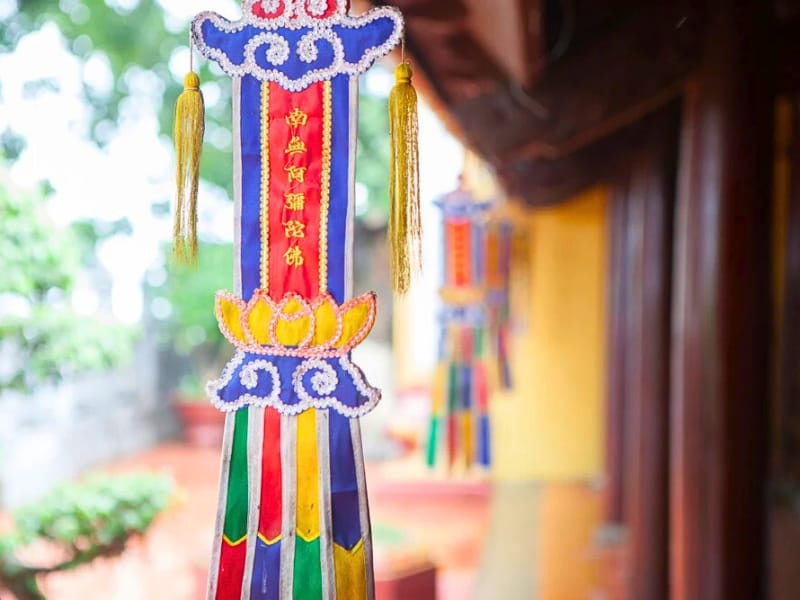
The Tiên Đường (entrance pavilion), facing west, is the first building encountered when visiting the pagoda. It houses several precious statues, including an extraordinary representation of Buddha Shakyamuni at the moment of his entry into Nirvana, carved from wood, lacquered, and gilded with gold leaf. This work is considered one of the most beautiful Nirvana statues in Vietnam.

The Thuong Dien is the main place of worship of Tran Quoc Pagoda.
The Thuong Dien, main sanctuary, is a traditional wooden structure topped by a roof of red tiles in the shape of fish scales, which gives the whole an ancient and authentic charm. On the back, a three-span pavilion houses a ceremonial bell.
On the sides: on the right is the temple of ancestors, and on the left the house of steles. Here are preserved 14 ancient steles carved with poems, tributes, and prayers written by scholars and high dignitaries of the time. These steles are precious testimonies of Vietnam’s intellectual and spiritual memory, and make Trân Quốc not only a place of worship but also a center for cultural transmission.
Practical Tips for Visiting Tran Quoc Pagoda
A sacred and living place, Tran Quoc Pagoda is at once a historical monument and a space of active contemplation. To respect the spirituality of the place and experience a serene and enriching visit, here are some simple gestures to adopt:
- Dress respectfully: cover shoulders and knees.
- Remove your shoes before entering worship buildings.
- Speak in a low voice and respect the silence of the faithful in prayer.
- Avoid laughing or making phone calls inside the pavilions.
- Do not touch statues or sacred objects.
- Ask permission before taking photos in interior spaces.
- Disable the flash if photographing outdoors.
- Do not eat, drink, or smoke inside the site.
- Choose quiet times, early morning or late afternoon, for a peaceful visit.
- Observe the gestures of locals to adapt to the place with respect and discretion.
Main Attractions Near Tran Quoc Pagoda
Located on the tranquil shores of the Western Lake, Tran Quoc Pagoda is not just a spiritual stop. Its surroundings offer a range of sweet, cultural, and deeply local experiences. Here are some ideas for extending your visit in the same spirit of calm and contemplation.
Quan Thanh Temple
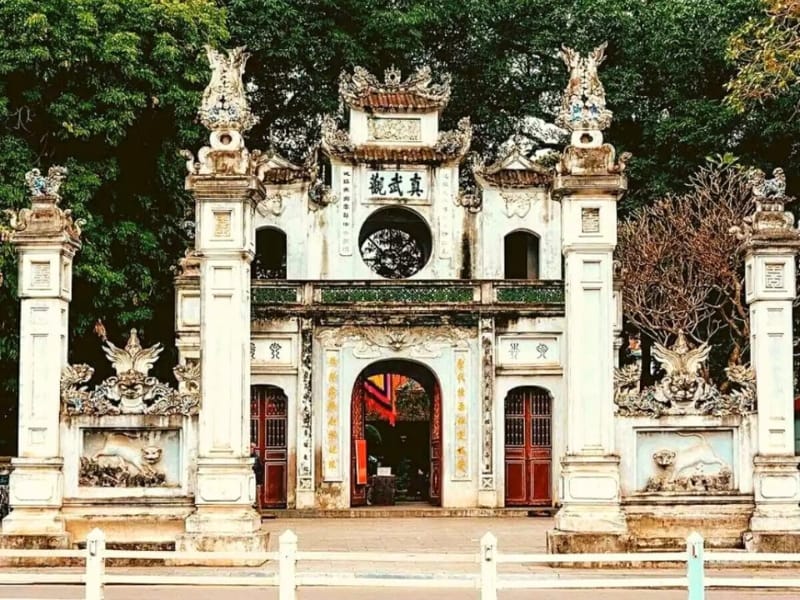
Quan Thanh Temple
Located just steps from the pagoda, this 11th-century Taoist temple is dedicated to the genius Tran Vu, protector of the North. It is part of the “Four Guardian Temples” of ancient Thăng Long. Its monumental black bronze statue is impressive and offers a complementary spiritual atmosphere to that of Tran Quoc.
Ho Chi Minh Mausoleum and Presidential Palace

Ho Chi Minh Mausoleum
About 1.3 km from Tran Quoc, the mausoleum houses the embalmed remains of Vietnamese leader Ho Chi Minh. Nearby is the Presidential Palace, built between 1900 and 1906, which was the residence of the Governor General of Indochina. Although the interior is not open to the public, the gardens can be visited.
Single Pillar Pagoda (Chùa Một Cột)
Located about 1.4 km from Tran Quoc, this iconic pagoda is built on a single stone pillar, symbolizing a lotus flower emerging from water. It was erected in 1049 by Emperor Lý Thái Tông in gratitude for the birth of his son.
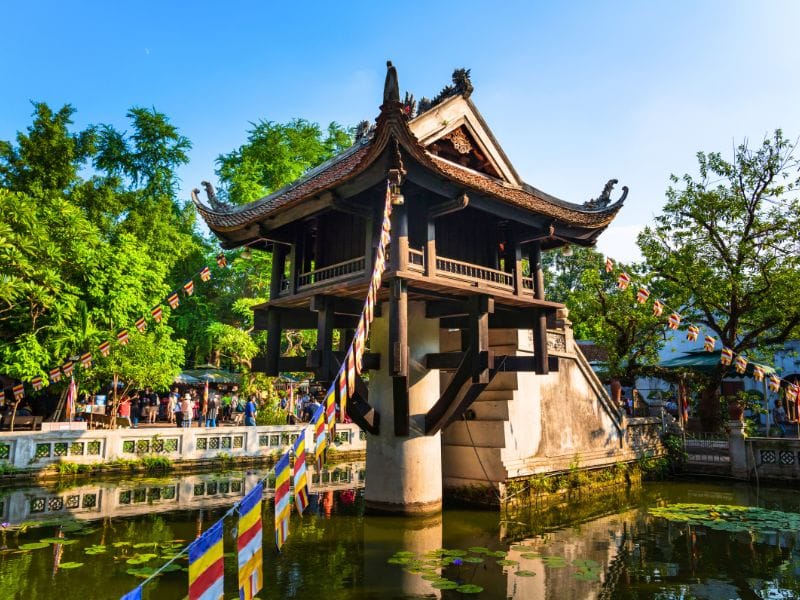
Single Pillar Pagoda
Temple of Literature – Quôc Tu Giam
About 15 minutes by car from Tran Quoc Pagoda, the Temple of Literature – Quôc Tu Giam is considered the first university in Vietnam. Dedicated to Confucius and scholars, this emblematic place embodies the educational tradition and erudite spirit of the country. With its internal courtyards, steles of doctors inscribed with the names of scholars, and its tranquil gardens, it offers a harmonious cultural break, ideal for extending your visit to Tran Quoc in a spirit of discovery and reflection.

Temple of Literature
Tran Quoc Pagoda is a place where spirituality, history, and serenity meet. Nestled on the shores of the Western Lake, it traverses time with tranquil grace, bearing within it the living memory of Hanoi. Its stupas, its sacred fig tree, and its silent atmosphere offer every visitor a moment of pause, favorable to introspection. Exploring Tran Quoc means discovering authentic heritage, harmonious architecture, and an essential part of Vietnamese culture. In the light of morning or at dusk, the place emanates a reassuring presence that leaves a subtle but lasting impression.



Our recommended itineraries
 Nature and Active travel
Northern Vietnam Explorer in 9 days and 8 nights
About ten days
Hanoi - Ha Long Bay - Saigon - Mekong Delta - Siem Reap - Luang Prabang - Pak Ou Caves - Kuang Si Waterfall
 Classic
Vietnam Exclusive in 13 Days
About 2 weeks
Hanoi - Bai Tu Long - Hue - Da Nang - Hoi An - Saigon - Mekong Delta