+84 9 75 46 33 10 (Whatsapp)
  info@horizon-vietnamtravel.com
  Français
  Español
  Português
  Deutsch

Tu Duc Tomb: Elegance, Poetry, and Imperial History in Hue
Table of contents
About the royal tomb
The Tu Duc tomb (Khiem Lang in Vietnamese) is undoubtedly the most representative monument of Nguyen Dynasty architecture, and one of the most elegant funerary complexes of the 19th century.
Even before the emperor’s death, this place served as a secondary residence, a true palace of retreat where Tu Duc loved to come to meditate, compose poetry, and contemplate nature.
Emperor Tu Duc (Nguyen Phuc Hong Nham, 1829-1883), the fourth sovereign of the Nguyen Dynasty, reigned from 1847 to 1883 — that is, the longest reign of the dynasty.
A cultured, romantic, and melancholy emperor, he had this tomb built both to prepare for his own death and to have a peaceful place to regenerate himself away from the affairs of the kingdom.
The site is located in a narrow valley of the village of Duong Xuan Thuong, about 6 km from the center of Hue, on the edge of a pine-covered hill.

Who was Emperor Tu Duc?
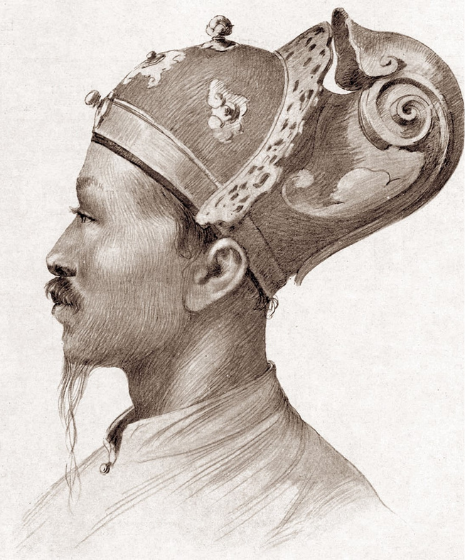
Tu Duc was an educated man, poet, and deeply connected to Vietnamese culture. He wrote hundreds of poems about nature, time, solitude, and the human condition. But his reign was also marked by numerous difficulties:
- peasant revolts,
- internal court tensions,
- and especially French colonial pressure, which would soon disrupt the country.
Tu Duc had no heirs. His personal life was marked by sadness and fragility. Perhaps this is why he decided to build in his lifetime a peaceful place to meditate, rest… and prepare for his final resting place.
History and construction of the tomb
Work began in 1864 and mobilized up to 50,000 workers and soldiers. At the time, the project was called Van Nien Co (« Ten Thousand Years »), a symbolic expression that represented eternity.
But behind this magnificence lay immense work: workers labored day and night, under very harsh discipline, with little food and miserable living conditions.
A popular complaint from that era expressed the people’s anger:
« How can Ten Thousand Years live?
The walls are made of bones, the moats dug in the blood of men. »
In 1866, exasperation led to a celebrated revolt known as the “Lime Pestle Rebellion” (Loan Chay Voi). The rebelling workers attempted to attack the imperial citadel, but the uprising was suppressed in blood.
Deeply affected by this episode, the emperor decided to rename the site Khiem Cung (« Palace of Modesty »), a symbol of humility and repentance.
Work was completed in 1873, nine years before the emperor’s death. Upon his death, the palace officially became Khiem Lang — « the Tomb of Modesty ».
Scale and architectural organization
The Tu Duc tomb extends over more than 120,000 m², or ten times the size of Gia Long’s tomb, the dynasty’s founder.
The entire complex is designed as a vast landscaped park that unites ponds, hills, pavilions, and temples, in an harmony inspired by the philosophy of yin-yang and feng shui.
It comprises approximately 50 monuments, all of whose names contain the word Khiem (« modesty »), in reference to the emperor’s spiritual vow.
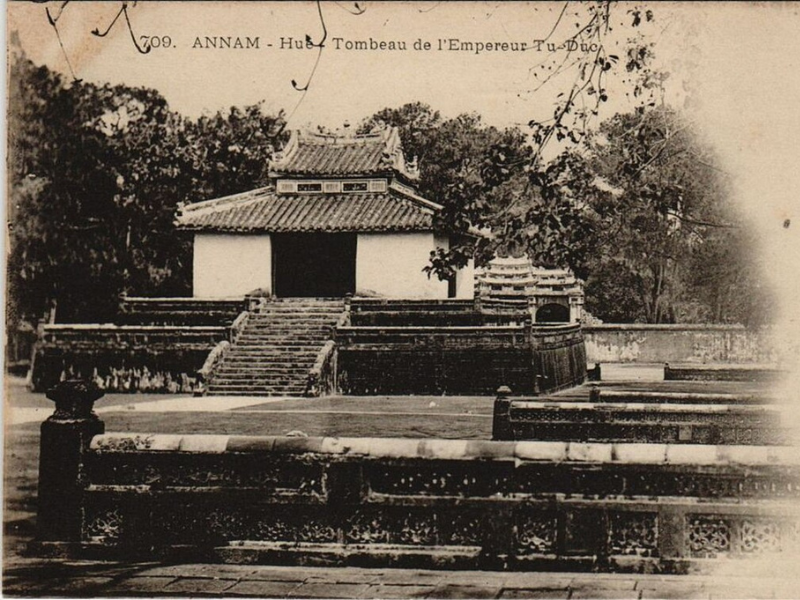
The residential area
This part once served as a recreation palace for Tu Duc and his concubines.
-
Vu Khiem Gate: main entrance leading to the funerary complex.
-
Chi Khiem Shrine: dedicated to the emperor’s wives and concubines.
-
Luu Khiem Lake: an ancient stream expanded into a vast basin that symbolizes purity and harmony of the Five Elements. Lotus were cultivated and fish were raised there.
-
Tinh Khiem Island: a small island in the center of the lake, an ancient imperial garden that housed rare flowers and animals.
-
Xung Khiem and Du Khiem pavilions: where the emperor wrote his poems and contemplated the landscape.
-
Tan Khiem, Tien Khiem, and Do Khiem bridges: which connect the residential area to the pine-covered hill.
-
Khiem Cung Mon Gate: a majestic two-story gate that provides access to the main palace.
-
Hoa Khiem Palace: the emperor’s former office, today transformed into a shrine dedicated to Tu Duc and his queen.
-
Phap Khiem Vu and Le Khiem Vu: accommodations for mandarins in charge of imperial affairs.
-
Luong Khiem Palace: Tu Duc’s personal residence, then a shrine dedicated to his mother, Empress Tu Du.
-
On Khiem House: warehouse for imperial items.
-
Minh Khiem Theater: considered one of the oldest theaters in Vietnam, where the emperor watched music and dance performances.
-
Tri Khiem and Y Khiem Rooms: apartments of the imperial concubines.
-
Tung Khiem and Dung Khiem Gardens: walking spaces planted with pines and tropical flowers.
The tomb area
Located in the rear part of the complex, it brings together the most solemn elements.
Behind the court of honor and the two rows of statues of mandarins, horses, and elephants, stands the stele pavilion (Bi Dinh).
On the 20-ton stele is inscribed a text written by the emperor himself, entitled “Khiem Cung Ky” (Memory of the Palace of Modesty).
Consisting of 4,953 Chinese characters, this text of great sincerity is an autobiography of Tu Duc, which evokes his life, his suffering, his fragile health, the absence of heirs, his regrets, and his merits.
It is an exceptional historical document, unique among Vietnamese imperial tombs.
The exact location of the burial remains unknown to this day. According to legend, the 200 servants who buried the emperor’s body were executed to keep the secret of the location of his remains.
Meaning and legacy
The Tu Duc tomb perfectly illustrates the harmony between nature and architecture, an aesthetic ideal of Vietnamese culture.
It is at the same time a reflection of the emperor’s refined and melancholy personality, and a poetic work of art, where water, stone, and trees dialogue in a reassuring balance.
Today, Khiem Lang is part of the Complex of Hue Monuments, classified as UNESCO World Heritage since 1993.
The site, notably well preserved, attracts thousands of visitors each year who come to admire its architecture, its tranquil gardens, and its atmosphere steeped in imperial nostalgia.
Practical Information
- Location: Duong Xuan Thuong village, Hue (about 5 km from the center)
- Hours: 7:30 a.m. – 5:00 p.m. every day
- Admission (2025): 150,000 VND (~5.50 EUR)
- Visit duration: 1.5 to 2 hours
- Access: taxi, motorbike, or guided tour from Hue
Horizon Vietnam Travel tip: Visit the Tu Duc tomb in the morning or late afternoon to avoid the heat and enjoy soft light on the pavilions and lake.
A visit between history and emotion
The Tu Duc tomb is not just an imperial monument: it is a reflection of the Vietnamese soul, between beauty, wisdom, and melancholy. Every stone, every tree seems to tell the story of an emperor poet, aware of the fragility of power and time. By visiting this place, you immerse yourself in a living page of Vietnam’s history, in the heart of an absolutely serene setting.




Our recommended itineraries
 Nature and Active travel
Northern Vietnam Explorer in 9 days and 8 nights
About ten days
Hanoi - Ha Long Bay - Saigon - Mekong Delta - Siem Reap - Luang Prabang - Pak Ou Caves - Kuang Si Waterfall
 Classic
Vietnam Exclusive in 13 Days
About 2 weeks
Hanoi - Bai Tu Long - Hue - Da Nang - Hoi An - Saigon - Mekong Delta