+84 9 75 46 33 10 (Whatsapp)
  info@horizon-vietnamtravel.com
  Français
  Español
  Português
  Deutsch

Time zones and time differences in Vietnam
Table of contents
Questions related to time in Vietnam – and more generally in Indochina – are particularly important for foreign travelers, especially those from Europe or North America, whose points of reference are very far from those of Southeast Asia. Beyond the distance, Vietnam’s time zone can disturb your first days on the ground, especially if you haven’t paid attention to it before departure. To this we must add differences in the rhythm of life and local habits regarding schedules – store openings, bank operations, meal times, rest periods – which can surprise and sometimes disorient visitors who are unprepared. These elements, though they may seem secondary, play an essential role in the smooth running of a trip. Understanding Vietnam’s time zone, anticipating the effects of jet lag, and adapting to local rhythms will allow you to face your stay more calmly, smoothly, and pleasantly. As a Vietnamese proverb says: “Health is worth gold.” It is also an invitation to listen to your body, to slow down, and to savor every moment in a country where daily life still has a sweetness and rhythm all its own.
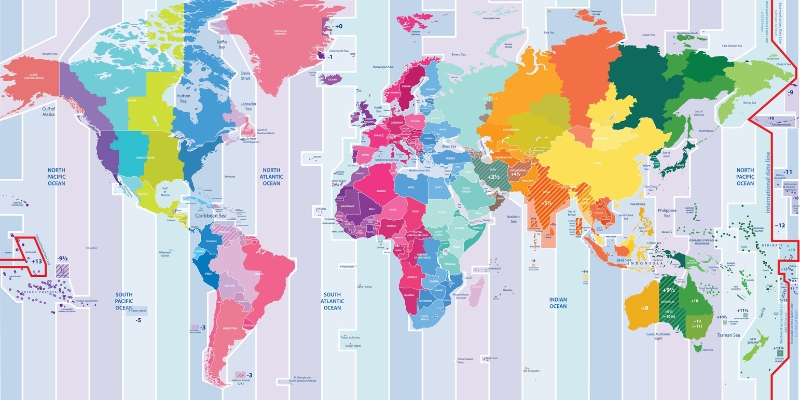
Map of time zones in the world
What is Vietnam’s time zone?
Vietnam is in the GMT+7 time zone (UTC+7), which is 7 hours ahead of Coordinated Universal Time (UTC). This means, for example, that when it’s noon in Paris (winter time), it’s already 6 PM in Hanoi or Ho Chi Minh City. This time zone is the same throughout the country, from north to south, with no regional variations. Unlike some Western countries, Vietnam does not adopt daylight saving time: the time therefore remains the same throughout the year.
Time difference with Europe:

-
In winter (from late October to late March), Vietnam is 6 hours ahead of France, Belgium, or Switzerland (e.g.: 8 in Paris = 14 in Vietnam).
-
In summer (from April to October), due to the switch to daylight saving time in Europe, the difference reduces to 5 hours.
Time difference with Canada:
Vietnam also has a significant time difference with Canada, particularly with eastern provinces such as Quebec, where the cities of Montreal and Quebec are located.
- In winter (Eastern Standard Time – EST), Vietnam is 12 hours ahead of Montreal and Quebec.
Example: When it’s 8 AM in Montreal, it’s already 8 PM in Vietnam.
- In summer (Eastern Daylight Time – EDT), the difference reduces to 11 hours.
Example: When it’s 8 AM in Quebec, it’s 7 PM in Vietnam.
To know: Remember to adjust your electronic devices and call schedules if you want to contact your loved ones or plan a video call with Europe. If you’re coming from a very different time zone, it may also be helpful to plan some time to adjust to jet lag in your first few days.
Jet lag: How to adapt?
When you travel to Vietnam from Europe or Canada, you suddenly move your clock forward several hours (+5 to +12 hours depending on the country and season). This change can disturb your body clock: this is what we call jet lag. Fortunately, there are simple steps you can take to limit it and quickly regain your rhythm:

Time difference How to adapt
Prepare your body before departure
A few days before your flight, start gently adapting your daily rhythm to Vietnam’s time.
- Gradually shift your bedtime and wake-up time by 30-60 minutes per day. This will help your body clock adapt gradually.
- Also adjust your meal times: eating dinner earlier, for example, helps sync digestion with your future time zone.
This simple preparation can significantly reduce jet lag effects once you arrive.
Expose yourself to natural light
Daylight is your best ally in recalibrating your body clock. From the moment you arrive in Vietnam, try to spend time outdoors, even if you feel tired.
- Take a walk early in the morning; this naturally stimulates energy and helps your body understand that a new day has begun.
- Avoid staying locked in your room or in places that are too dark, especially in the first 24 hours.
The more you expose yourself to natural light early in the day, the more you’ll help your body align quickly with the new time zone.
Stay well hydrated
Air travel, especially long-haul, quickly dries out your body due to the dry, pressurized cabin air. Dehydration intensifies fatigue and jet lag effects.
- Drink water regularly during the flight, even if you’re not thirsty.
- Avoid alcohol, coffee, or soft drinks, which tend to dehydrate further.
- A water bottle within reach and frequent small sips are better than a large glass every 4 hours.
Upon arrival in Vietnam, continue to stay well hydrated to help your body regain its balance more quickly.
Avoid sleeping too much during the day
Upon arrival, fatigue can be intense, especially after a long flight and many hours of time zone difference. But resisting the temptation to sleep too early or too long during the day is essential to readjust your rhythm.
- Try to stay awake until evening, even if you feel exhausted. This will allow your body to align with local time.
- If drowsiness is too strong, allow yourself a short, refreshing nap, but limit it to 20 or 30 minutes maximum to avoid disturbing your night.
Quickly adopting a day/night cycle in sync with Vietnam will help you recover more effectively.
Be kind to yourself
In your first few days on the ground, there’s no need to rush from one site to another. Your body needs time to find its new rhythm.
- Favor gentle and relaxing activities: a walk through a local market, a quiet visit to a temple, or simply a moment of relaxation on a terrace.
- Eat lightly, rest when you need to, and don’t impose a schedule that’s too heavy from the moment you arrive.
Traveling also means listening to your body and slowing down. By giving it time to adapt, you’ll be able to fully enjoy every moment.
Vietnam’s time zone is one of the small challenges to anticipate when preparing to discover this fascinating country. Traveling to Vietnam means entering a new world… and a new time zone. With a difference of +5 to +6 hours from Europe, and up to +12 hours with Canada, it’s completely normal for your body to need time to adjust. Fortunately, by slightly adjusting your habits before departure – sleep schedules, meals, light exposure – and adopting a gentle pace upon arrival, you can ease the effects of jet lag. Good preparation for Vietnam’s time zone will allow you to fully enjoy your stay from the first hours, without missing any of the wonders the country has to offer. Ready to plan your adventure? Discover our tailor-made itineraries and experience an unforgettable experience, at a Vietnamese pace.