+84 9 75 46 33 10 (Whatsapp)
  info@horizon-vietnamtravel.com
  Français
  Español
  Português
  Deutsch

Tipping in Vietnam: Should You Leave It, and How Much?
Table of contents
When preparing a trip to Vietnam, the question of tipping in Vietnam often comes up. Is it a common practice? Should you budget for it? Who to tip, how much, and when? As a local agency, we know this topic can raise questions and even some discomfort. There is no universal rule, but a few simple reference points can help you act wisely, based on your experience, your feelings, and your desire to thank those who make your stay more pleasant.
Is Tipping in Vietnam Mandatory?
No, tipping is in no way an obligation in Vietnam. It is not included in the price of your trip and does not constitute either a due or a salary supplement. Unlike some destinations where tipping is almost systematic, here it remains entirely voluntary.
It is first and foremost a gesture of appreciation, to be made if you have been satisfied with the service received. Did you have an attentive guide, passionate about their work? A punctual driver, careful, always smiling? A helpful porter or a friendly boatman?

Then, leaving them a tip is a simple way to thank them, to show that you appreciated their guidance. Even modest, this gesture is always well received and can represent real encouragement for these often discreet but essential professionals for the smooth running of your trip. Keep in mind that nothing is obligatory, but that a spontaneous thank you, given sincerely, always has value.
Who to Tip in Vietnam… and How Much?
Although tipping remains a free gesture, it is always reassuring to have some reference points to know what is commonly done in Vietnam. Here are some suggestions based on local practice, feedback from travelers, and recommendations from reference guides such as Le Routard Guide.
The Local Guide

Our travelers accompanied with care and kindness throughout their discovery of Vietnam
A true pillar of your trip, the local guide is much more than a simple guide. They share with you their culture, their history, their personal anecdotes. They translate, organize, adapt to your needs, and help you better understand the country in daily life. If you had a good feeling, an attentive and passionate guide, a tip is a simple and human way to thank them for their commitment.
👉 Recommended Amount: 5 EUR per day per person
The Driver

Often discreet but always present, the driver is the one who accompanies you on your trips, sometimes over long distances. They drive carefully, adapt to the group’s pace, and ensure the cleanliness and comfort of the vehicle. A small tip at the end of your stay is an appreciated gesture to recognize their reliability and punctuality.
👉 Recommended Amount: 2 to 3 EUR per day per traveler
The Porter (Hotel Bellhop)

Upon arrival or departure, the hotel porter helps you carry your suitcases to your room or vehicle. This service is quick but useful, especially in mid-range and upscale hotels. A small amount left at the time of service is well perceived and falls within international customs.
👉 Recommended Amount: 1 EUR (or 20,000 VND) per suitcase, for each service rendered
Sampan Rowers, Cyclo Drivers, or Tuk-Tuk Drivers

Sampan rower at Ninh Binh
Often from modest backgrounds, these workers perform demanding work, sometimes irregular or seasonal. They are sometimes members of cooperatives and must wait several days to get a ride. Moreover, they only receive a portion of the fees paid by travelers; the rest goes to the cooperative. A small tip can really make a difference in their daily life, while also recognizing their hospitality and effort.
👉 Recommended Amount: 10,000 to 50,000 VND (i.e., 0.4 to 2 EUR), depending on the duration or quality of the service
Restaurant or Hotel Staff

In most restaurants and hotels in Vietnam, service is included in the bill. It is therefore not necessary to leave a tip, unless a staff member has been particularly attentive or you wish to highlight exceptional service. In this case, a small note left discreetly is always well received.
👉 Recommended Amount: Optional, at your discretion (for example 10,000 to 20,000 VND, i.e., 0.4 to 0.8 EUR)
What Are the Most Commonly Used Banknotes in Vietnam?
In Vietnam, the official currency is the Vietnamese dong (VND). Banknotes are the only means of payment used in daily life, with coins having almost disappeared from circulation.
Among all available denominations (from 1,000 to 500,000 VND), here are the ones you will use most often:
- 20,000 and 50,000 VND: Perfect for small expenses, street purchases, or tips.
- 100,000 and 200,000 VND: Practical for meals, transportation, or tourist entries.
- 500,000 VND: Useful for major payments (hotel, store purchases), but sometimes refused for small transactions due to lack of change.
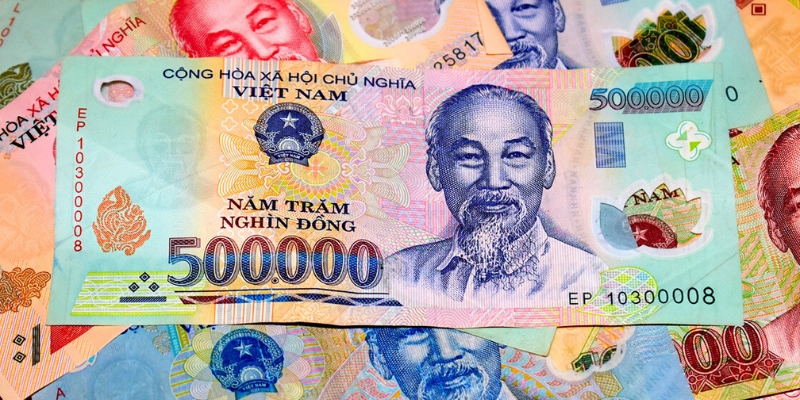
500,000 VND, approximately 20 EUR, is the largest denomination of Vietnamese currency.
Remember to always keep small banknotes with you, particularly for markets, taxis, or occasional services. It is also ideal for tips, which can be given in VND, in euros, or in dollars, although local currency is the simplest to use on site.
Tipping in Vietnam is neither an obligation nor a codified practice. It is not expected systematically, but it is often well received, particularly in the tourism sector, where many professionals perform demanding jobs with sometimes modest incomes. Giving a tip remains a personal gesture that depends entirely on your satisfaction, the quality of the service provided, and your desire to say thank you. It is neither a duty nor a social norm: you are free to give, or not, according to what you believe is right. In fact, even a small amount can be enough to express your gratitude, encourage a professional, and appreciate work well done. The essential thing is to act sincerely, without pressure, and in accordance with your conscience.