+84 9 75 46 33 10 (Whatsapp)
  info@horizon-vietnamtravel.com
  Français
  Español
  Português
  Deutsch

The Perfume River in Hué – Vietnam
Table of contents
Introduction
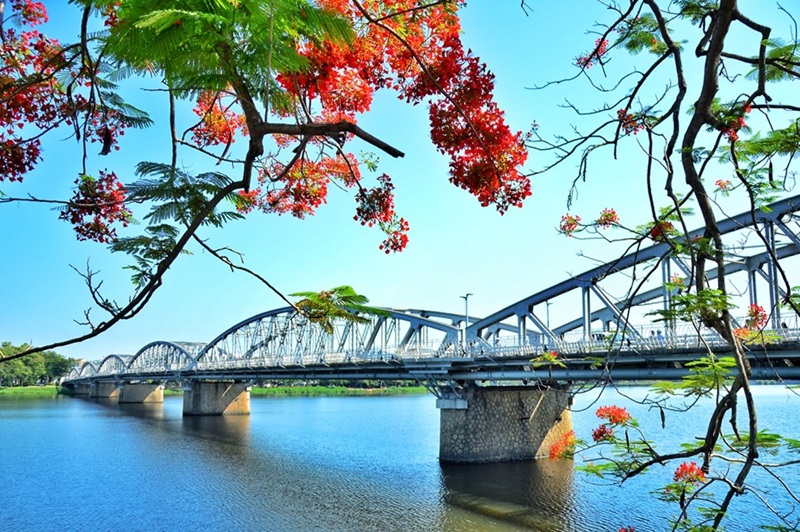
The Perfume River (or Sông Hương in Vietnamese) is an emblematic river of central Vietnam. Approximately 80 kilometers long, it flows through the imperial city of Hué and several districts of Thua Thien–Hue province before emptying into the sea at Thuan An. For all Vietnamese, it represents the soul and poetic symbol of Hué.
The river flows gently, with a water level relatively low compared to the sea. As it winds between hills and passes at the foot of Ngoc Tran Mountain, it takes on a bluish and mystical hue. This is where you’ll find the Hon Chen Temple, a sacred place rich in legend.
The Perfume River is particularly fascinating when admired at its source or as it slowly glides between mountains and tropical jungles before reaching the city. It envelops the villages in a sweet and melancholic atmosphere. On its banks, Hué’s monuments are reflected in the calm waters—a sight that stirs emotion and nostalgia in those sailing on its waters listening to Hué’s traditional songs.
In the middle of the river lies the Hen Dune, a picturesque island famous for its culinary specialty: “com hen” (rice with clams).
Origin and Characteristics
The river is born from the confluence of two tributaries: Ta Trach and Huu Trach, which meet at Bang Lang to form the main course.
Along these tributaries grow numerous fragrant herbs called Acorus. According to tradition, their flowers fell into the water and perfumed its course all the way to the city—hence the poetic name “Perfume River” would come.
A Source of Poetic Inspiration
For centuries, the Perfume River has inspired poets, writers, and musicians. In the love song by composer Pham Duy, it becomes a symbol of tenderness and nostalgia:
“I love the long rivers so much,
On the Perfume River, I feel love.”
(Song of Love, 1953)
Another composer, Pham Dinh Chuong, pays homage to it in his work Festival of the Ninth Day of the Ninth Lunar Month, where the river embodies the beauty of central Vietnam.
Legends of the Perfume River
The Legend of Incense
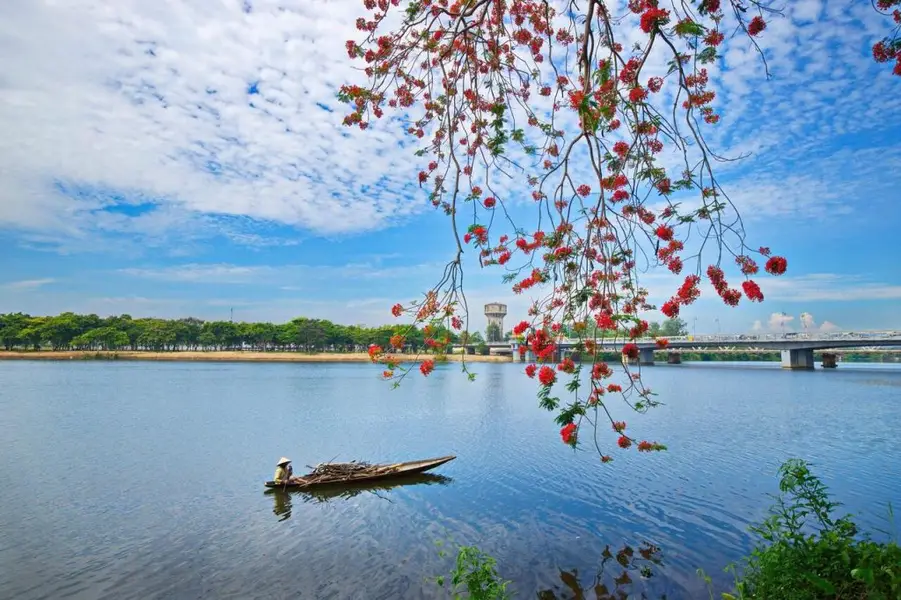
According to tradition, the First Lord Nguyen Hoang one day crossed the hill of Ha Khe, on the river’s banks. In a dream, a Celestial Lady appeared to him and gave him a stick of incense:
“Light this incense and walk along the river. Where the flame goes out, you will find the propitious land for your capital.”
Upon waking, the sovereign followed the goddess’s words and founded the city of Hué. He had the Pagoda of the Celestial Lady (Thien Mu) built on the Ha Khe hill and gave the river the name of Huong, which means at once “perfume” and “incense”.
The Princess Legend
Another version tells how a princess named Huyen Tran crossed the river to marry the King of Champa. With a broken heart, she wept so much that her tears perfumed the river’s water, thus giving it its poetic name.
The Legend of the Inhabitants
Hué’s storytellers also love to recall a popular myth:
“One day, the inhabitants of villages along the river boiled hundreds of flowers and poured that water into the river so that its perfume would last forever.”
A poetic legend, probably the most beautiful of all.
Cruise on the Perfume River
Thanks to its natural beauty and historical importance, the Perfume River is included in most excursions in Hué:
visiting the imperial citadel, the Thien Mu Pagoda, the Dong Ba Market, or the royal tombs of Khai Dinh and Minh Mang.
A cruise on a dragon-shaped boat at sunset is an unforgettable experience. The slow pace, romantic landscapes, Hué’s songs, and light mist on the banks create a unique atmosphere, between poetry and serenity.
The Perfume River is not just a waterway: it is the pulsing heart of Hué, witness to its history and guardian of its poetic soul. Its reflections, legends, and gentleness make it one of Vietnam’s most cherished symbols.
Navigating the Sông Hương means traveling through time, between spirituality, music, and natural beauty—an essential experience for those wishing to understand Vietnamese culture in its full emotional depth.



Our recommended itineraries
 Nature and Active travel
Northern Vietnam Explorer in 9 days and 8 nights
About ten days
Hanoi - Ha Long Bay - Saigon - Mekong Delta - Siem Reap - Luang Prabang - Pak Ou Caves - Kuang Si Waterfall
 Classic
Vietnam Exclusive in 13 Days
About 2 weeks
Hanoi - Bai Tu Long - Hue - Da Nang - Hoi An - Saigon - Mekong Delta