+84 9 75 46 33 10 (Whatsapp)
  info@horizon-vietnamtravel.com
  Français
  Español
  Português
  Deutsch

Confucianism in Vietnam
Table of contents
Confucianism (Nho giao) has deeply shaped the culture, education and social organization of Vietnam for over a millennium. Introduced from China through political and intellectual exchanges, it became the ideology of the State under various dynasties, carrier of an ideal: “tu than, te gia, tri quoc, binh thien ha” (cultivate yourself, order your family, govern the country, pacify the world). Around the values of Nhan, Le, Nghia, Tri, Tin and the Ngu luan (five relationships), the system of mandarinal exams, the Van Mieu – Quoc Tu Giam, the huong uoc (village conventions) and family ethics took shape. If the twentieth century saw the emergence of other currents, the Confucian imprint remains: respect for elders, hieu voi cha me (filial piety), valorization of study, sense of community responsibility. Exploring Confucianism in Vietnam means understanding the mechanisms of a society in which academic excellence, hiep hoa (harmony) and civic responsibility continue to dialogue with modernity.
Confucius and Confucianism
Founded on the teachings of Confucius (551–479 BC), Confucianism (Nho giao or Khong giao in Vietnamese) is not so much a religion as a political and social morality: it assigns to each person their own place, their own rights and their own duties within the family as in society, in order to ensure peace and order.
Master Kong (Kongzi) himself never drafted a systematic doctrine; it was his disciples who gathered his sayings in the Analects (Lunyu). Elevated to a State philosophy under the Chinese Han dynasty (206 BC – 220 AD), Confucianism entered Vietnam in the same period and deeply shaped the behaviors of Vietnamese society.
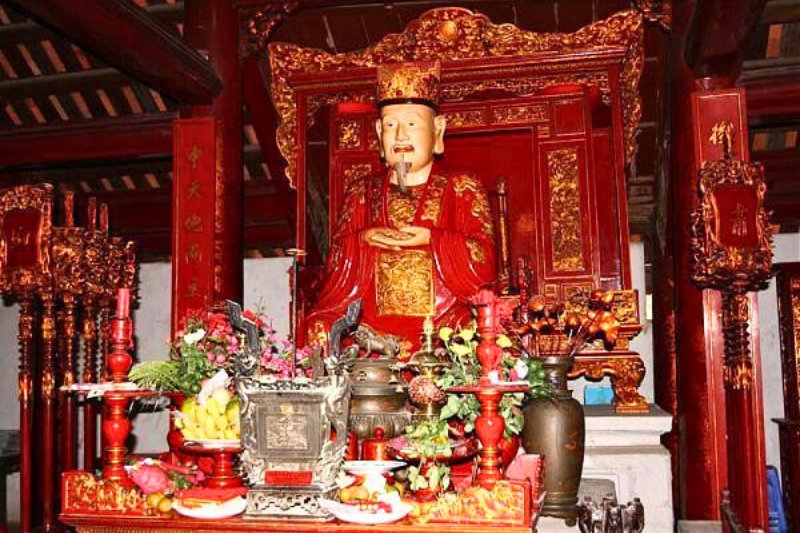
Altar of Confucianism at the Temple of Literature
The Principles of Confucianism
According to Confucius, the virtuous man must put into practice two complementary principles: ren (humanity, benevolence) and yi (justice, rectitude), and cultivate various moral qualities: filial piety (ensured by ancestor worship), respect for rites and rules of precedence, loyalty, faithfulness to one’s word, courage.
Confucius defines five relationships to which each person must conform to ensure social order and cohesion:
- father / son (the son must respect and obedience to the father);
- husband / wife (traditionally subordinate status of the wife in classical ethics);
- elder / young;
- friend / friend (relationship of reciprocity);
- prince / subject (analogy with father / son).
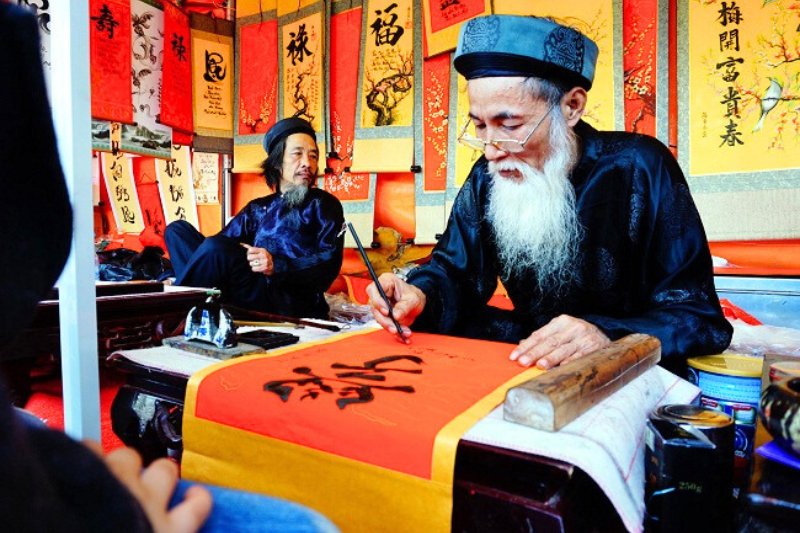
Writing in a Confucian center in Vietnam
Complex and precise rites seal this set of relationships. To be legitimate to govern, the prince must study the Five Classics and conform to them with benevolence toward his subjects:
- Book of Odes (Shijing)
- Book of Documents (Shujing)
- Book of Rites (Liji)
- Spring and Autumn Annals (Chunqiu)
- Book of Changes (Yijing)
The royal virtue is considered capable, by its mere irradiance, of harmonizing nature and society.
Confucianism in Vietnamese History
Confucianism places emphasis on education: each individual can study the Five Classics deeply. Knowledge is not the privilege of birth, but the fruit of merit and determination. After nearly a millennium of Chinese presence, the Ly instituted, in the eleventh century, the first mandarinal exams designed to train the empire’s officials.
These exams — in principle open to all, except for comedians and women — required mastery of the Five Classics, but also knowledge of Buddhist and Taoist principles.
In 1802, when the Nguyen dynasty reunified Vietnamese territory, Confucianism became the official doctrine of the empire. But, hardened into values considered immutable, it proved incapable of dealing with upheavals born from openness to the West.
Indeed, French colonization introduced exact sciences and the industrial revolution, which the immobility of the neo-Confucians of Huế received with suspicion. The extreme rigidity of part of the mandarin class that surrounded the last Nguyen emperors contributed, in part, to the fall of the dynasty.