+84 9 75 46 33 10 (Whatsapp)
  info@horizon-vietnamtravel.com
  Français
  Español
  Português
  Deutsch

The Vietnamese Conical Hat
Table of contents
The Non La, more commonly known as the Vietnamese conical hat, is one of the most recognizable symbols of Vietnam. Light, elegant, and entirely handmade, it has accompanied farmers, fishermen, women in ao dai, and travelers throughout the country for centuries.
More than just a simple accessory, the Non La has become a powerful cultural imprint. Its distinctive conical silhouette, visible in the streets, markets, and rice fields, represents both the simplicity of everyday life and the timeless beauty of Vietnamese tradition. This duality—utilitarian and aesthetic—makes the conical hat a true emblem of Vietnam.
History and Origins of the Conical Hat
The Vietnamese conical hat, known by the name Non La, possesses an ancient history deeply linked to Vietnamese culture. Its earliest traces appear on bronze drums of the Dong Son civilization, dating back more than 2,000 years ago. These archaeological objects display figures wearing conical hats, suggesting that the ancestor of the Nón Lá was already being worn at that time. While its precise form may have evolved, these representations demonstrate that this type of headwear has been used in Vietnam since antiquity.
Over the centuries, the Non La became an indispensable companion to daily life. Farmers used it to protect themselves from the tropical sun and sudden downpours. Light, breathable, and durable, it was perfectly suited to work in the rice fields, travel, and rural activities. It also found its place in Vietnamese aesthetics, particularly when worn with the ao dai, creating an elegant and emblematic image of the country.

Non La of the Past
Alongside these historical origins, Vietnam also transmits popular legends surrounding the conical hat. One of the most well-known tells the story of a benevolent giantess who protected villagers from the rain with an immense hat woven from leaves. Inspired by this gesture, the villagers then created their own version of the hat. These tales have no historical foundation, but they show how deeply the object is rooted in Vietnamese imagination and sensibility.

Ao Dai and Non La: Vietnamese elegance enhanced at the edge of a lotus pond.
Today, despite the country’s modernization, the Non La remains an essential symbol of identity. Still made by hand in various artisan villages, it represents the simplicity, gentleness, and elegance of Vietnam. A living heritage that crosses the centuries and continues to accompany daily life as much as cultural traditions.
Non La and Its Varieties
Although the Vietnamese conical hat is often recognized in a single form, there are actually several regional and functional variants. Each type has its own characteristics, uses, and distinctive style.
Traditional Non La

The traditional Nón Lá is the most emblematic and most common form of the Vietnamese conical hat. Light, simple, and particularly durable, it has always accompanied farmers, merchants, and fishermen in their daily lives. It is recognized by its distinctive conical silhouette, its meticulously overlapped leaves, and its bamboo structure that gives it both strength and flexibility. It is the essential model, the one that alone embodies the image of traditional Vietnam.
Non Bai Tho (Poetic Conical Hat)

The Non Bai Tho, or poetic hat, is one of the most refined variants of the Non La, emblematic of the city of Huế. Its particularity lies in the poems, motifs, or designs subtly inserted between two layers of leaves, which appear only when the hat is held up to the light. This delicate technique makes it a true work of art, where craftsmanship meets poetry, and perfectly reflects the gentle and timeless elegance characteristic of Huế.
Non Go Gang (Binh Dinh)
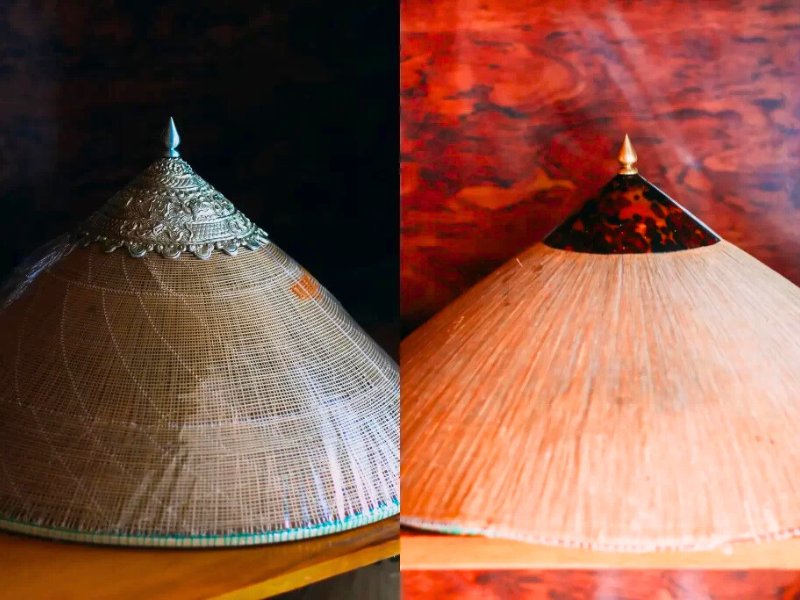
The Non Go Gang, originating from Binh Dinh province, stands out for its robustness and thickness, making it an ideal hat for long days of outdoor work. More solid than classic models, it is particularly valued for its durability and ability to protect effectively from the sun and bad weather.
Non Ba Tam
The Non Ba Tam, typical of Northern Vietnam, is recognized by its rounder, softer shape and slightly wider form. Often associated with the traditional image of Northern women, it stands out for its wide circumference and elegant, protective silhouette. This hat, an emblem of folk arts, frequently appears during festivals, traditional performances, and cultural representations.
Non Quai Thao
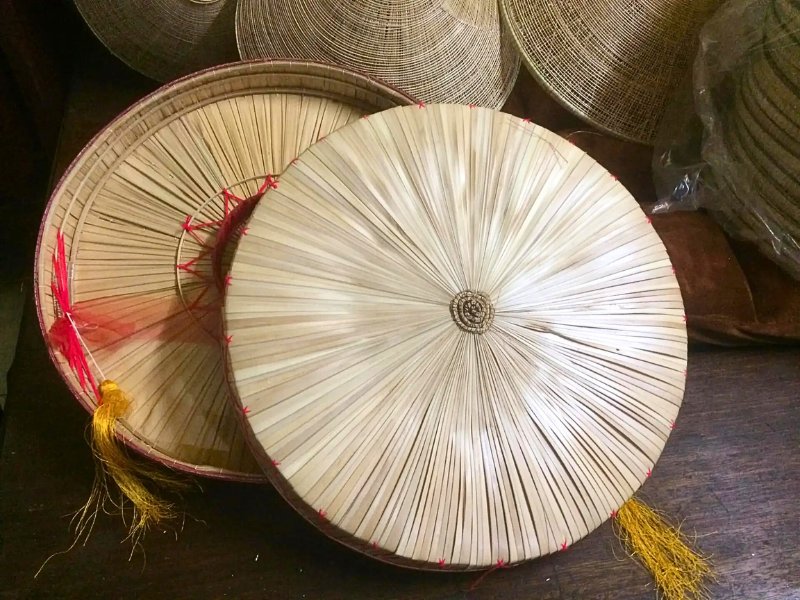
The Non Quai Thao, often called the flat Northern hat, is a wide, flattened model worn during ceremonies, celebrations, and folk dances. It stands out for its very wide brim, colorful decorations, and silk or velvet cords that add a touch of grace and refinement. A strong cultural symbol of Northern Vietnam, it is particularly associated with traditional artists and representations of Vietnamese heritage.
The Conical Hat Manufacturing Process
The manufacture of a conical hat is a meticulous traditional craft, passed down through generations in the artisan villages of Vietnam. Each Non La, though seemingly simple in appearance, requires extreme precision, patience, and unique expertise.
Below, we present the manufacturing process as it is carried out in the village of Chuông (Hanoi), one of the most renowned places for making the traditional conical hat.
Phase 1: Preparation of Materials

After harvesting and sorting leaves, the craftsman spreads them in the sun to dry
To make a nón lá, several natural materials and accessories are needed:
- the leaves (lá lụi),
- the bamboo rings (vòng nón),
- the mo nứa layer to be placed between the leaves,
- as well as various tools: needle, nylon thread (cước), colored thread, bamboo, guột to connect the rings, etc.
The leaves undergo numerous stages: soaking, cleaning, sun drying, dew drying, hot pressing, cutting into strips.

Leaves dried in the sun before hat manufacture
Everything must be carefully selected: beautiful, flexible leaves without tears; solid and well-dried bamboo.
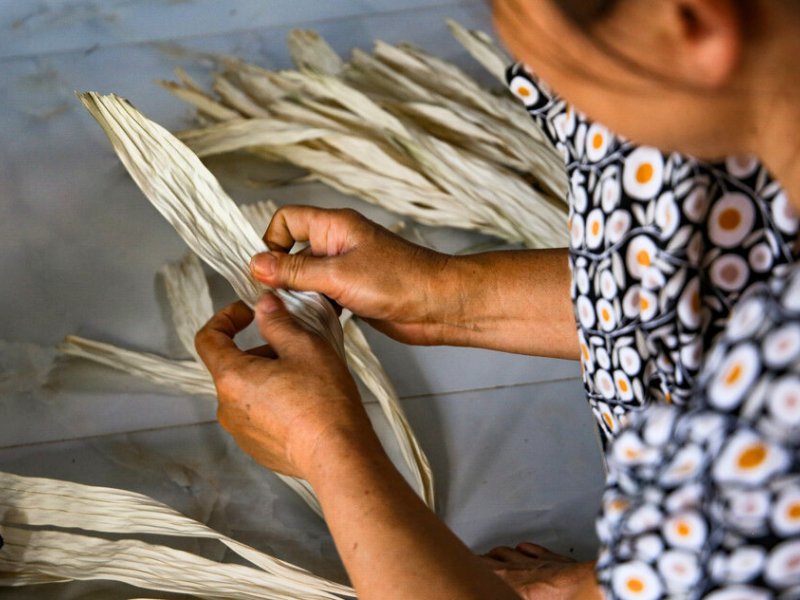
Once dry, the leaves are cut into fine strips to prepare for hat manufacture
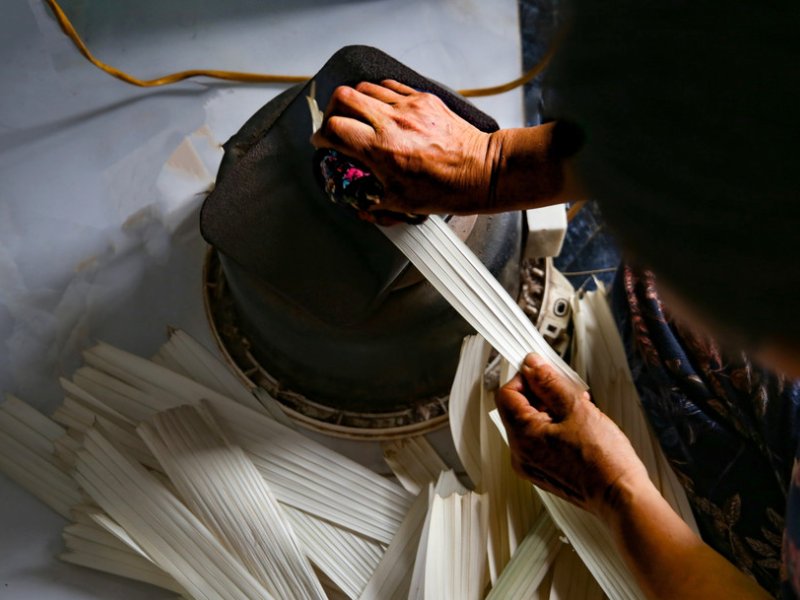
Leaves hot-pressed before hat assembly
It is this meticulous treatment that gives them their characteristic whiteness and flexibility.
Phase 2: Creating the Hat Mold (khuon non)
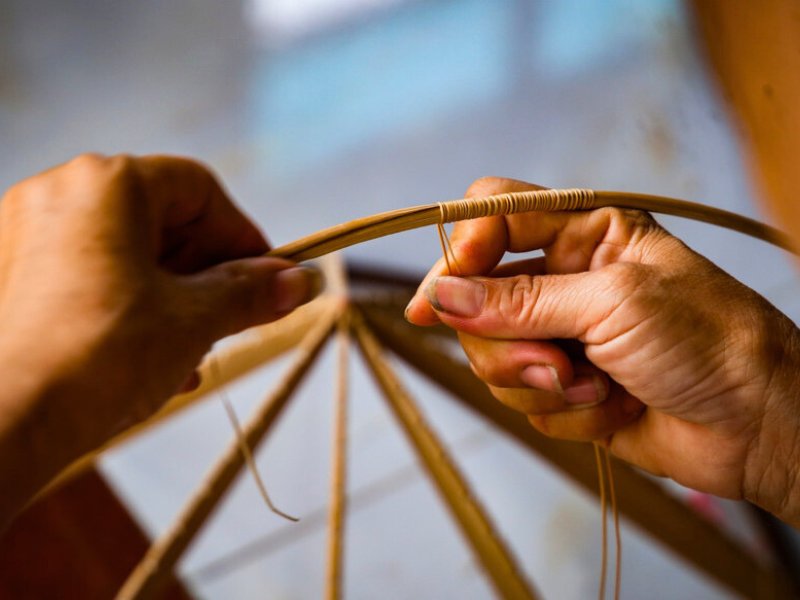
Formation of the bamboo ring, essential base of the hat frame
This phase is essential: it determines whether the hat will be perfectly round and harmonious.
- A piece of bamboo about 50 to 60 cm is used, which is divided into 8 strips (nan tre).
- Each strip is cut, thinned, and then planed to be smooth.
- Small regular grooves are carved into it: they will be used to position the rings (vành nón) later. An adult hat often has 16 rings, so 16 grooves.
- A large bamboo ring (40–50 cm in diameter) is then prepared to serve as the base.
- The 8 strips are fixed vertically on this ring with thread, then their ends are brought together at the top to form the cone’s point.
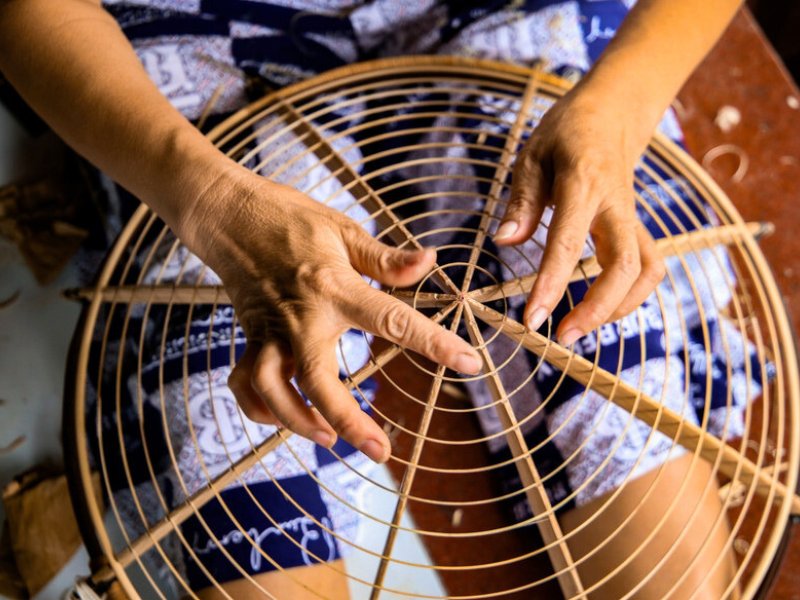
The craftsman assembles the 16 bamboo rings that give the Non La its strength while preserving its delicacy
A complete mold is thus obtained on which all subsequent phases will take place.
Phase 3: Manufacturing and Assembly of Rings
The rings that form the hat’s structure are manufactured from split bamboo and then carefully shaped to obtain perfectly round rings. The lower ring, wider, ensures the base’s stability, while successive rings become progressively thinner as they rise toward the point.
Each ring is then fixed onto the mold’s grooves with the help of resistant nylon thread.
In the tradition of this artisan village, the hat has sixteen rings, a number that ensures solidity, lightness, and flexibility of the whole.
Phase 4: Arranging the Leaves
The leaves, previously cut and brought to the same length, are carefully arranged on the mold. The craftsman begins with a first inner layer, then adds outer layers by rotating them around the mold to completely cover the frame. A ring is then placed on top to hold everything in place and facilitate stitching.
This phase requires real experience: only an experienced hand can achieve a regular, homogeneous, and perfectly adapted surface.
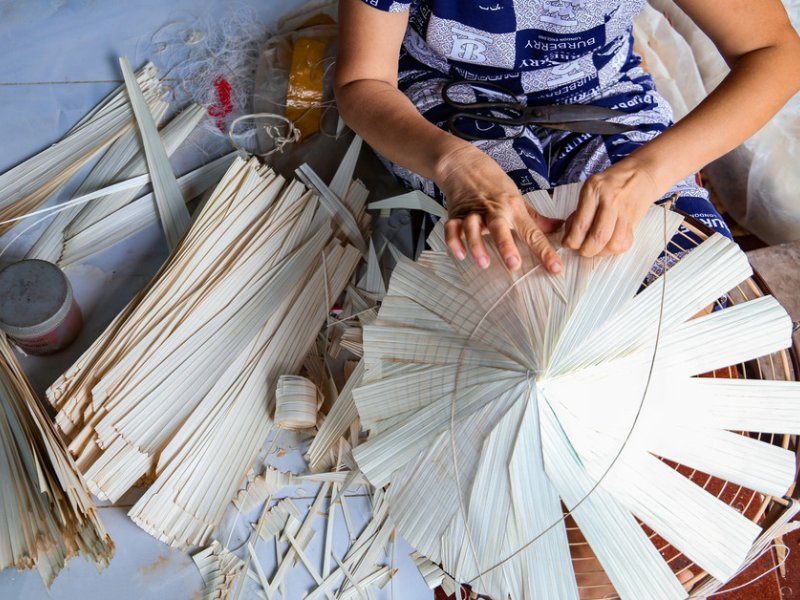
The leaves are arranged in three layers to form the hat’s surface.
In the village of Chuông, the hat’s covering is traditionally made up of three layers:
- two layers of dried leaves,
- and, in the center, a thin intermediate layer intended to reinforce the structure.
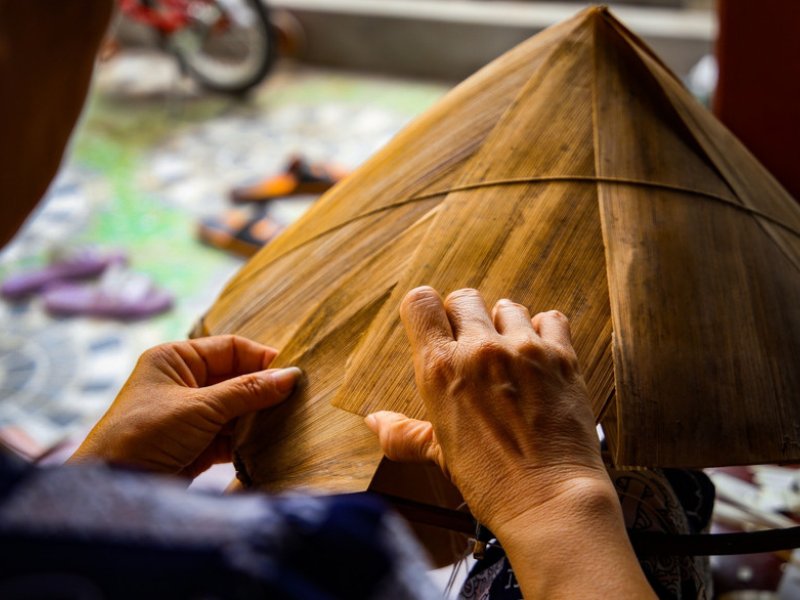
The intermediate layer (Mo) is fixed.
This overlapping gives the hat great lightness, while ensuring solidity and good ventilation.
Phase 5: Stitching the Hat (cham non)
In this phase, the craftsman uses a thin needle and resistant thread to stitch the leaves onto the bamboo rings. The stitches must be regular, neither too tight nor too far apart, so that the hat is solid and harmonious.
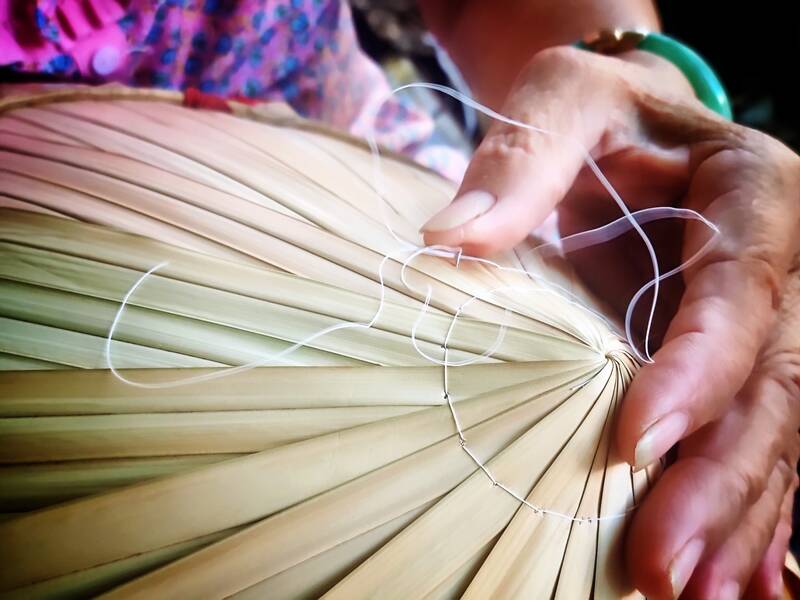
Two types of stitching are generally distinguished:
- the nón dày, with tight stitches, more solid and durable;
- the nón thưa, with more spaced stitches, lighter but less resistant.
The quality of this stitching often reveals the level of the craftsman’s mastery.
Phase 6: Finishing the Edge and Attaching the Chin Strap
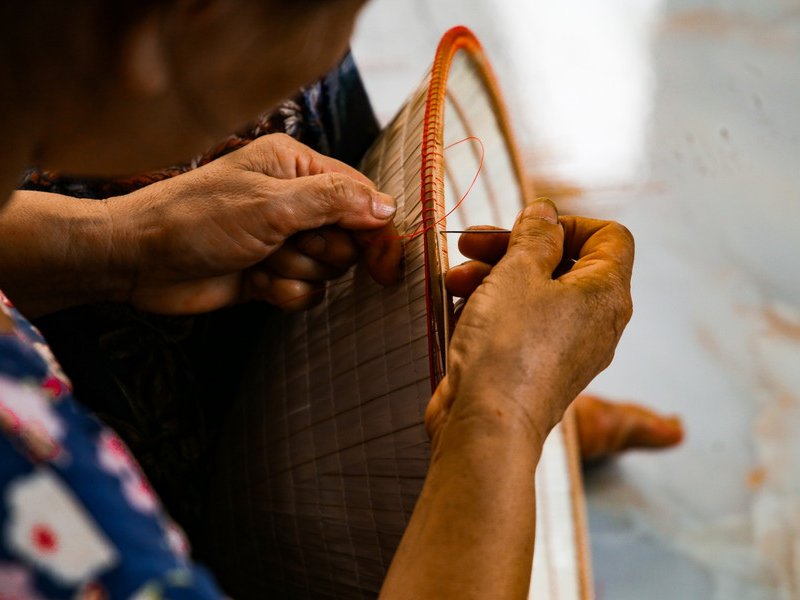
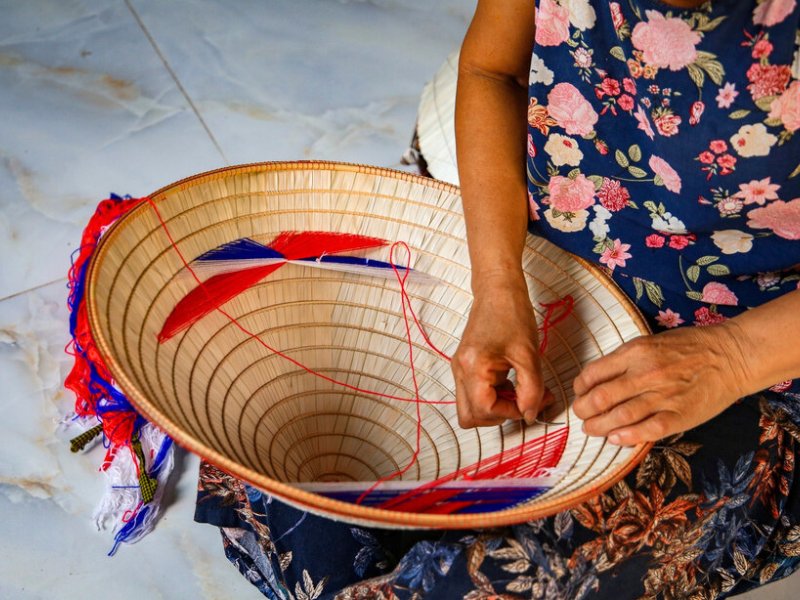
Finally, two thin flattened bamboo strips are fixed around the last ring to reinforce the edge and ensure a well-rounded shape. The craftsman then installs the chin strap: two attachments are stitched on each side, into which a cord of about 60 cm, often made of wool or colored thread, is inserted. It allows the hat to be worn without slipping.
Famous Villages for the Conical Hat
Village of Chuông (Hanoi)
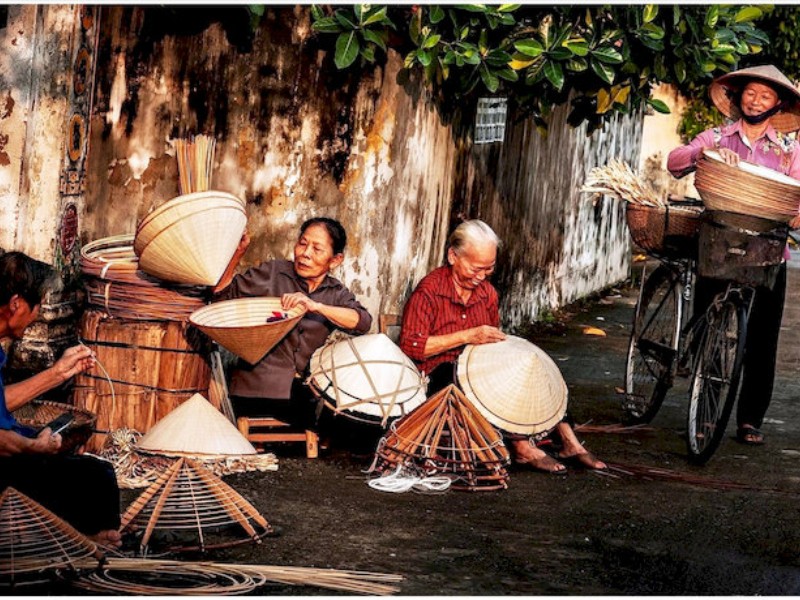
The village of Chuông, located near Hanoi, is considered the cradle of the conical hat in Northern Vietnam. Renowned throughout the country, it stands out for the production of light Non La, well-proportioned and particularly solid.

Village of Chuong
Here, craftsmanship is a true family tradition: techniques are passed down from generation to generation, and every resident masters the art of weaving, shaping, and stitching the hat with great precision. This village remains today one of the essential references for anyone wishing to discover the authentic knowledge of the Vietnamese Non La.
Village of Tây Hô (Hue)
Located in the ancient imperial capital of Hue, the village of Tay Hô is famous for its Non Bai Tho, the poetic conical hat. This unique model reveals, when held up to the light, delicate patterns, poems, or landscapes subtly inserted between the layers of leaves.
Village of Tây Hô (Hue)
The manufacture of this hat requires particularly refined work: every detail must be perfectly aligned so that words and designs appear in transparency. Thanks to this delicate and meticulous knowledge, Tay Hô has become a true center of Vietnamese craftsmanship, where the Non La becomes a work of art in itself.
Village of Phú Cam (Hue)
The village of Phú Cam, located in the heart of Hue, is one of the most renowned places for traditional Vietnamese conical hat manufacture. Its craftsmen are known for their exceptional mastery of the Non La, which they craft with elegance and precision.

Village of Phu Cam (Hue)
The hats produced at Phú Cam stand out for their fineness, lightness, and harmonious proportions, making them models often associated with Hue’s Ao Dai, celebrated for its refinement. In this village with a strong artisan tradition, every hat reflects the gracious and poetic style characteristic of the region.
The Conical Hat in Vietnamese Life
In Western imagination, the image of conical hats is almost inseparable from that of Vietnamese women. Women and young girls wear them when working in the rice fields. Grandmothers often use them as a fan to help their grandchildren fall asleep on scorching days. At a wedding, a conical hat can replace the words a mother wishes to say to her daughter, by placing it on her head before letting her go.
Nowadays, many foreign tourists wear conical hats on their heads as typically Vietnamese souvenirs.

Young models in the collection presenting Nón Việt (The Vietnamese conical hat)
These Vietnamese hats are also increasingly present in artistic performances or fashion shows, and in beauty pageants, they are often worn with traditional Vietnamese garments such as the ao dai. Such performances are often very applauded. The famous Italian designer Alberta Ferretti once presented a collection featuring renewed conical hats full of colors!

The conical hat is an essential accessory of Vietnamese farmers
Through its history and origins deeply rooted in Vietnamese culture, the conical hat appears not only as a utilitarian object, but also as a true symbol of identity. Its numerous varieties showcase the richness of regional traditions and the evolution of artisan knowledge over time. The manufacturing process, meticulous and passed down from generation to generation, reveals all the patience, precision, and skill of the craftsmen, particularly in celebrated villages like Chuông or Tây Hồ. These places perpetuate an authentic craftsmanship that continues to keep this precious heritage alive.
In Vietnamese life, the conical hat remains naturally present: worn in the rice fields, at the market, during festivals or associated with the Ao Dai, it is at once protection, elegance, and a cultural symbol. Generally considered one of the most emblematic images of Vietnam, the Non La embodies the fineness, simplicity, and beauty of the country. Whether seen as an everyday object or as an artistic piece, it remains a living witness to the soul of Vietnam.