+84 9 75 46 33 10 (Whatsapp)
  info@horizon-vietnamtravel.com
  Français
  Español
  Português
  Deutsch

The Five Fruits Tray: An Ancestral Tradition for Vietnamese New Year
Table of contents
Têt Nguyên Đán, or the Lunar New Year, is one of the most important and widely celebrated festivals in Vietnam. At the heart of these festivities lies an ancient and deeply rooted tradition: the five fruits tray of Vietnamese culture, or “Mâm ngũ quả” in Vietnamese. A symbol of gratitude and aspirations for the year ahead, this tray of varied fruits holds a place of honor on the ancestral altar or the guest reception table. Each fruit selected and its arrangement on the tray carries profound meanings, reflecting the family’s wishes for the new year. From green bananas to golden grapefruits, every element of the tray is carefully selected to bring good fortune, prosperity, and happiness.
Today, while preserving its spiritual significance, the five fruits tray of Vietnamese culture has also evolved to become a central decorative element of Têt celebrations, adding an aesthetic touch to the festivities. In this blog, we explore the history, meanings, and practices surrounding this fascinating tradition, and how it continues to play a vital role in contemporary Vietnamese culture.
Meaning of the Têt Five Fruits Tray
The Vietnamese five fruits tray is an indispensable component of Lunar New Year celebrations in Vietnam, embodying the richness of Vietnamese culture. This ancestral tradition is laden with symbolism and history, reflecting the cultural and spiritual values of the Vietnamese people. The Mâm Ngũ Quả is generally composed of five types of different fruits, carefully chosen for their symbolism and profound meaning. This practice finds its roots in the Vu Lan Bôn Sutra, where fruits represent the five colors, emphasizing the importance of the number five in Vietnamese culture, particularly in veneration rituals and offerings. This tradition illustrates the attachment of Vietnamese people to beliefs and practices that celebrate gratitude, prosperity, and honor to ancestors.
- Phú: Wealth, abundance of goods
- Quý: Nobility and elegance
- Thọ: Longevity
- Khang: Health
- Ninh: Peace and tranquility

The five fruits tray on the Têt altar symbolizes Prosperity, Nobility, Longevity, Health, and Peace
In Buddhism, the five colors of the five fruits tray represent the “five roots of virtue”: faith (tín căn), perseverance (tấn căn), mindfulness (niệm căn), concentration (định căn), and wisdom (huệ căn). Thus, the fruits chosen for the five fruits tray of Têt carry specific meanings:
- Grapefruit and watermelon: Round and fresh, they promise a prosperous and fortunate new year.
- Persimmon and mandarins: Red and vibrant orange, they symbolize good fortune and success.
- Pear: Sweet, it suggests that all will go well.
- Pomegranate: Many seeds, wishing for a numerous and joyful lineage.
- Peach: Represents promotion and progress.
- Apricot: Implies that daughters should marry and be happy.
- Apple (red apple): Signifies wealth.
- Dragon fruit: Implies prosperity.
- Lucuma: Represents heavenly blessing.
- Coconut: Pronunciation similar to “vừa” (sufficient) in South Vietnamese, means that nothing is lacking.
- Fig: Represents abundance in all things, such as health, work, love…
- Papaya: Brings abundance and prosperity.
- Mango: Pronunciation similar to “xài” (to spend) in South Vietnamese, suggests that throughout the year nothing will be lacking.
Although the foundations of this tradition are similar throughout the country, each region of Vietnam brings its own unique variations and meanings to this practice. Here is an overview of the meanings of the five fruits tray in different regions of Vietnam:
Northern Vietnam
For the northerners, a beautiful five fruits tray must contain several types of fruits such as: green banana, grapefruit, Buddha’s hand, fig, persimmon, ornamental mandarin, chili pepper, pineapple… with bright but harmonious colors, respecting the five elements:
- Metal (Kim) – white
- Wood (Mộc) – green
- Water (Thủy) – black
- Fire (Hỏa) – red
- Earth (Thổ) – yellow
In the five fruits tray, bananas are arranged in a bunch and must be green, symbolizing unity, conviviality, and family warmth. The yellow grapefruit represents wealth and good fortune. Some families replace the grapefruit with a Buddha’s hand (whose role is to retain the spirits of ancestors and keep them longer in the house to protect the family).
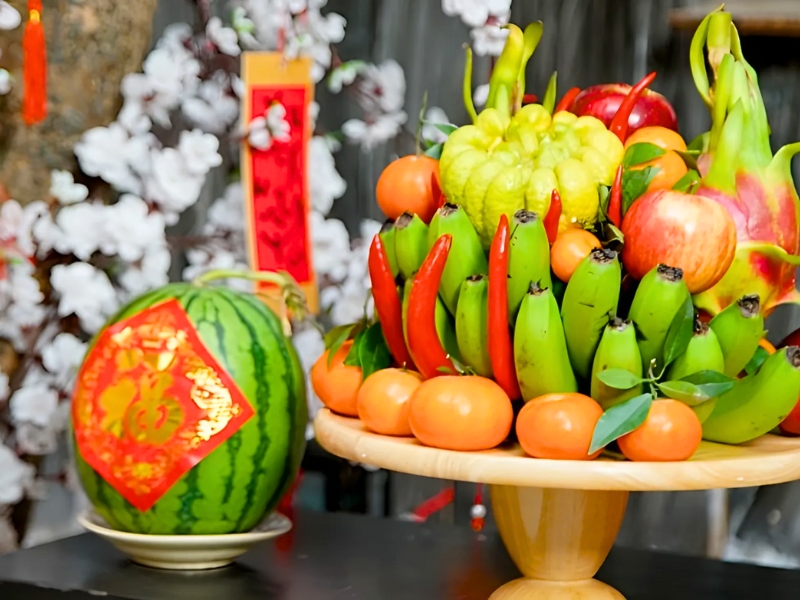
The five fruits tray of Northern Vietnam embodies the richness of traditional Tết symbols
The ornamental mandarin, persimmon, or red chili pepper are arranged around the five fruits tray because of their bright red and yellow colors, symbolizing good fortune and success. The pineapple, with its distinctive aroma, expresses the wish for a peaceful and prosperous new year.
The northerners traditionally arrange the five fruits tray by first placing a bunch of green bananas underneath to support all the other fruits. In the center they place a grapefruit, Buddha’s hand, or custard apple, and other fruits such as peach, persimmon, mandarin, and apple are arranged around. The empty spaces can be filled with chili peppers or ornamental mandarins.
Central Vietnam
The inhabitants of central Vietnam, known for their kindness and warmth, are not too demanding regarding the five fruits tray for Têt. Because of the cultural fusion between North and South, as well as difficult climatic conditions such as storms, floods, and frequent droughts, the five fruits tray of central residents is simple and informal. With less fertile soil and rarer fruit trees, they use available fruits, emphasizing the sincerity of intention rather than appearance.
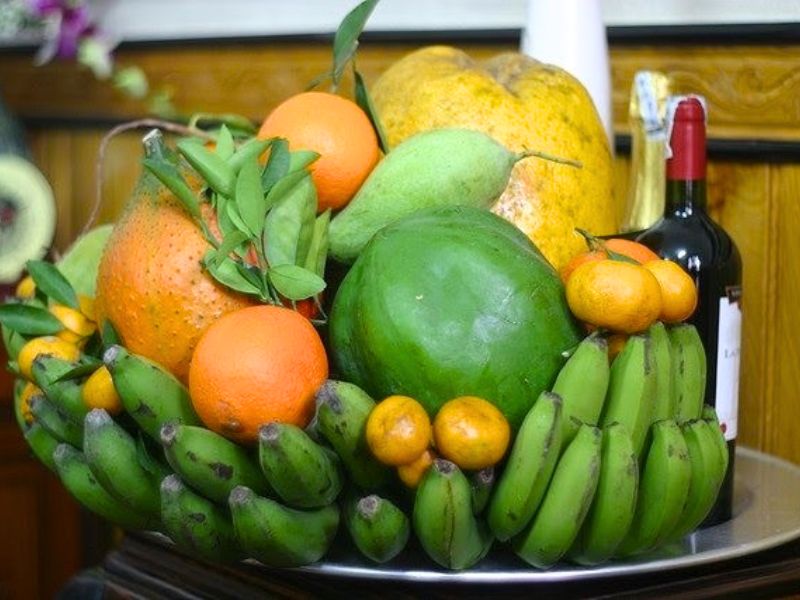
The five fruits tray of Central Vietnam is truly simple
Common fruits present in the five fruits tray of central residents include: dragon fruit, banana, watermelon, custard apple, pineapple, fig, orange, mandarin. These fruits represent simplicity and authenticity, reflecting the modest but sincere life of the inhabitants of this region.
Southern Vietnam
The southerners consider the five fruits tray as a symbol of results achieved after a year of hard work. These fruits are the fruit of labor, sweat, and efforts of the workers, carefully gathered to be offered with respect to the ancestors.
For Têt, the five fruits tray of southerners generally contains fruits such as soursop, coconut, papaya, mango, and fig, according to the expression “Cầu sung vừa đủ xài” (pray that everything is sufficient and abundant). Three pineapples are often added as a base to symbolize stability. Another essential element is a pair of watermelons with red flesh and green skin.
- Soursop (Mãng cầu): Represents prayers and wishes (cầu)
- Coconut (Dừa): Means “just enough” (vừa)
- Papaya (Đu đủ): Symbolizes sufficiency (đủ)
- Mango (Xoài): Means “to spend” (xài)
- Fig (Sung): Evokes abundance (sung túc)
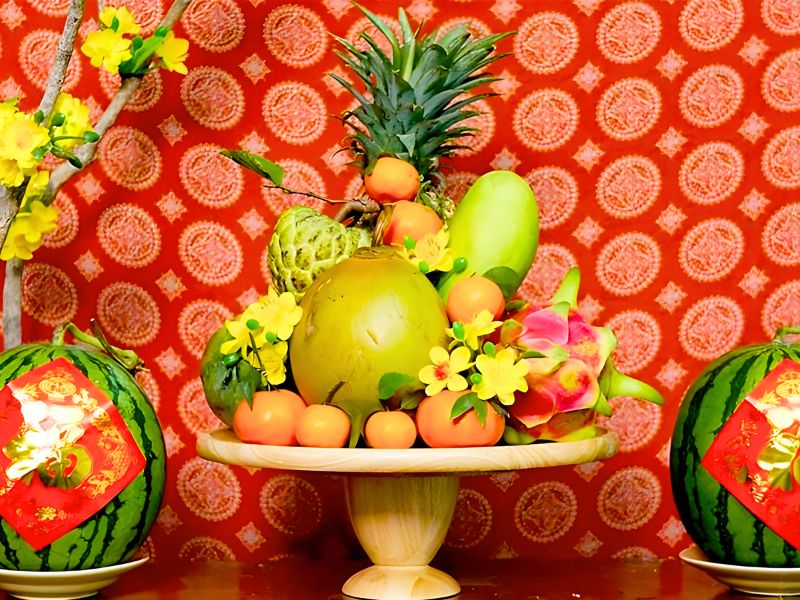
The five fruits tray of Southern Vietnam reflects wishes for prosperity and sufficiency for Têt
The southerners avoid certain fruits whose pronunciation has negative connotations, such as banana (which suggests stagnation in business), pear (which evokes failure and hardship), as well as orange and mandarin (which may suggest submission and resignation).
The most common way to arrange the five fruits tray in the South is to place first the papayas, coconuts, and mangoes, since they are large and heavy enough to support the other fruits, then arrange the other fruits around.
Essential Tips for Arranging the Tray
To create an elegant and well-balanced five fruits tray, follow these detailed recommendations:
- Choose fresh, quality fruits, ensuring that each fruit is in perfect condition, without blemishes or imperfections, to guarantee a visually attractive presentation.
- Select fruits with symbolic meanings, offering a beautiful palette of colors and symbolizing wishes such as wealth, health, and prosperity.
- Vary the shapes and sizes of fruits to add diversity and visual interest to your tray.
- Adapt the selection of fruits according to the customs and traditions of your region, whether Northern, Central, or Southern Vietnam.
- Position the larger and heavier fruits at the base to support the smaller and lighter ones. Organize them in a way that highlights each fruit while creating a cohesive whole.
- Enrich your tray with additional elements such as leaves, flowers, or symbolic accessories for a refined and festive finishing touch.
By following these tips, you can create a Vietnamese five fruits tray that not only respects traditions, but also offers an elegant and meaningful presentation for Têt celebrations.
The Vietnamese five fruits tray is not just a simple festive decoration for Têt in Vietnam, but also embodies a rich cultural and spiritual tradition, blending elements of symbolism, respect for ancestors, and auspices for the year ahead. Each region of Vietnam brings its own unique imprint to this tradition, whether in the choice of fruits, symbolic meanings, or presentation methods. By following these traditions and meticulously selecting fruits, the Vietnamese compose an aesthetic arrangement rich with profound meanings. The Mâm ngũ quả remains thus a powerful emblem of the Têt festival, illustrating the richness and diversity of Vietnamese culture, while bringing hope, prosperity, and happiness for the new year.