+84 9 75 46 33 10 (Whatsapp)
  info@horizon-vietnamtravel.com
  Français
  Español
  Português
  Deutsch

Everything You Need to Know About Education in Vietnam
Table of contents
Education in Vietnam has always played a central role in Vietnamese culture and society. It is considered the path to social advancement, and families regularly make great sacrifices to ensure their children receive the required education. The primary goal of education in Vietnam is to “improve people’s general knowledge, develop quality human resources, cultivate and encourage talent.” In response to public opinion, the Ministry of Education and Training has presented resolutions aimed at reforming the education system, seeking to overcome outdated curricula and teacher-focused courses. Although there is still much work to be done, standards have improved over the years. According to UNESCO statistics, in 2019 more than 95% of Vietnam’s population was literate.
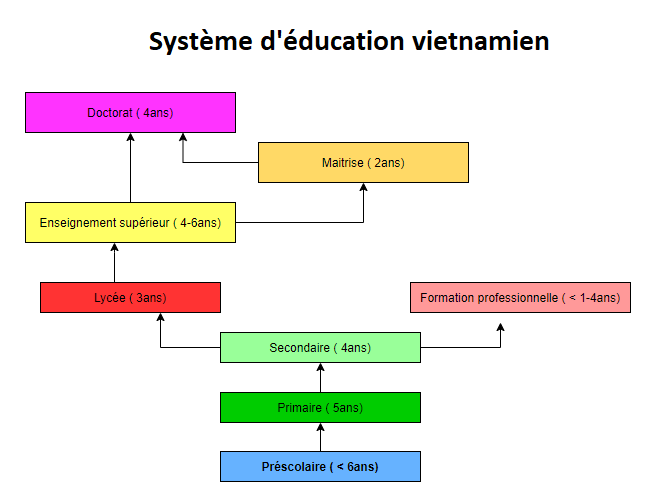
Education in Vietnam is a system of public and private education managed by the Ministry of Education and Training. The system is divided into five levels :
- preschool (from 18 months)
- primary (from 6 years old)
- secondary (from 12 years old)
- high school (from 16 years old)
- higher education
Formal education includes twelve years of basic education. In fact, basic education consists of five years of primary school, four years of secondary school, and three years of high school.
Furthermore, there are still interesting things to know about Vietnamese education such as : extracurricular activities, schedule, school discipline, and school fees.
General Information About Academic Life
Formal education in Vietnam consists of twelve years of compulsory basic education : five years of primary school (starting at age 6), four years of intermediate education (starting at age 12), and three years of secondary education (age 16).
It should be noted that kindergarten is not compulsory in Vietnam. We will provide more details later in the article.
To obtain a secondary education diploma, students must pass the intermediate exam at the end of their studies. This exam is organized by the local Ministry of Education and Training.
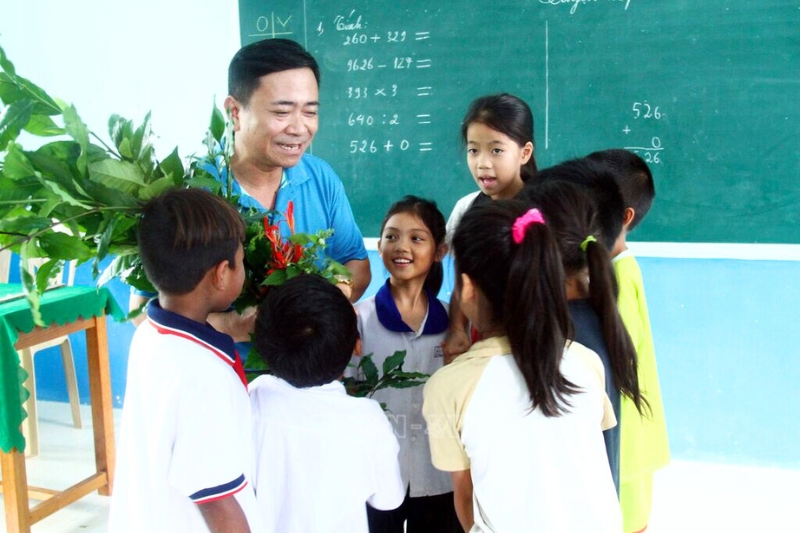
Vietnamese students generally have classes from Monday to Saturday for 6 to 8 hours a day in classes of 35 to 50 students. It should be noted that education in Vietnam is evolving: previously, lessons were taught in a one-way manner: the teacher explained the lesson and the student listened and wrote. Today, communication and participation are prioritized; students work more in small groups.
The Vietnamese Education System in Detail
Would you like to learn more about the Vietnamese education system? In this article, we will show you the fundamental components of the education system in Vietnam to give you a general understanding.
A Vietnamese education system is organized by the Ministry of Education and Training and is applied throughout the country. According to UNESCO statistics, by 2009 more than 90% of Vietnam’s population was literate.
Now let’s take a look at the components of the education system in Vietnam.
I. Preschool (Kindergarten)
Before the age of 6, school is not compulsory in Vietnam. You may choose to send your children to school or leave them at home at this stage.
Daycare, kindergarten : is a place to care for children when parents go to work to earn a living. A child can enter daycare at the age of 18 months.
Preschool : When a child reaches the age of 3, parents take him/her to preschool where he/she is required to become familiar with school from 8:00 AM to 4:30 PM, Monday through Friday. This routine will continue until the child reaches age 5. At this stage, preschool teachers will teach children to sing, dance, draw, and perform some simple activities on their own. Teachers also teach simple letters and mathematics. Today, as English becomes increasingly popular, English is added as a subject in preschool as well. Children will learn to become familiar with some simple and popular phrases, colors, numbers, shapes, etc.
II. General Education
When a child is 6 years old, it is time to officially start school. A conventional general education class consists of approximately 30 to 40 students. The class is often accompanied by a homeroom teacher, 2 to 3 vice-homeroom teachers, and a form teacher. Students wear uniforms to school. The design of the uniform differs from one school to another. Generally, the normal path is twelve years of general studies from grade 1 to grade 12, including primary, secondary, and high school, before proceeding to higher education or vocational training.
1. Primary School
Primary school lasts 5 years, from grades 1 to 5. At primary school, students will study literature, mathematics, history, geography, etc., taught by a teacher called the homeroom teacher. Other subjects such as art, music, physical education, etc. are taught by other teachers. Students who complete primary school continue their studies in secondary school. There is no entrance exam to enter secondary school.
2.Secondary School
Secondary school lasts 4 years, from grades 6 to 9 (children are between 12 and 16 years old). A major difference between primary school and secondary school is that different teachers teach different subjects. One of the teachers will be the homeroom teacher. Additionally, the homeroom teacher is responsible for following up with students in other aspects such as administrative or counseling activities. When students complete their secondary studies, an exam is held throughout Vietnam to evaluate students’ abilities, which is the entrance exam for high school. This entrance exam is currently applied to both public and private schools.
At this stage, it is possible to discontinue general education and start working. Work will then be mostly manual, difficult, and not very well paid. Cases of dropping out of secondary school are often due to a difficult family environment that pushes the student to work to bring money to the family.
3.High School
High school lasts 3 years, from grades 10 to 12 (ending around age 19). In high school, subjects such as art and music are eliminated. Students will be tasked with guiding their career and will focus on the subject in which they specialize. When students finish their high school studies, they must take an end-of-studies exam. This exam will allow entry to public and private universities. Regarding this exam, students will choose the specialization they wish to study at university and take the exams associated with it. In recent years, many changes have been made to this exam regarding the form of the exam, questions, structures, quizzes, etc.
If the student passes the exam with a grade that meets the criteria of the Vietnam Ministry of Education and Training, he/she should obtain a diploma considered equivalent to the baccalaureate in France.
After high school, one can enter university, pursue vocational training, or work.
III. Vocational Training
In the Vietnamese education system, vocational training is designed to teach students a particular skill such as carpentry, hairdressing, and tailoring. Students, after completing vocational training, should possess the basic skills for employment. Subsequently, he/she can work with an experienced senior to refine his/her skills, or can start his/her own business. This training is divided into two types: short-term training and long-term training. Short-term training lasts less than a year while long-term training lasts from 1 to 3 years.
IV. Higher Education
Higher education includes undergraduate, master’s, and doctoral degrees. University education typically lasts 4 years in Vietnam, depending on the field of study. However, for certain specific specializations such as medical studies, a degree could last 6 years or more. Once higher education is completed, students can choose to enter the official job market or continue their studies. Students typically need to spend 2 years for a master’s degree and 4 years for a doctoral degree.
V. Continuing Education
Furthermore, these centers are created with the aim of bringing education to all environments. If your studies are interrupted unexpectedly for some reason, you can enroll in a course designed to eliminate illiteracy in society and to encourage people to study when they are ready to do so.
Extracurricular Activities
Regarding extracurricular activities, students are not used to participating in them. It is preferable that teachers or parents encourage students to engage in other activities outside of school, including student associations, sports projects, and volunteering. However, since life becomes more modern and requires outdoor activities necessary for people, extracurricular activities are increasingly being chosen by students themselves.
Schedule and Discipline at School
Discipline
Teachers are highly respected. In fact, when a teacher enters the classroom, the entire class must stand up to greet the teacher. During the lesson, students are very attentive to the explanations. And at the end of the lesson, students wait until teachers must leave the classrooms before they start to leave.
There are specific dress codes regarding clothes and hairstyles. There is a dedicated assessment of ethical behavior in high school. Many schools require that students wear a uniform and follow a code of conduct. If rules are broken, there is a school ethics committee. This committee determines the punishment and students are not allowed to obtain an average ethical diploma. Romantic relationships are prohibited at school, as students are encouraged to focus on their studies.
Schedule
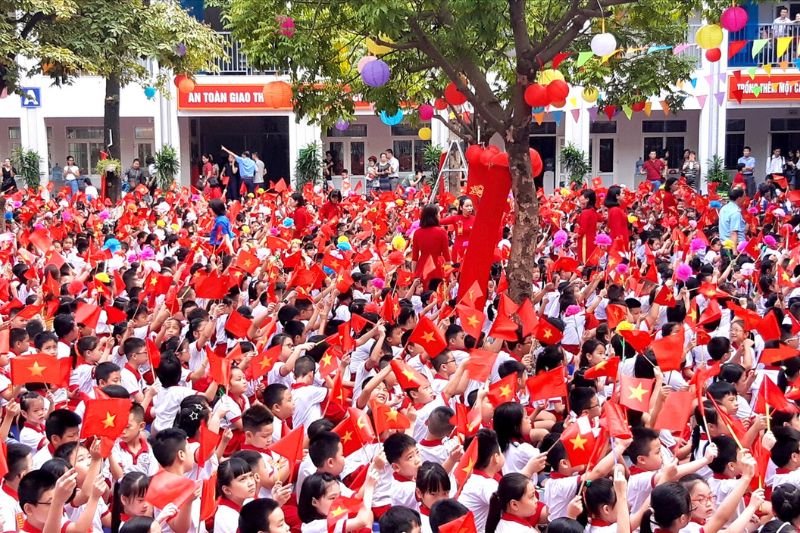
In Vietnam, a school day begins from 7:00 AM to 11:00 AM, from 1:00 PM to 4:00 PM or 5:00 PM in the afternoon, Monday to Friday and Saturday morning for some schools. Students will also have a 30-minute break in the morning and afternoon. A school year typically starts in September and ends in May of the following year.

During a school year, there are holidays during which students are allowed to take one or more days of leave. Such as Tet holidays, Independence Day, Labor Day, Hung Kings’ Commemoration Day, and Teachers’ Day. Summer usually lasts 3 months from the beginning of June to the end of August. However, in recent years, a school year must start earlier, in August. This explains why other holidays of the year will last longer. Summer schools and supplementary courses such as evening courses are optional. In recent years they have been discouraged by the government.
A school year in Vietnam is often divided into two semesters. There will be a test in the middle and at the end of the semester. The objective is to assess student progress and determine if they are eligible to study in the next class. In the last 3 years, the Minister of Education and Training has applied a new evaluation system in primary school. In particular, teachers will write comments for students instead of assigning grades. This is to reduce study pressure for primary school students. However, this system still needs to be improved to achieve better results.
School Fees
As for public schools, primary school students are exempt from enrollment fees. The objective of this policy is to encourage universal schooling and ensure that every child can read, write, and master basic mathematical skills after five years of primary school. In the Vietnamese education system, primary school is compulsory.
Students at other levels of education must pay modest monthly school fees, which vary depending on the region (urban, rural, or mountainous) and the degree of autonomy of the institution. On average, they amount to 150,000 – 650,000 VND per month, to which are added various incidental costs such as school meals, uniforms, extracurricular activities, or school materials.
- Daycare : approximately 300,000 – 540,000 VND / month
- Preschool : approximately 250,000 – 500,000 VND / month
- Primary school : free (exemption maintained)
- Secondary school : approximately 150,000 – 650,000 VND / month
- High school : approximately 200,000 – 650,000 VND / month
It should be noted that as of the 2025-2026 school year, the Vietnamese government is planning complete exemption of school fees for all students in the public system, from kindergarten to high school.
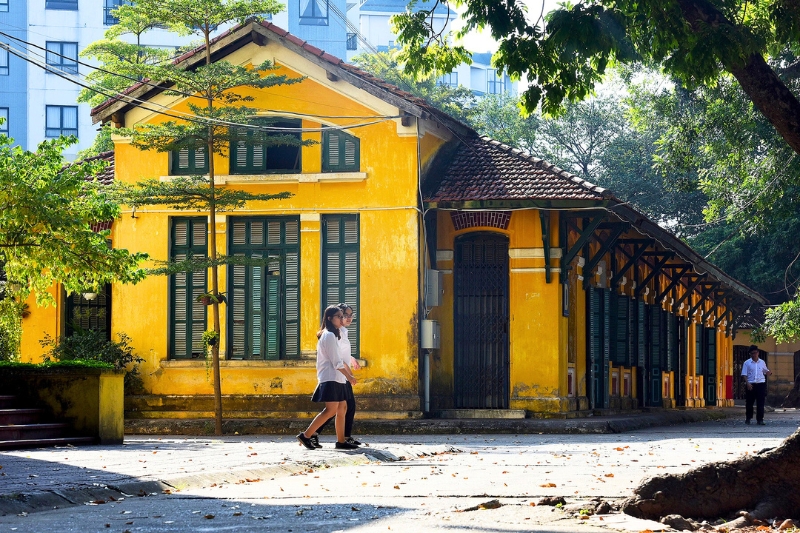
University fees in public institutions vary greatly depending on the type of program: approximately 10 – 41 million VND per year for standard programs, and up to 70 – 85 million VND per year for so-called high-quality or bilingual programs. Some international programs can exceed 100 million VND per year.
As for private schools, school fees vary depending on each institution. For general education, the lowest price could be approximately 1 million VND per month for half-day courses, 2 million VND per month for full-day classes, and 3 million VND per month for boarding school. Conversely, the highest price in high-level international schools can reach up to 900 million VND per year, or approximately 75 million VND per month, depending on the program (Cambridge, IB, bilingual, or international).
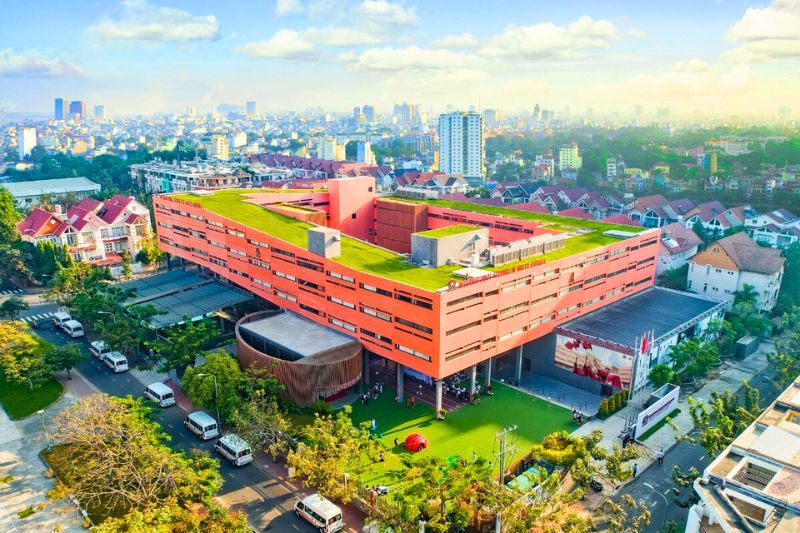
Private school in Vietnam – an example of modern educational infrastructure open to international standards
Students in private or international schools therefore generally pay much more compared to those in public schools. In return, they benefit from more modern facilities, a bilingual or international educational environment, and a pedagogy more open to world standards.
Education in Vietnam has always been considered crucial and is the foundation of future success. As in many other parts of the world, highly qualified people are highly respected in Vietnam. In recent years, Vietnam has implemented numerous innovations to update and improve the quality of teaching. The Vietnamese education system should continue to develop in the future, as it is considered the cornerstone of a prosperous nation.