+84 9 75 46 33 10 (Whatsapp)
  info@horizon-vietnamtravel.com
  Français
  Español
  Português
  Deutsch

Hinduism in Vietnam
Table of contents
Introduced to Vietnam through ancient trade routes connecting India to Southeast Asia, Hinduism deeply marked the culture of the Champa kingdom. Today, its traces are still found in Cham temples such as Po Nagar or My Son, symbols of a unique spiritual and artistic heritage. More than a remnant of the past, Hinduism in Vietnam remains a living testimony to the dialogue between India and Vietnam.
1. General Overview of Hinduism
Hinduism is one of the oldest religions in the world, with over a billion followers today. Born in India several millennia ago, this spiritual system brings together a set of religious, philosophical and cultural teachings deeply rooted in Indian tradition. In contemporary India, Hinduism remains the dominant religion, practiced by the majority of the population.
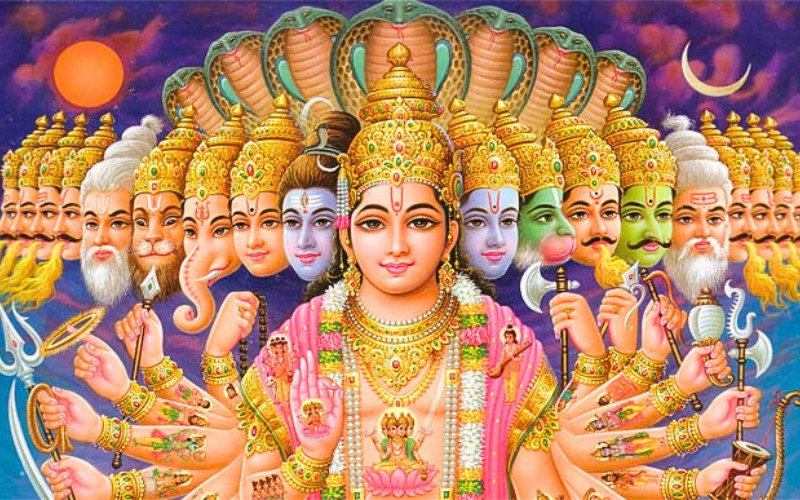
Hinduism, born in India, is one of the oldest religions in the world, deeply rooted in the spiritual and cultural life of the Indian people
Hindu life is based on four major principles called Purusarthas, considered the essential purposes of human existence:
- Dharma: moral duty and good conduct, guarantors of social order.
- Artha: the pursuit of material prosperity acquired in the right way.
- Kama: the pursuit of desire, love and passion, necessary for life’s balance.
- Moksha: spiritual liberation, ultimate liberation from the cycle of rebirths.
Among these four objectives, Dharma is considered fundamental: without moral balance, the pleasures of Artha and Kama lead only to disorder, preventing the achievement of Moksha. Hinduism teaches purity of heart, benevolence and devotion to the gods. The sacred symbol “Om” (or Aum), a fusion of the Sanskrit letters A, U and M, represents the primordial vibration of the universe — a transcendent intonation that transcends the boundaries of language, culture or belief.
Origins of Hinduism in Vietnam
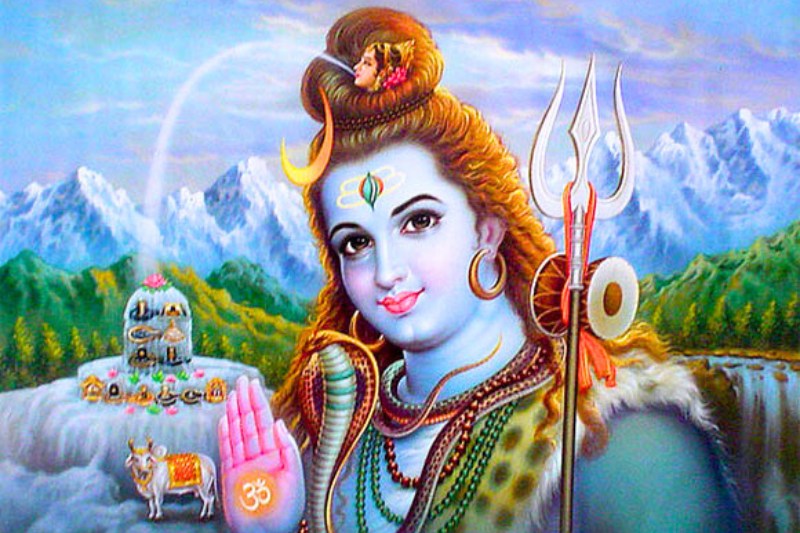
Like Buddhism, Hinduism arrived in Vietnam through maritime trade routes that once connected India to Southeast Asia. This religion developed in particular within the Champa kingdom (7th – 19th centuries), an ancient state located on the central coast of the country, where it deeply influenced Cham culture, art and architecture.
Today there are approximately 50,000 Hindu Chams, settled mainly in the coastal provinces of Ninh Thuan and Binh Thuan, as well as in Ho Chi Minh City, where several active temples are found.
The influence of Hinduism also persists in some Vietnamese customs and practices, such as purification rites, family offerings or the sacred thread used to ward off evil spirits — many traditions inherited from the spiritual syncretism between India and Vietnam.
Hindu Temples in Vietnam
Hinduism left a spectacular architectural footprint in the country. Cham temples, built with red bricks and richly decorated with carved motifs, testify to a unique synthesis between Indian art and local culture.
Mariamman Temple (Ho Chi Minh City)
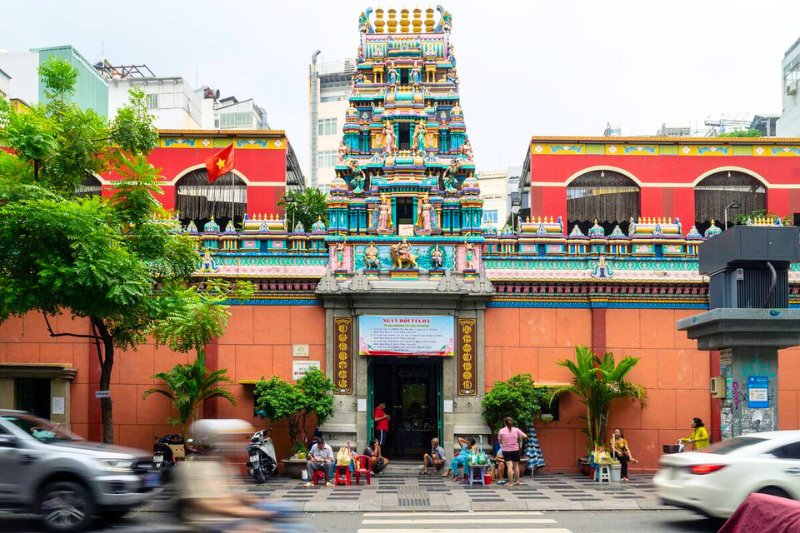
Mariamman Temple (Ho Chi Minh City)
Built in the 19th century by Indian merchants who came to settle in Saigon, the Mariamman Temple is one of the most famous Hindu sanctuaries in Vietnam. Dedicated to the goddess Mariamman, symbol of fertility, health and protection, this place of worship is located in the heart of the 1st district of Ho Chi Minh City. The temple impresses with its colorful statues representing the great Hindu deities such as Ganesha, Vishnu or Shiva. A place of prayer, meditation and contemplation, it attracts both Hindu believers and foreign visitors, curious to discover Indian spirituality and its influence in Vietnam.
Po Nagar Towers (Nha Trang, Khanh Hoa Province)
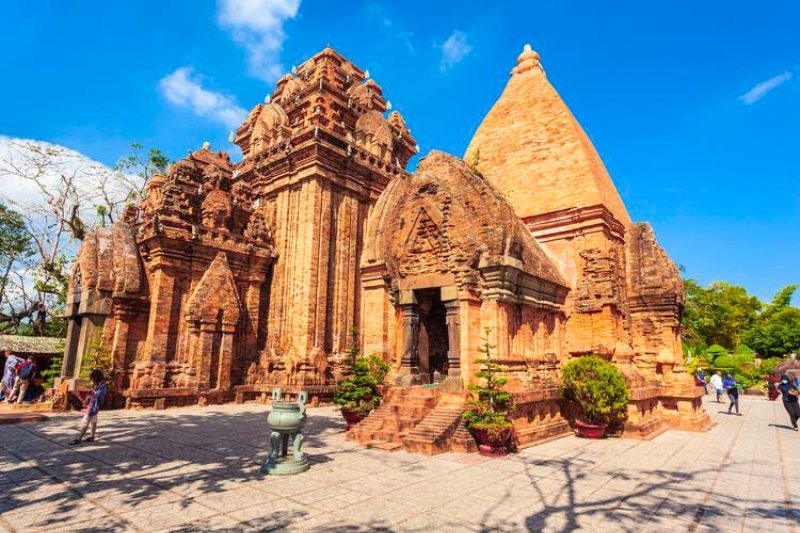
Po Nagar Towers (Nha Trang, Khanh Hoa Province)
Built between the 2nd and 13th centuries, the Po Nagar towers are among the most emblematic Cham monuments in Vietnam. They are dedicated to the goddess Po Nagar, also called “Mother of the Country,” a figure venerated for having transmitted to the Cham people the arts of weaving and agriculture. Originally, the complex comprised ten towers, but only four have withstood the ravages of time. The tallest, the Po Nagar Kalan tower (25 meters), impresses with its architectural majesty, its finely carved red bricks and the symbolic strength it emanates. Still an active place of worship for Hindu Chams, Po Nagar is also recognized as a UNESCO World Heritage site, attracting thousands of pilgrims and visitors each year fascinated by spirituality and Hindu art in Vietnam.
My Son Sanctuary (Quang Nam Province)
Classified as a UNESCO World Heritage site, the My Son Sanctuary is the largest and most sacred religious complex of the ancient Champa kingdom. Built between the 4th and 14th centuries, it was mainly consecrated to the god Shiva, while honoring other Hindu deities such as Vishnu and Ganesha. The site brings together about sixty temples and towers of brick, magnificently decorated with symbolic sculptures representing Hindu beliefs and mythology.
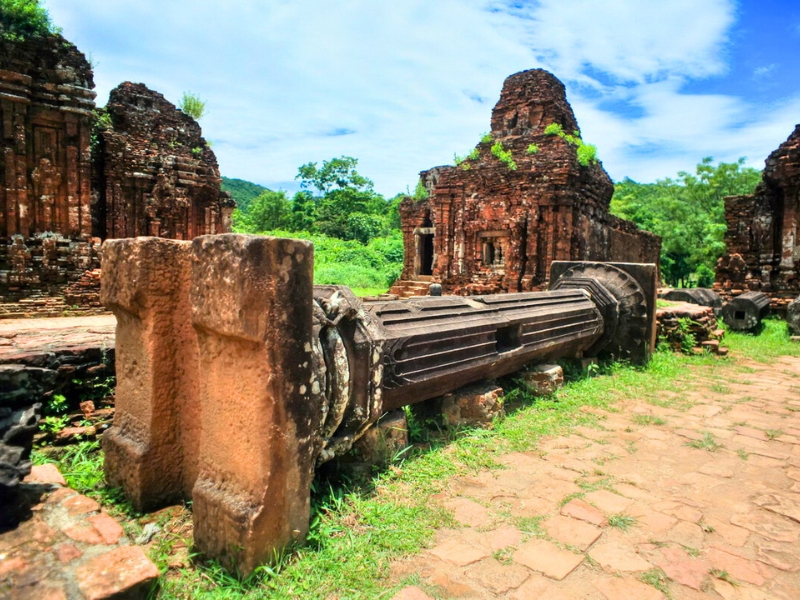
Today, the My Son Sanctuary is restored thanks to international support and hosts a site museum that showcases its heritage, whether moved or damaged.
A masterpiece of Cham architecture, My Son testifies to a unique blend of Indian, Indonesian and Malay influences, illustrating the depth of cultural exchanges between India and Southeast Asia. Today, My Son remains both a high spiritual place and a source of pride for Vietnamese heritage, attracting travelers from around the world fascinated by its thousand-year history and mystical beauty.
Living Legacy of Hinduism in Vietnam
Although Vietnam is today predominantly Buddhist, Hinduism occupies a unique place in the religious mosaic of the country. Cham traditions continue to perpetuate the rites, festivals and ancestral practices inherited from the Champa kingdom, forming a bridge between spiritual past and modern life. Hindu temples in Vietnam are not just places of worship: they are also symbols of tolerance and cultural diversity, testifying to the long history of exchanges between India and Vietnam. These monuments, still visited today, remind us that the country remains a spiritual and cultural crossroads in the heart of Southeast Asia.
Hinduism in Vietnam is not merely a relic of the past, but a living heritage that continues to enrich national culture. From the towers of Po Nagar to the temples of My Son and Mariamman, these sanctuaries recall the profound spiritual and artistic influence left by India on Cham land. Through these sites and their still-living traditions, Hinduism remains a precious testimony to the harmonious coexistence of cultures, beliefs and peoples of Asia.