+84 9 75 46 33 10 (Whatsapp)
  info@horizon-vietnamtravel.com
  Français
  Español
  Português
  Deutsch

History of Vietnam: From Origins to Modern Times
Table of contents
Dramatic and heroic, Vietnam’s history has profoundly shaped the entire world. Known for its numerous wars and multiple colonial occupations, it bears witness to great suffering. Yet Vietnam’s history is also filled with successes that make the Vietnamese people proud. Throughout history, the Vietnamese people have never ceased to repel invaders and to aspire to freedom and independence. This independence was officially recognized on September 2, 1945, the day President Hồ Chí Minh proclaimed the Declaration of Independence. It marked the beginning of a new chapter in the country’s history: an era of independence and freedom. We do not claim here to present an exhaustive account of Vietnam’s history. This article simply proposes the broad outlines of the country’s history, summarized, that led it to become an independent and sovereign nation.
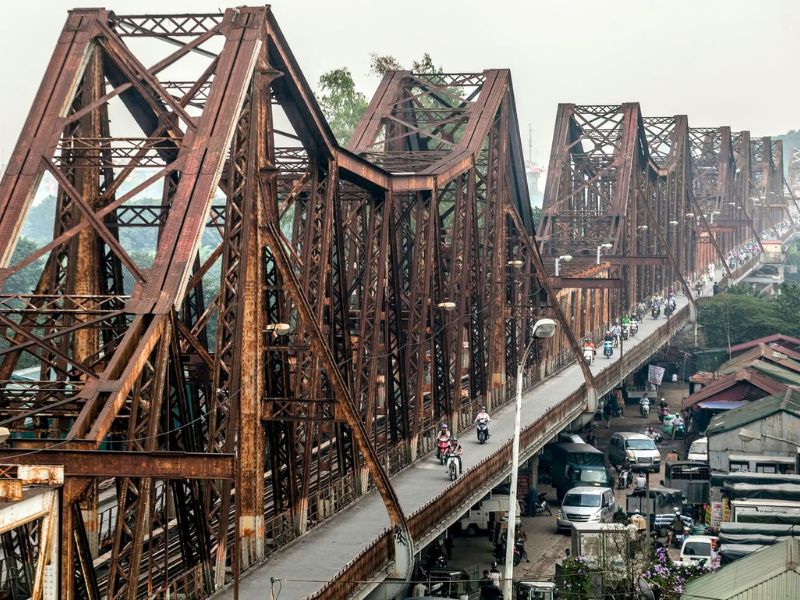
The Long Bien bridge, silent witness to so many epochs of Vietnamese history
The Semi-legendary Period (–1000 BCE)
Starting 1000 years before Christ.
It should be known that the first known historical document that recounts the facts of Vietnam’s history dates only to 1339 after Christ. Until then, due to lack of written documentation, Vietnam’s history was transmitted orally, mixing reality and legends.
Here then are the origins of Vietnam’s history: a legend dating back to the mists of time.
According to the annals, King Lac Long Quân, an illustrious descendant of the Hồng Bàng, from the lineage of dragons — a legendary creature of the southern seas and considered as the chief totem of the first Viet — married an immortal named Âu Cơ, descendant of the mountain spirits.
From this union were born one hundred boys, all beautiful and strong. After this joyous event, the prince and the fairy, aware of the transience of existence and the inevitable brevity of human happiness, decided to part ways. Âu Cơ then departed toward the mountain with fifty of their sons, while the others followed their father toward the shores of the southern seas.
This scattering would have allowed the birth of one hundred regions of Vietnam (Bách Việt), distributed over a vast zone comprised between the Red River in the north, Champa in the south, the South China Sea in the east, and Sichuan in the west. Of all these lordships, the most dynamic and best organized seemed to be the Lac Việt, or Văn Lang, literally “the land of scholars,” whose extent corresponded to present-day northern Vietnam up to the northern part of central Vietnam.
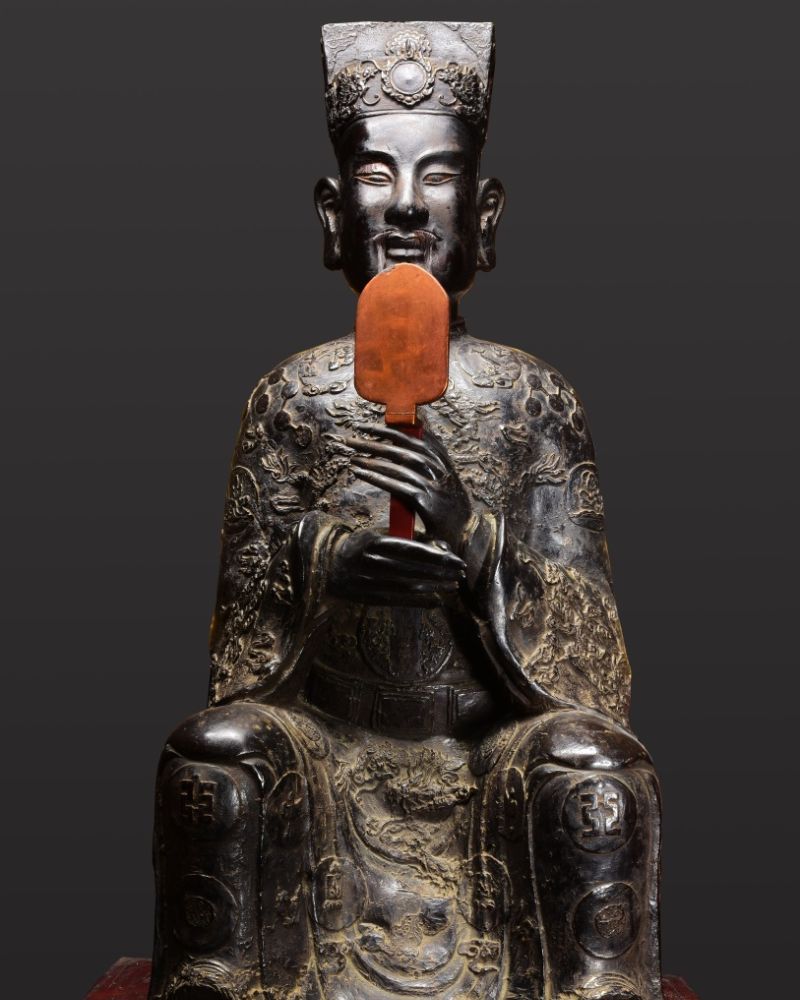
An Dương Vương – Mythical king of Âu Lạc, whose statue perpetuates the memory of the visionary sovereign and the tragic fate of Cổ Loa
Legend gives way to history beginning in 257 BCE. King An Dương Vương, a Chinese sovereign, descendant of the Thục, ruled over the kingdom of Tây Âu (present-day Yunnan, in China). Angered at being refused the hand of a Vietnamese princess, he raised an army and undertook the annexation of Lạc Việt. He made it the kingdom of Âu Lạc (an abbreviation of Tây Âu and Lạc Việt). King An Dương reigned until 208 BCE, thanks in particular to the protection of a spiral-shaped citadel, called Loa Thành.
In 206 BCE, the Chinese general Zhao Tuo, called by the Vietnamese Triệu Đà, overthrew King An Dương. Nicknamed the “General Triệu Đà,” he reigned over Nam Việt, one of the hundred viet lordships of the coastal zone located northeast of present-day Tonkin. He subdued the kingdom of Âu Lạc through a matrimonial ruse: a arranged marriage between his son Trọng Thủy and Princess Mỵ Châu, daughter of King An Dương, allowed the conquest of the nine-walled citadel, considered until then impregnable. Zhao Tuo founded the dynasty of the Southern Yue, or Triệu dynasty, and proclaimed himself king of Nam Việt. This dynasty reigned until 111 BCE, a date that marks the establishment of the first Chinese domination in Vietnamese history.
Chinese Domination (111 BCE – 939 CE)
It was then the long night of Vietnamese history, a thousand-year night during which Chinese civilization became firmly established in the country. There were, certainly, numerous uprisings — those of the Trưng sisters (39–43 CE), of Triệu Ẩu (248), of Lý Bôn (544) or again of Phùng Hưng (791) — but most were quickly suppressed, or achieved only fleeting success. Chinese domination, which lasted approximately a thousand years (from 111 BCE to 938 CE), can be divided into four distinct periods:
-
First Chinese Domination (111 BCE – 43 CE)
In 111 BCE, the Chinese general Lü Bode (Lô Bác Đức) conquers the kingdom of Nam Việt, ending the independence of this State founded by Triệu Đà. The region is then integrated into the Han empire and placed under Chinese protectorate, known by the name Giao Chỉ (present-day Tonkin).
Under this domination, China imposes its administration, its fiscal system and its culture, initiating a first phase of sinification of the country. Nevertheless, the inhabitants retain a strong sense of identity and mount sporadic resistance to the occupation.
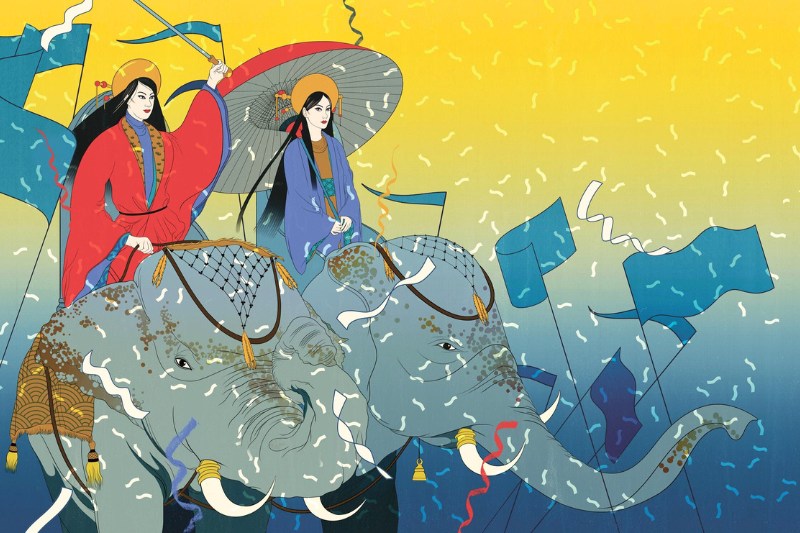
The Trưng sisters – heroines of Vietnamese resistance against Chinese domination (40–43 CE)
Between 39 and 43 CE, the famous revolt of the Trưng sisters, Trưng Trắc and Trưng Nhị, daughters of a local chief, breaks out. Leading a vast insurrection, they manage to drive out Chinese authorities and govern for three years. Their defeat before the troops of General Ma Viên (Mã Viện) ends this brief episode of independence, but their courage makes them the first national heroines of Vietnam, symbols of resistance and the pride of the Vietnamese people.
-
Second Chinese Domination (44 – 543 CE)
After the bloody repression of the Trưng sisters’ revolt, Vietnamese territory falls back under China’s domination for nearly five centuries. This period sees the installation of powerful Chinese governors, such as Tích Quang and Sĩ Nhiếp, considered as “civilizing administrators.” They introduce the administrative model, Confucian rituals and Chinese writing, initiating a profound process of sinification.
The country, then called Giao Chỉ, then Giao Châu, is integrated into the Chinese empire and becomes a regional center of culture and commerce. Nevertheless, despite this influence, the local population retains its own identity and nurtures a strong sense of autonomy.
It is also during this era that the kingdom of Lâm Ấp forms in central Vietnam, ancestor of future Champa. Relations between Giao Châu and Lâm Ấp oscillate between exchanges and conflicts, Chinese authorities conducting numerous military campaigns against this new kingdom.
-
Earlier Lý Dynasty (544 – 602)
In the middle of the VI century, in a context of intermittent Chinese domination, Lý Bí, known by the name of the kingdom Lý Nam Đế, rises against the invaders and founds an ephemeral but symbolic dynasty: that of the Earlier Lý. He proclaims the creation of the kingdom of Vạn Xuân, “Ten Thousand Springs,” a name bearing hope and rebirth for the Vietnamese people.
This period, marked by constant struggles against China and the emergence of various rival local dynasties (Later Triệu, Later Lý), remains confused and unstable. According to legend, Lý Nam Đế conducted his last heroic resistance at the “Lake of Night” (Hồ Tụy Động), before the region fell back under Chinese domination in 602.
Despite its brevity, this first attempt at lasting independence remains a founding symbol of Vietnamese patriotism and the will to national self-assertion.
-
Third Chinese Domination (603 – 938)
A new period of Chinese domination. The country bore the names of An Nam đô hộ phủ (“Protectorate-General of Annam”) and Trấn Nam đô hộ phủ (“Protectorate-General of the South”).
Under the Tang (618–907 and 923–936), Tonkin was profoundly marked by the governor Cao Biền, the founding of Đại La and by strong administrative organization.
Nevertheless, numerous popular uprisings broke out, presaging the victory of Ngô Quyền over the Bạch Đằng River in 939, which ended ten centuries of Chinese domination.
The Great National Dynasties (939 – 1945)
Return to National Independence (939)
One must wait until the X century to see the conclusion of nearly a millennium of Chinese domination. The resounding victory of the Bạch Đằng River, achieved by Ngô Quyền in 939, marks a decisive turning point in Vietnamese history: for the first time, the country regains its full independence.
Ngô Quyền then founds the first national dynasty, laying the foundations of autonomous Vietnamese central power. From this moment on, Vietnamese history is organized around a succession of dynasties, each contributing to the construction, consolidation, and expansion of the realm.
For nearly ten centuries, eight dynasties succeed one another on the throne of Đại Việt, animated by the same will to defend national identity and ensure the continuity of power.
Ngô Dynasty (939 – 967)
After centuries of Chinese domination, Ngô Quyền achieves the famous victory of the Bạch Đằng River in 938, definitively ending China’s grip on Vietnam. He founds the Ngô dynasty the following year and establishes the capital at Cổ Loa, in the north of the country.
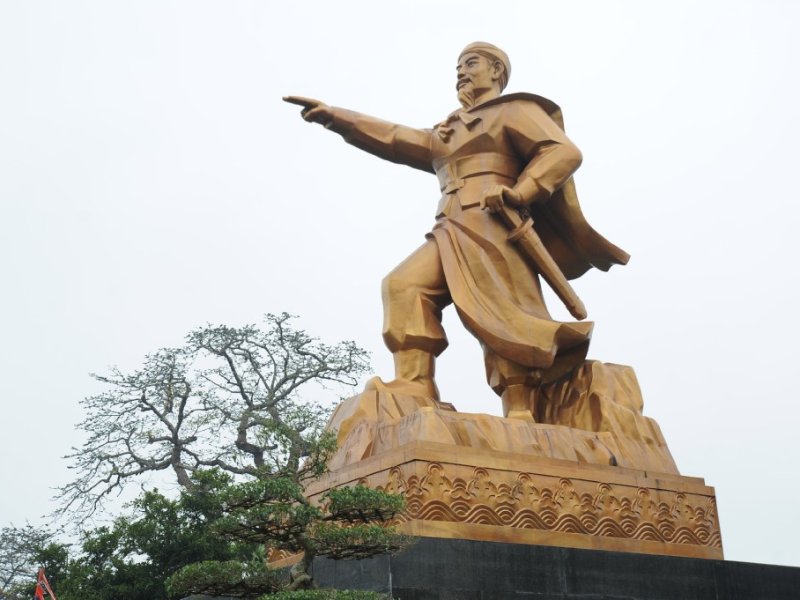
Ngô Quyền (939) – The hero who ended a thousand years of Chinese domination and founded the first independent dynasty of Vietnam
This reign marks the return of national independence and the birth of autonomous Vietnamese power. Nevertheless, after Ngô Quyền’s death in 944, the realm sinks into anarchy: various local chiefs contend for power, causing the division of the territory into twelve rival fiefs.
This period, known as the “Rebellion of the Twelve Warlords” – the rebellion of the twelve seigneurs – ends only with the reunification of the country by Đinh Bộ Lĩnh, future founder of the Đinh dynasty.
Đinh Dynasty (968 – 980)
After decades of feudal wars that followed the end of Chinese domination, Đinh Bộ Lĩnh succeeds in unifying the country and founds the first truly independent monarchy of Vietnam. Crowned under the name of Đinh Tiên Hoàng (963–979), he establishes his capital at Hoa Lư (present-day province of Ninh Bình) and proclaims the Đại Cồ Việt, first official name of the independent Vietnamese realm.
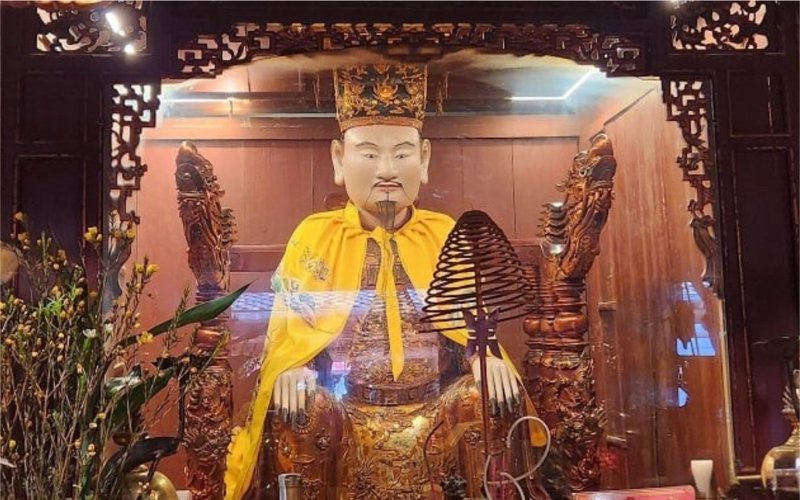
Đinh Tiên Hoàng – First emperor of the Đại Cồ Việt, symbol of national unity
His reign marks the return of national sovereignty and the implementation of the first administrative and military structures of a centralized State. Despite its brief duration, the Đinh dynasty constitutes a founding stage in the political construction of Vietnam and in the affirmation of its independent identity in the face of China.
Earlier Lê Dynasty (980 – 1009)
Lê Đại Hành (Hán characters: 黎大行; personal name: Lê Hoàn, August 10, 941 – April 18, 1005) was the founder of the Earlier Lê dynasty, a decisive stage in the consolidation of Vietnamese independence.
Following the fall of the Đinh dynasty, Lê Hoàn seized power, restored the unity of the realm and victoriously repelled invasions of the Song dynasty from China, thereby reaffirming the sovereignty of the Đại Cồ Việt. An energetic sovereign and able strategist, he also conducted several victorious campaigns against Champa, consolidating the southern borders of the country.
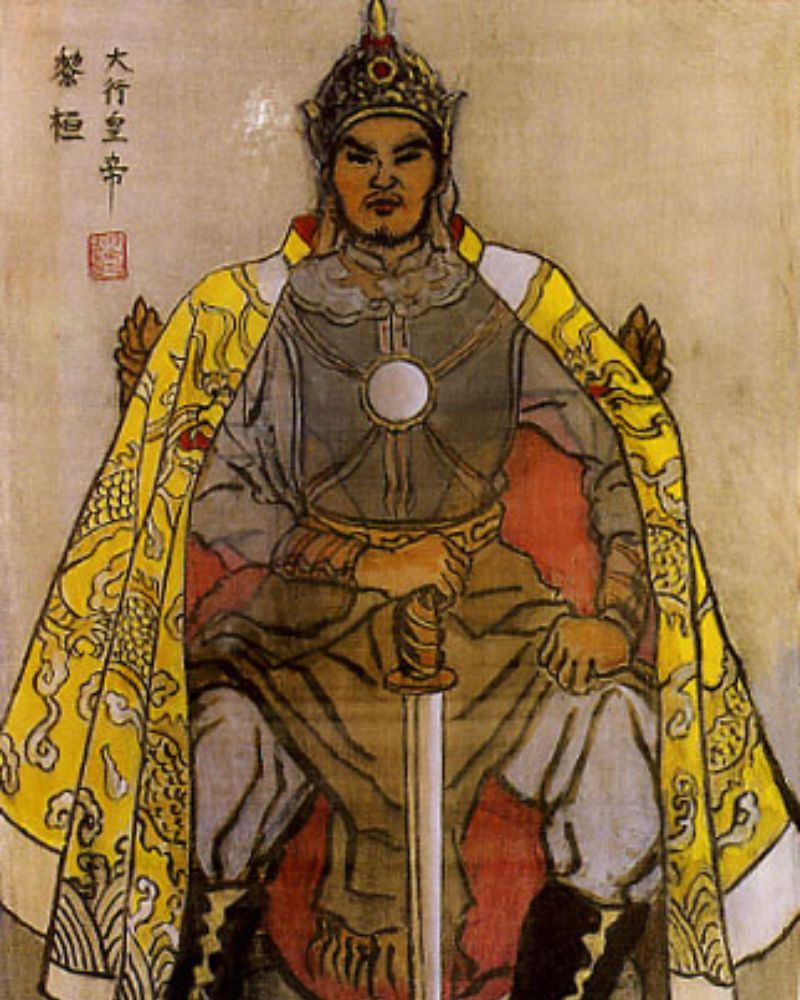
Lê Đại Hành – The warrior sovereign who brought triumph to the Đại Cồ Việt against invasions and ensured the stability of the young independent realm
His reign was devoted to the pacification of internal disorders, the reorganization of administration and the stabilization of central power, laying the foundations of a structured and durable State. Though brief, the dynasty he founded opened an era of political stability and national pride, preparing the ground for the great Vietnamese dynasties that would mark the centuries to come.
Lý Dynasty (1010 – 1225)
Founded by Lý Thái Tổ (Lý Công Uẩn, 974 – 1028), the Lý dynasty opens an era of prosperity and lasting stability in Vietnamese history. In 1010, the sovereign transfers the capital to Thăng Long, present-day Hanoi, marking the symbolic beginning of an organized realm turned toward the future.
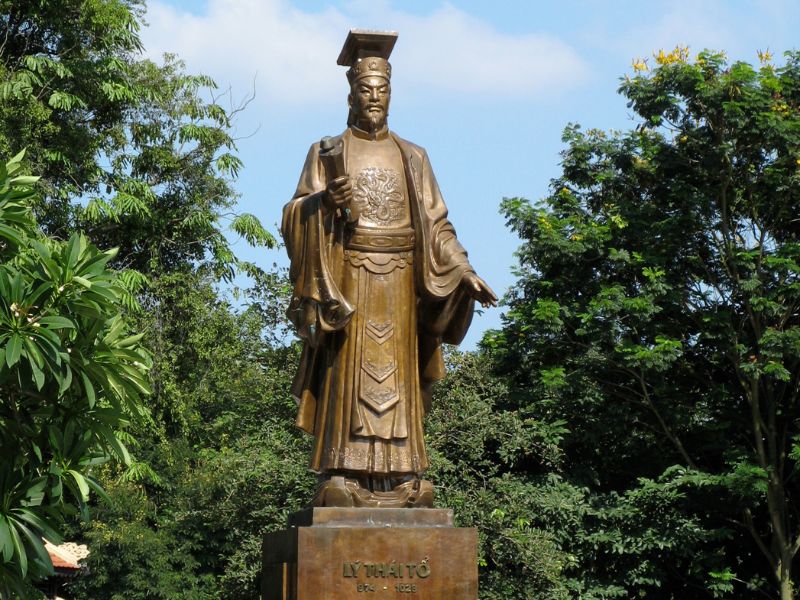
Lý Thái Tổ (974 – 1028) – Founder of the Lý dynasty and of the kingdom of Đại Việt. In 1010, he transferred the capital to Thăng Long, present-day Hanoi
Under the Lý, the country consolidates its territorial and political unity. The sovereigns continue the defense of the territory against China and the Champa kingdom, while developing a centralized administration, a structured army and an expanding economy.
Buddhism, the State religion, experiences remarkable development during this time and deeply permeates the culture, art and intellectual life of Đại Việt. Great hydraulic works, temples and pagodas emerge, testifying to the prosperity of the realm.
In 1054, the country officially takes the name of Đại Việt, a symbol of greatness and independence. This denomination lasts until 1164, before the realm is recognized by the name of Annam, a title retained until 1802.
Trần Dynasty (1225 – 1400)
The Trần dynasty succeeds the Lý and continues the work of unification and consolidation of Đại Việt. Under their reign, the country experiences a period of economic and cultural prosperity, marked by the strengthening of administration, the development of commerce and the arts, as well as the spread of Buddhism.
The Trần distinguish themselves especially for their resounding victories against Mongol invasions in the XIII century. Three times, the armies of Đại Việt repel the offensives of the Mongol empire, particularly thanks to the military genius of Marshal-Prince Trần Hưng Đạo, a legendary figure and national hero.
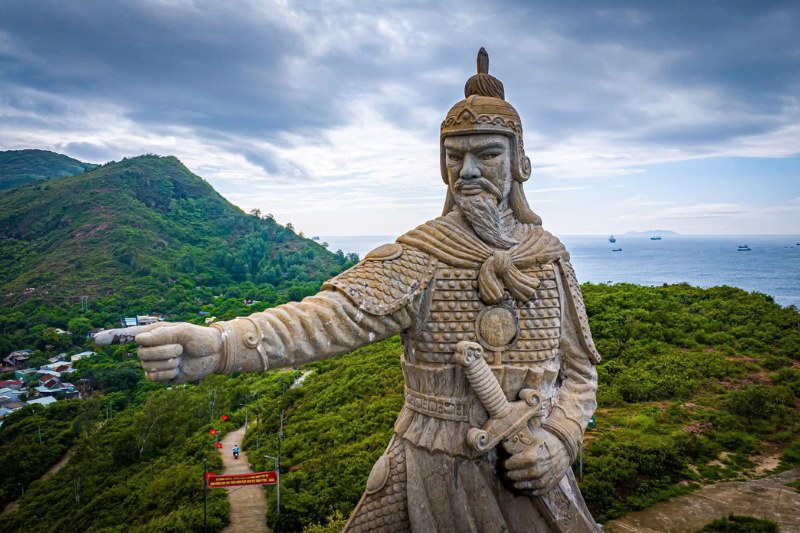
Dominating the sea at Quy Nhơn, the sacred statue of Trần Hưng Đạo unites the land, sky and waters – a tribute to the invincible spirit of Vietnam
Despite internal tensions and progressive weakening at the end of the XIV century, the Trần dynasty leaves the image of a golden age of Vietnamese patriotism and resilience. During this period, the country retains the name of Annam (1164 – 1802), under which it is recognized in diplomatic exchanges.
Hồ Dynasty (1400 – 1407)
In 1400, Hồ Quý Ly overthrows the Trần dynasty and seizes the throne, founding the Hồ dynasty. An ambitious reformer, he attempts to modernize the administration, the currency and the educational system, while seeking to strengthen central power. Nevertheless, his brutal reforms and his controversial rise to power provoke strong internal resistance. The country, immersed in political and social chaos, becomes vulnerable to the ambitions of neighboring China. Taking advantage of this instability, the Ming dynasty intervenes militarily in 1407, ending the brief existence of the Hồ regime.
Ming Chinese Domination (1407 – 1427)
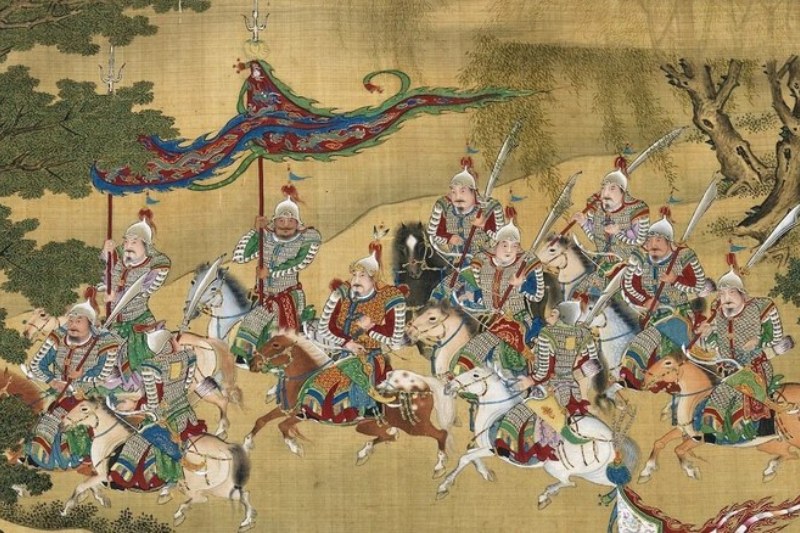
Under Ming occupation, Vietnam underwent a policy of forced assimilation: destruction of archives, prohibition of the Vietnamese language and plundering of cultural treasures
After the fall of the Hồ dynasty, the armies of the Ming dynasty invade Đại Việt and impose their domination for twenty years. The territory, renamed “Giao Chỉ,” is administered as a province of the Chinese empire. This period is characterized by a policy of cultural assimilation, the destruction of many Vietnamese works and the exploitation of local resources. Despite the repression, the national spirit does not disappear and paves the way for resistance led by Lê Lợi, founder of the next dynasty.
Lê Dynasty (1428 – 1789)
Starting from Lam Sơn (province of Thanh Hóa), Lê Lợi conducts a heroic ten-year struggle against Ming Chinese occupation. In 1428, he triumphs and founds the Lê dynasty, inaugurating one of the most enduring and influential periods of Vietnamese history.
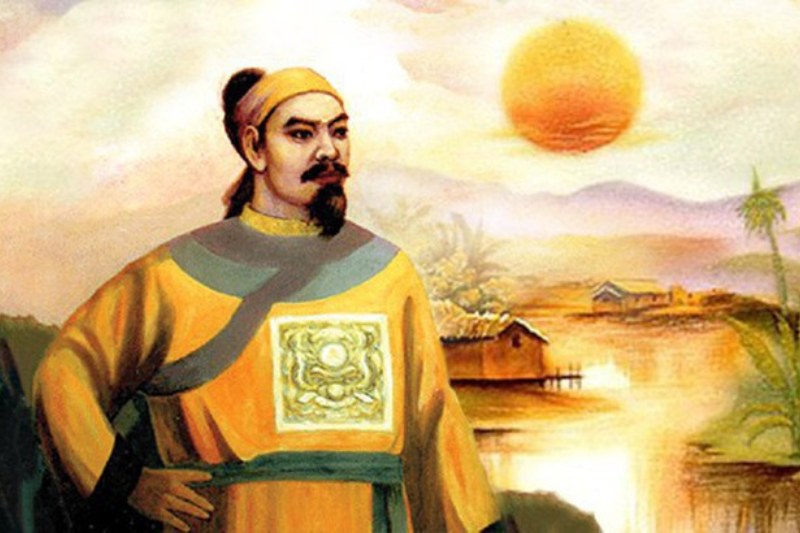
Lê Lợi – The hero of Lam Sơn who liberated the country from Chinese occupation and laid the foundations for a strong and independent Vietnam
Under the early sovereigns, particularly Lê Thánh Tông (1460–1497), the realm achieves a high degree of organization and stability. The administration, army and justice are codified with rigor in the Lê code, while culture and literature experience remarkable development. Great historical, geographical and literary works emerge, written in Chinese characters or in demotic nôm script.
Confucianism becomes the ideology of State, strengthening the role of scholars and mandarin examinations. In parallel, Christianity makes its appearance with European missionaries, while the first commercial contacts with the West intensify. In the XVII century, the missionary Alexandre de Rhodes develops the quốc ngữ transcription system, at the origin of modern Vietnamese writing.
On the territorial front, the Lê consolidate their definitive victory over Champa and initiate an expansion toward the South (Nam Tiến), particularly through dynastic alliances in which Vietnamese princesses marry sovereigns of Champa and Chenla (Cambodia).
Nevertheless, from the XVI century onward, real power weakens, giving way to a long factional war between the Trịnh lords in the North and the Nguyễn lords in the South, a prelude to the political division of the country before the advent of the next dynasty.
Nguyễn Dynasty (1802 – 1945)
Gia Long, after defeating the Northern lords and the Tây Sơn dynasty (1788–1802), founded the Nguyễn dynasty. The realm then took the name of Việt Nam from 1804 to 1820, then of Đại Nam starting in 1820.
Vietnam might have known several centuries of respite but for the rivalry, many centuries old, between the Trịnh lords in the North and the Nguyễn lords in the South, who challenged the authority of the Lê kings and constituted two independent fiefs to the detriment of national unity. These rivalries set the country ablaze starting in 1627 and lasted until 1775, when both families fell into decline.
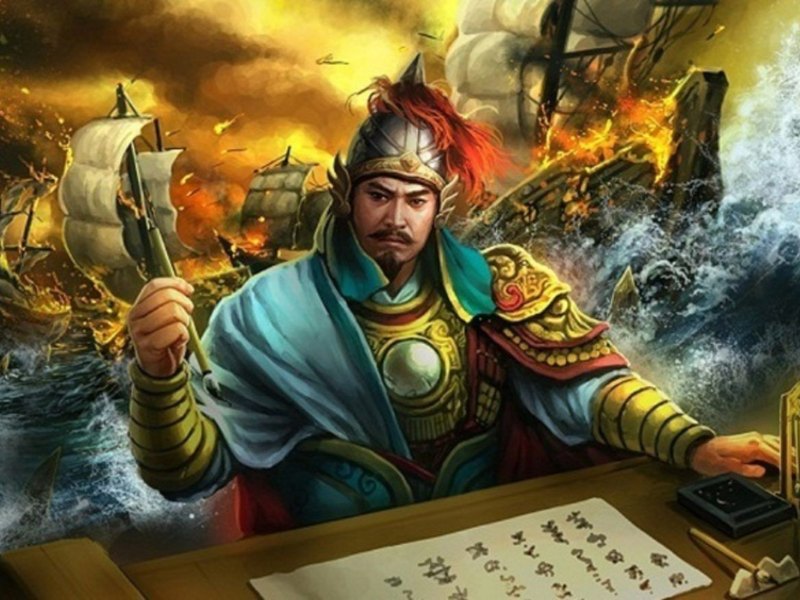
Quang Trung – The visionary strategist of the Tây Sơn who unified Vietnam and repelled Manchu armies, symbol of Vietnamese courage and patriotism
Fortunately, the spirit that animated the first Viet remained intact. In the most critical moments of history, farsighted patriots always appeared at the right moment to restore the unity of the country. Thus, from the bosom of the peasantry, arose the Tây Sơn brothers, who took advantage of internal divisions to raise the banner of liberation. They drove out the Nguyễn at the same time and put to flight the last Lê sovereign. One of them, Nguyễn Huệ, proclaimed himself emperor under the name Quang Trung, and with him the country recovered its original unity. Unfortunately, he died in 1792, unable to ensure the permanence of his dynasty.
Reunification
Meanwhile, in the South, Nguyễn Ánh, successor of the Nguyễn lords, resumed the struggle against the Tây Sơn, then weakened, and succeeded in 1801 in unifying the country once again after twenty-seven years of war. He proclaimed himself emperor in 1802 and took as his reign name Gia Long, a contraction of Gia Định (Lower Cochinchina) and Thăng Long (capital of northern Vietnam).
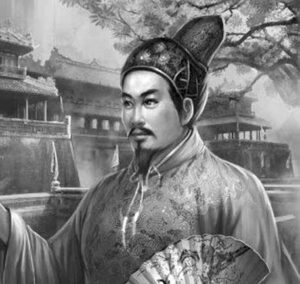
Gia Long – The builder sovereign who united South and North, bringing forth a unified Vietnam between Gia Định and Thăng Long
He adopted the national name of Việt Nam, to clearly signify that the realm encompassed both the territories of ancient Annam (Tonkin proper) and Việt Thường, corresponding to ancient Champa, to which Lower Cochinchina was added. Starting from the reign of Gia Long, Vietnam experienced a brief period of peace, soon interrupted in the second half of the XIX century by the irruption of French squadrons into its territorial waters.
The Sovereigns of the Nguyễn Dynasty
- Gia Long (1802–1819)
First emperor of the Nguyễn dynasty in Vietnamese history. Of his birth name Nguyễn Phúc Ánh (or Thánh Tổ Gia Long), born in Huế in 1759, a cadet grandson of the lord of Huế Định Vương, he is considered as the founder of modern Vietnam. He had 31 children (13 sons and 18 daughters).
- Minh Mạng (1820–1840)
Of his name Nguyễn Phúc Đảm, born in 1791, fourth son of Gia Long. A rigorous legislator, he pursued a policy opposite to that of his father: anti-European and anti-Christian.
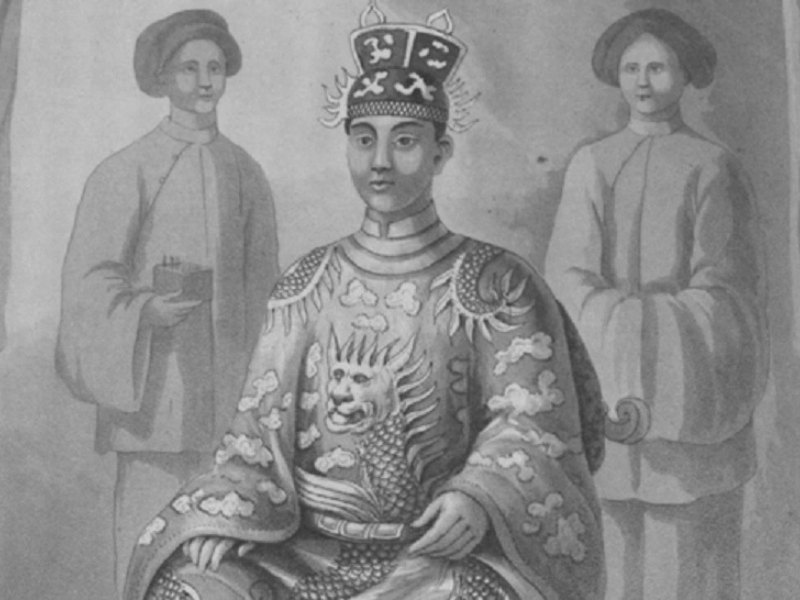
Minh Mạng – Emperor of the Nguyễn, symbol of rigor and imperial order
In 1825, he promulgated the first persecutions of Christians and adopted a centralizing policy. An enlightened prince, active and talented administrator, he had numerous public works carried out and reformed the educational system.
He died following a fall from his horse. He had 142 children (78 sons and 64 daughters), including princes Tuy Lý and Tùng Thiện.
- Thiệu Trị (1841–1847)
Of his name Nguyễn Phúc Miên Tông, elder son of Minh Mạng, born in 1807. He continued his father’s policy and died of an apoplectic stroke caused, it is said, by the false news that French ships were preparing to bombard Vietnamese coasts.
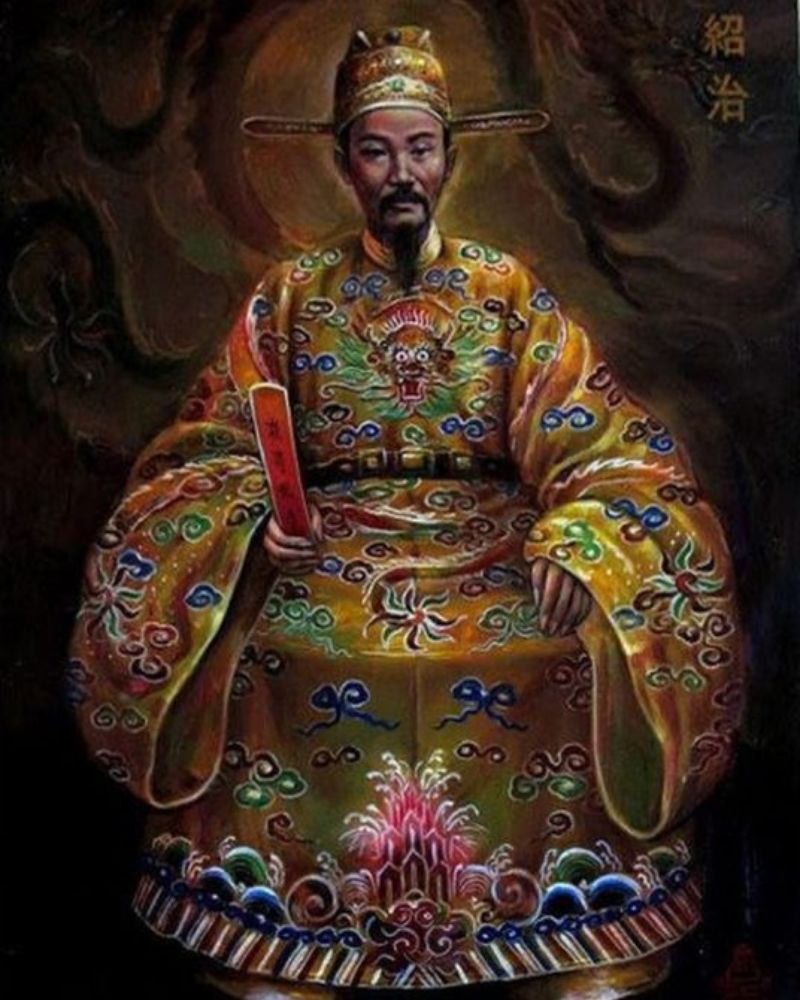
Thiệu Trị – Son of Minh Mạng, he continued the centralization of power while protecting Confucian traditions
A conservative monarch and little open to reformist ideas, he showed himself resolutely hostile to the growing influence of Europeans. He would have had objects of Western origin destroyed in the palace. Under his reign, Vietnam reached its maximum extent: in 1846, Cambodia would have ceded Cochinchina to him. He had 64 children (29 sons and 35 daughters).
- Tự Đức (1847–1883)
Of his name Nguyễn Phúc Hồng Nhậm, born in 1829, younger son of Thiệu Trị and a woman from the province of Gò Công (Cochinchina). Crowned in November 1847, he ousted his elder brother Hồng Bảo, who led a revolt in 1848.
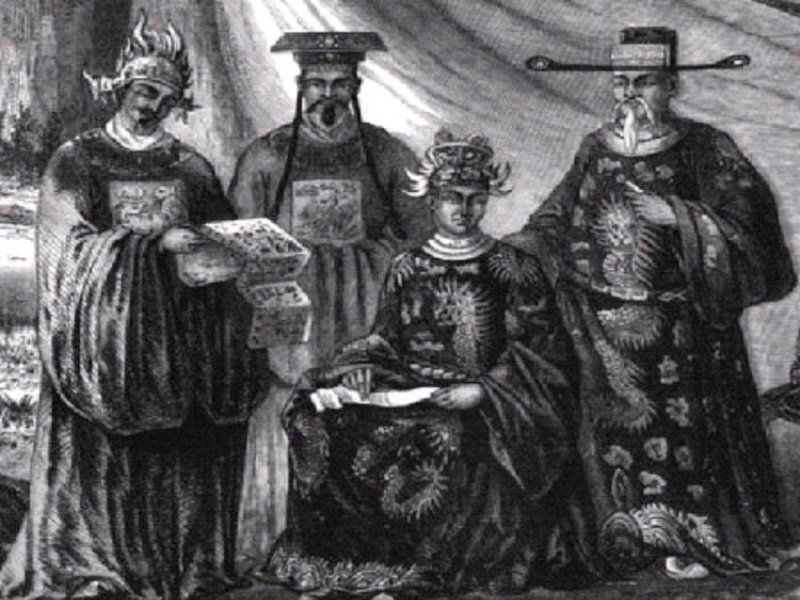
Tự Đức (1829 – 1883) – Fourth emperor of the Nguyễn, last great sovereign before French colonization
The repression was bloody: Tự Đức had his brother and all his family executed. Accused of complicity, Christians underwent new persecutions, offering France and Spain a pretext to intervene. His reign was darkened by the progressive dismemberment of the country and his lack of an heir — a bout of smallpox contracted in 1845 had rendered him sterile. This would explain the dynastic crises that followed.
- Dục Đức (1883)
Son of Prince Thoại Thái Vương (†1877), younger brother of Tự Đức. Adopted by the latter, he succeeded him in July 1883, under the control of a regency council (Nguyễn Văn Tường and Tôn Thất Thuyết).
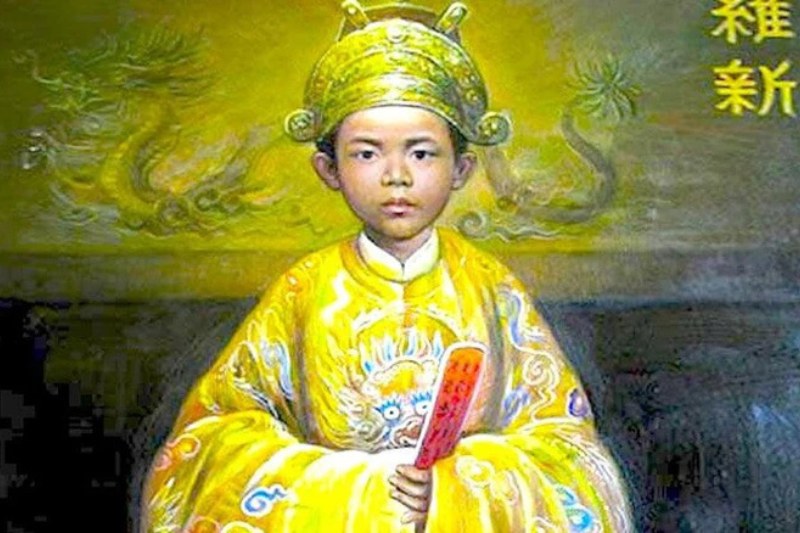
Dục Đức (1852 – 1883) – Ephemeral emperor of the Nguyễn, deposed after three days of reign
Three days after his ascension to the throne, he was deposed and condemned to die of hunger, accused of “debauchery” for not observing the prescriptions of mourning. Imprisoned in a rest pavilion of his predecessor — thereafter called the Dục Đức pavilion — he died there after a week. This pavilion, located in the Citadel of Huế, was transformed into a commemorative pagoda.
- Hàm Nghi (1884–1885)
Born in Huế in 1870, brother of Kiến Phúc, he was crowned king of Annam with French consent on August 2, 1884, at the age of thirteen, under the guardianship of regents Tường and Thuyết. During the Huế ambush (night of July 4–5, 1885), he fled with Tôn Thất Thuyết and took refuge at Cam Lộ, from where the Cần Vương movement (“Support the King”) against the French protectorate was directed.
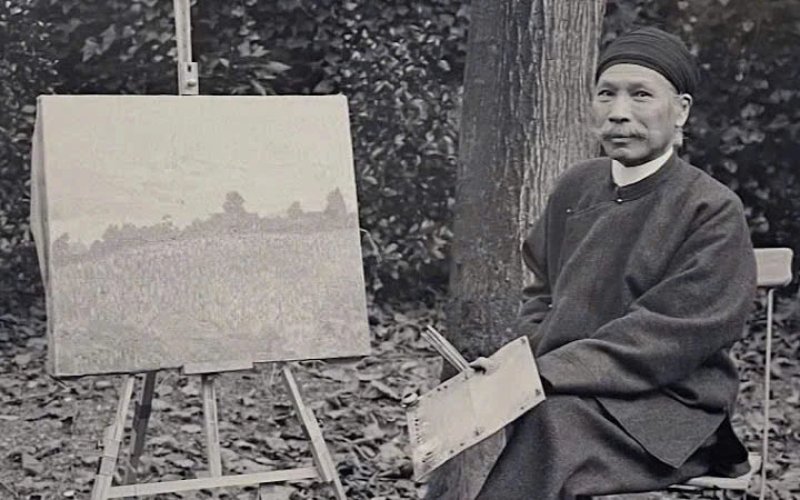
Hàm Nghi – Sovereign-artist and patriot, figure of Vietnamese youth fighting for independence
Captured in 1887 after three years of wandering in the mountains, he was exiled to Algeria in 1888, where he became known as the Prince of Annam. He married in 1904 in Algiers to a young French woman, daughter of the Attorney General. He died in 1947.
- Duy Tân (1907–1916)
Born in 1899, with the name Nguyễn Phúc Vĩnh San. A reformist and patriotic emperor, he attempted to support nationalist movements, which led to his deposition in 1916 by French colonial authorities. Exiled to Africa, he never officially renounced the throne.
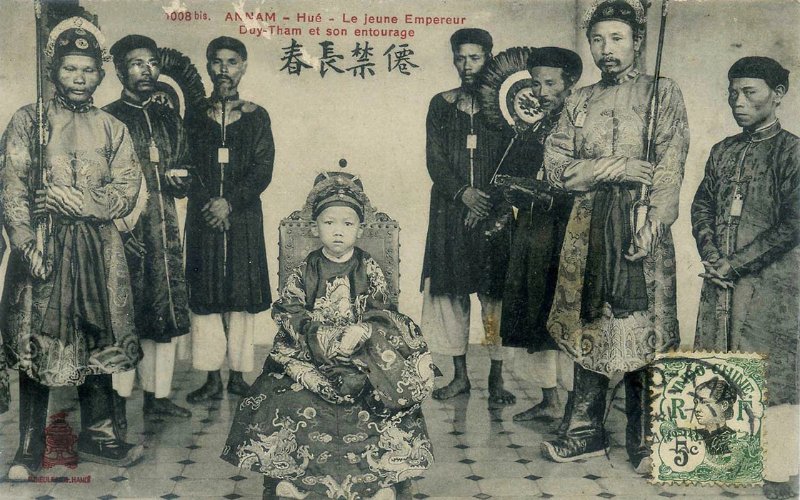
In 1987, thanks to the will of his children and the assistance of Paris Mayor Jacques Chirac, his mortal remains were repatriated to Huế, where he rests today among his ancestors. On this account, he is still considered as the last legitimate emperor of Annam.
- Khải Định (1916–1925)
Born in 1885 with the name Nguyễn Phúc Bửu Đảo, only son of Đồng Khánh. Proclaimed emperor on May 18, 1916, at the age of 31, in a difficult political context, he attempted to assert a sovereignty weakened by French domination.
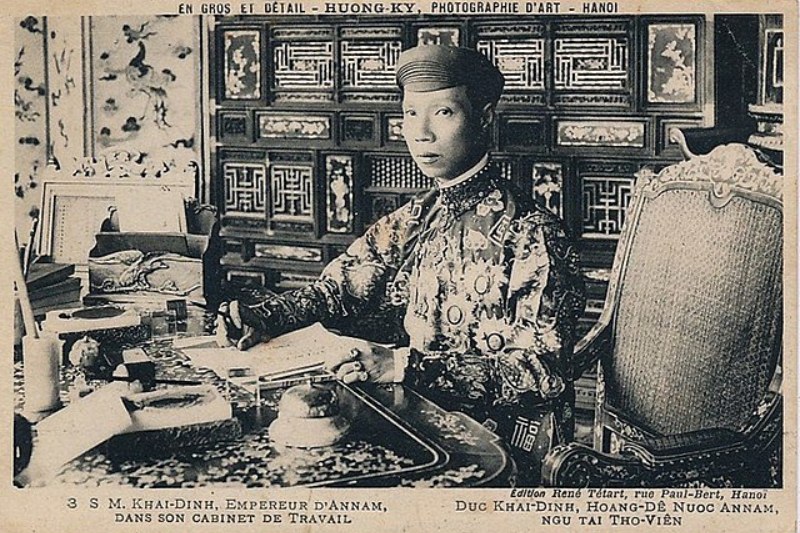
Khải Định (1885 – 1925) – Emperor of the Nguyễn under French protectorate, known for his mausoleum blending Oriental and Western styles
Seeking to modernize the realm, he abolished the mandarin examinations that had become obsolete and was the first Vietnamese sovereign to travel to France. This journey aimed to advocate for true autonomy of Vietnam within the framework of the protectorate. Afflicted by impotence, he left no children and died in November 1925.
- Bảo Đại (1925–1945)
Born in 1913 with the name of Prince Vĩnh Thụy, adopted son of Emperor Khải Định, Bảo Đại is crowned in July 1926, at the age of twelve. Educated in France, he embodies a generation of sovereigns trained in Western culture. His reign officially begins in 1925, but his authority remains strictly limited by French colonial administration, which confines him to an essentially symbolic role.
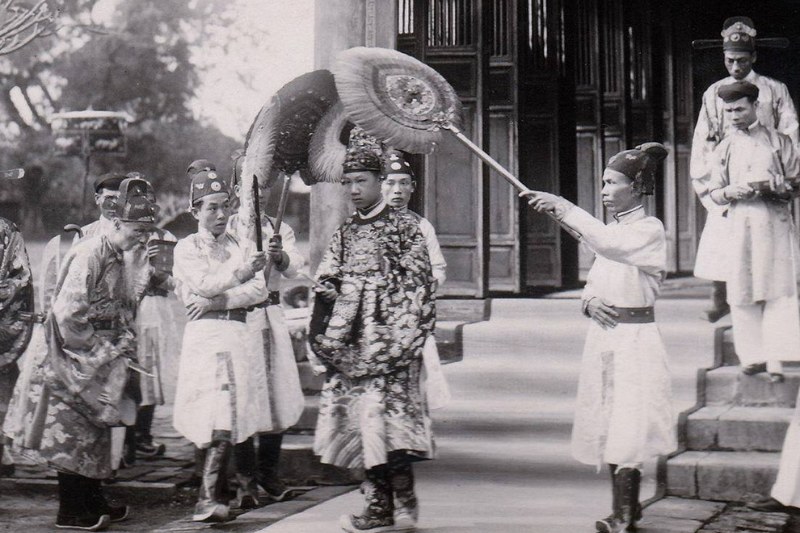
Bao Dai – Last Vietnamese emperor, witness to a decisive turning point in national history
In August 1945, in the context of the August Revolution led by the Việt Minh, Bảo Đại abdicates and accepts the role of Supreme Advisor to the new revolutionary government. The following year, he goes into exile in Hong Kong.
In 1948, France appeals to him to attempt to reestablish a constitutional monarchy under the name of the “State of Vietnam,” considering his abdication as merely a brief interlude. Nevertheless, the project encounters only weak echoes within the Vietnamese population.
After the defeat at Điện Biên Phủ in 1954, the political situation changes: supported by the United States, Ngô Đình Diệm seizes power and overthrows Bảo Đại following a rigged referendum on October 23, 1955. The former emperor settles permanently in France, where he leads a discreet life. He retains, however, the imperial seal, symbol of dynastic legitimacy, until his death in Paris in July 1997.
French Colonization (1862 – 1945)
The Establishment of French Colonial Power
The establishment of French colonial power in Vietnam truly begins in 1862, with the signing of the Treaty of Saigon, by which France obtains control of southern Cochinchina.
Over the years, French presence extends progressively toward the Center (Annam) and the North (Tonkin), up to the official formation of the Indochinese Union in 1887, grouping Vietnam, Laos and Cambodia.
This period marks the beginning of a profound political, economic and cultural domination: France imposes its administration, exploits local resources and introduces an educational and social model inspired by that of the metropolis.
Nevertheless, behind the façade of the “civilizing mission,” colonization translates into the dispossession of lands, a racial hierarchy and growing Vietnamese resistance.
Vietnamese Resistances and Patriotic Movements
From the very installation of French colonial power, the Vietnamese people have never ceased to resist foreign domination.
From popular uprisings to intellectual movements, the struggle for independence takes multiple forms, translating the deep will of the country to recover its sovereignty.
At the end of the XIX century, the Cần Vương movement (“Support the King”) mobilizes the nobility and literati loyal to the Nguyễn dynasty against French occupation.
In parallel, at the beginning of the XX century, two great figures of Vietnamese patriotism emerge:
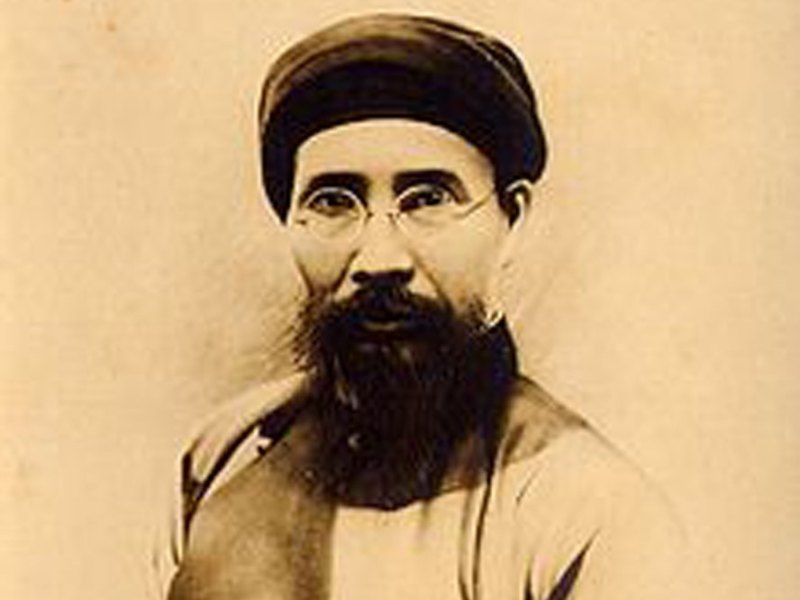
Visionary reformer and man of letters, Phan Bội Châu devoted his life to the independence of Vietnam, calling for the awakening of the people in the face of colonial domination
- Phan Bội Châu, founder of the Đông Du movement (Journey to the East), which encourages young Vietnamese to study in Japan to prepare for the anticolonial struggle;
- Phan Châu Trinh, advocate of peaceful reform, who proposes education and modernization of the country as a means of emancipation.
The following years see the development of secret societies, nationalist associations and workers’ strikes, announcing the revolutionary awakening of the Vietnamese people. This patriotic ferment would prepare the ground for the birth of the Indochinese Communist Party in 1930, under the impetus of Nguyễn Ái Quốc (Hồ Chí Minh).
Revolutionary Awakening: The Creation of the Indochinese Communist Party (1930)
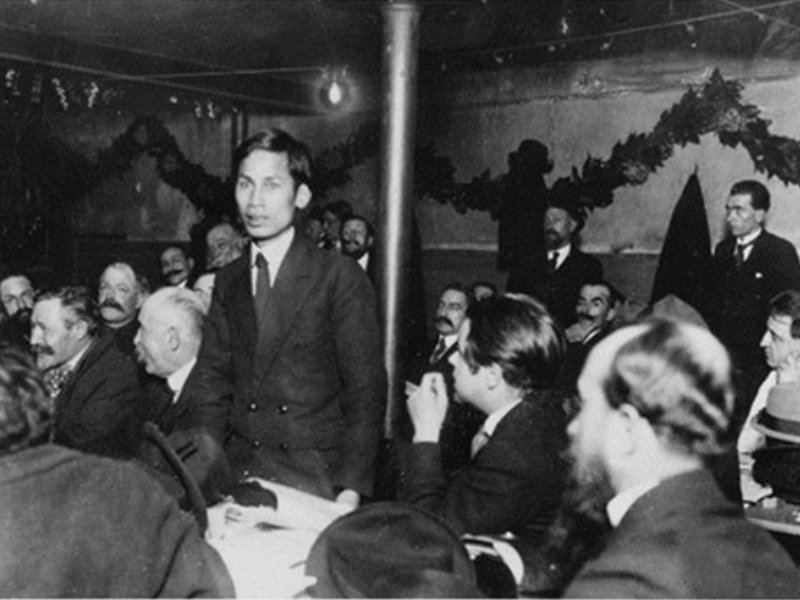
Nguyen Ai Quoc – The man who sowed the seeds of Vietnamese freedom, transforming the pain of colonization into an ideal of emancipation
Around 1930, Vietnam experiences a profound revolutionary awakening. Under the influence of Marxist ideals and the international context, Vietnamese patriotic movements gradually transform into organized revolutionary forces. This evolution finds its most striking expression in the creation of the Indochinese Communist Party (ICP), founded in 1930 in Hong Kong by Nguyễn Ái Quốc, later known by the name Hồ Chí Minh.
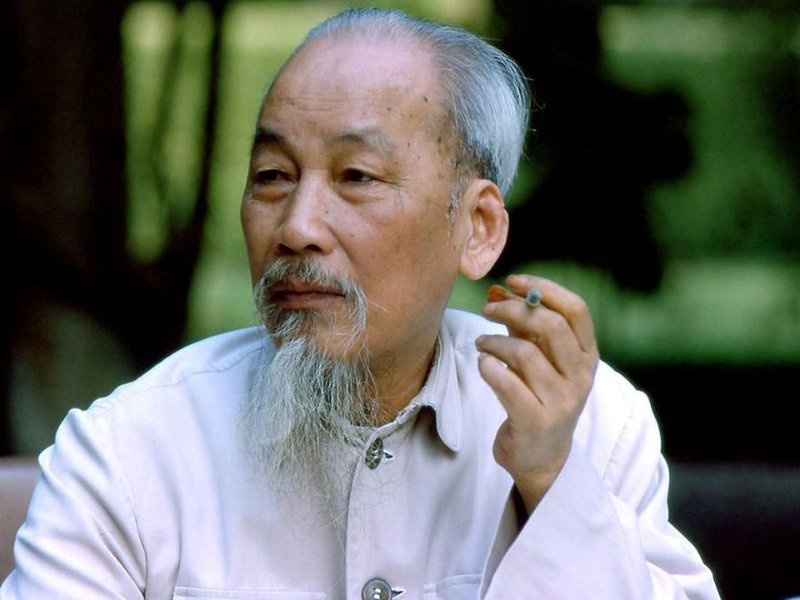
The great President Hồ Chí Minh of our people
This party is born from the merger of several revolutionary groups:
- the Revolutionary Youth Association of Vietnam,
- the Communist Party of Annam,
- and the Communist Party of Indochina of the North.
The ICP advocates national liberation, agrarian reform and solidarity among the peoples of Indochina (Vietnam, Laos, Cambodia). It rapidly becomes the spearhead of the fight against French colonialism and lays the ideological foundations of the Democratic Republic of Vietnam, proclaimed fifteen years later, in 1945.
Colonial Vietnam Through Culture and Cinema
The period of French colonization has profoundly marked Vietnamese culture, leaving an imprint that is at once architectural, linguistic and artistic. In great cities such as Hanoi, Saigon or Huế, Western influence manifests itself through administrative buildings, churches, theaters and French-style boulevards. This architecture testifies to a mixture of Asian traditions and European style, symbol of an era of domination but also of cultural exchanges.
On the artistic front, colonization introduced Latin script (quốc ngữ), which became the official alphabet of the country, as well as the first schools of art and architecture. In parallel, Vietnamese intellectuals used literature and the press to express their national consciousness and criticize the colonial system.
Cinema also immortalized this era. The French film Indochine (1992), directed by Régis Wargnier and starring Catherine Deneuve, retraces life in colonial Vietnam from the 1920s–1950s.
Similarly, The Quiet American (2002), an adaptation of Graham Greene’s novel, evokes Vietnam’s transition from colonization to the Cold War, through a story of love and political engagement.
These works testify to the complex memory of colonial Vietnam, oscillating between aesthetic nostalgia and historical drama, and still contribute today to the understanding of this crucial period of Vietnamese history.
Toward Vietnamese Independence (1945 – 1954)
The Provisional Government of Trần Trọng Kim (1945)
Following the Japanese coup d’etat of March 9, 1945, French authority is neutralized in Vietnam. The imperial government of Trần Trọng Kim is then formed in Huế under the reign of Emperor Bảo Đại. This cabinet, essentially composed of moderate nationalist intellectuals, attempts to establish autonomous Vietnamese administration and to reform the country in a context of world war approaching its end.
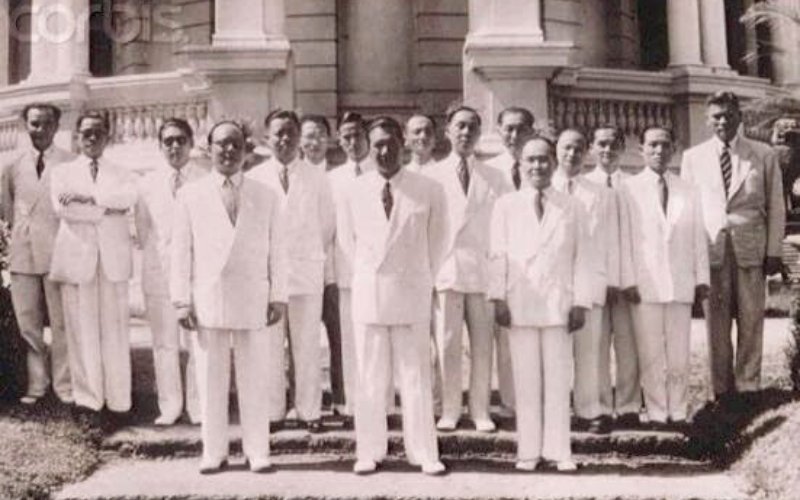
The provisional government of Tran Trong Kim
Nevertheless, this provisional government has only limited power, depending strictly on the Japanese. Its existence comes to an end in August 1945, with the outbreak of the August Revolution, conducted by the Việt Minh under the direction of Hồ Chí Minh.
The Proclamation of Independence on September 2, 1945
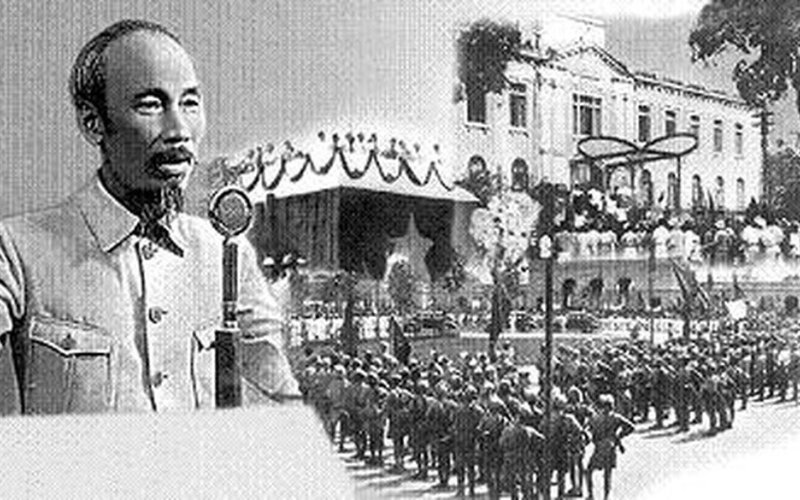
Historic moment in Hanoi: Hồ Chí Minh reads the Declaration of Independence, symbol of the rebirth of the Vietnamese people after centuries of domination
On September 2, 1945, in Ba Đình Square in Hanoi, President Hồ Chí Minh solemnly proclaims the Declaration of Independence of Vietnam, announcing the birth of the Democratic Republic of Vietnam. This text is inspired both by the Declaration of Independence of the United States (1776) and by the Declaration of the Rights of Man and Citizen (1789), asserting the right of the Vietnamese people to self-determination.
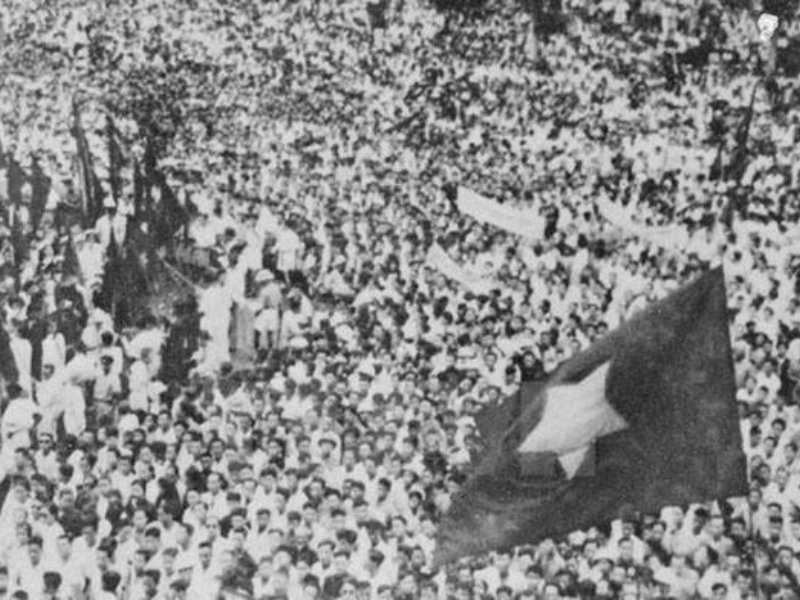
This event marks a major historical break: after more than 80 years of colonial domination, Vietnam regains its de facto sovereignty. Nevertheless, international recognition is slow to arrive, and France refuses to relinquish its influence in Indochina, opening the way to a new armed conflict.
From the August Revolution to International Recognition (1945 – 1954)
After the proclamation of independence, the young Vietnamese government must face multiple challenges: French reconquest, internal struggles and international pressures. From 1946, the situation degenerates into the Indochina War, pitting French troops against the Việt Minh, a nationalist and communist movement. For nearly eight years, the country experiences fierce struggle, punctuated by decisive battles, particularly that of Điện Biên Phủ, in May 1954, which sees the total defeat of the French army.
This military victory entails the signing of the Geneva Accords in July 1954, by which France officially recognizes the independence of Vietnam, as well as of Laos and Cambodia. These accords mark the end of the French colonial regime in Indochina, but also the beginning of a new division of the country, prefiguring the Vietnam War to come.
The Vietnam War (1954 – 1975)
The Geneva Accords and the Partition of Vietnam (1954)
The Geneva Conference, held from April 26 to July 21, 1954, marks the end of the first Indochina War opposing France to the Việt Minh. These international negotiations bring together the great powers of the era — France, United Kingdom, Soviet Union, China and United States — as well as delegations from Vietnam, Laos and Cambodia.
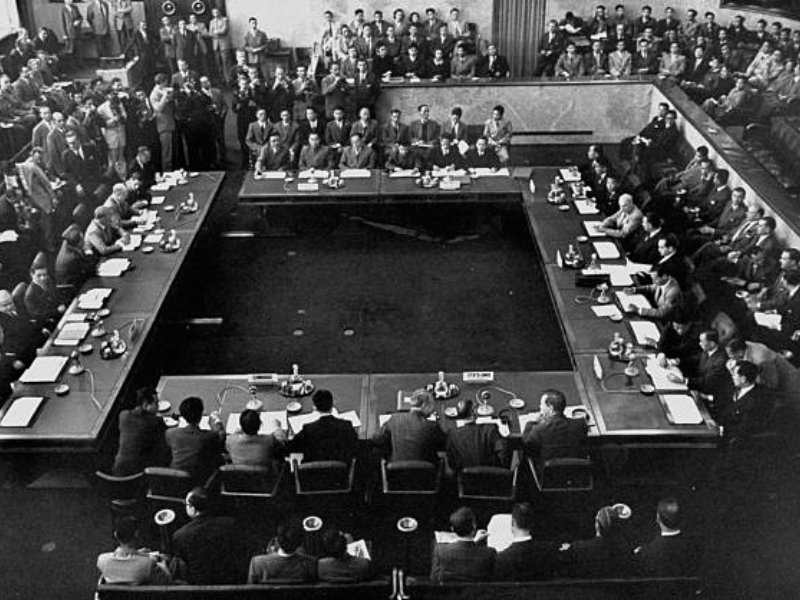
The Geneva Accords (1954) – A major turning point in Vietnamese diplomacy: they ended the Indochina War and recognized the independence of Vietnam, Laos and Cambodia
The Geneva Accords, signed on July 21, 1954, consecrate the official recognition of the independence of Vietnam, Laos and Cambodia. Nevertheless, they also provide for a temporary partition of Vietnam along the 17th parallel north, intended to precede national elections scheduled for 1956.
In the north, power is entrusted to the Democratic Republic of Vietnam, directed by Hồ Chí Minh, while in the south, the State of Vietnam remains under the nominal authority of Bảo Đại, assisted by his Prime Minister Ngô Đình Diệm.
This division, conceived as a transitional measure, rapidly transforms into a lasting separation, marking the beginning of the Vietnam War, one of the most striking conflicts of the XX century.
Two Vietnamese States: Communist North and Anticommunist South
From 1955, Ngô Đình Diệm excludes Bảo Đại and proclaims the Republic of Vietnam, with Saigon as the capital. The country is then divided into two antagonistic States:
- in the North, a communist regime supported by China and the Soviet Union,
- in the South, an anticommunist government supported by the United States and its Western allies.
Each claims legitimacy to represent all the Vietnamese people. The political climate hardens, tensions increase, and the reunification promised by the Geneva Accords seems now impossible.
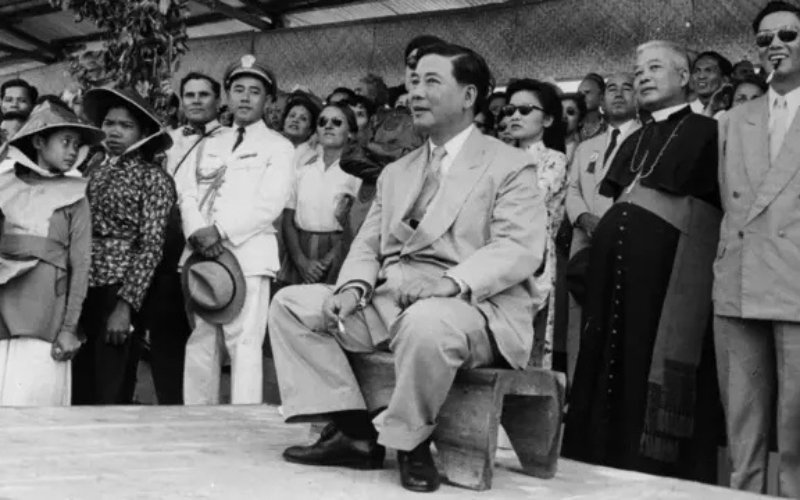
Ngô Đình Diệm (1901 – 1963) – First president of South Vietnam, he established an authoritarian regime, repressive toward opposition and Buddhists, before being overthrown by a coup
The Machinery of War and American Intervention
Faced with the expansion of communism in Asia, the United States becomes increasingly involved in the Vietnamese conflict, under the pretext of containing the “domino theory.” Starting in 1964, after the Gulf of Tonkin incident, Washington massively sends troops to South Vietnam.
What was to be a local war then becomes total warfare. Massive bombings, such as Operation Rolling Thunder, and ground interventions plunge the country into an unprecedented humanitarian tragedy. Despite their military power, the United States fails to defeat the guerrilla of the National Liberation Front (Việt Cộng), supported by the North.
The Fall of Saigon and the End of the War (April 30, 1975)
After the progressive withdrawal of American troops (1973), South Vietnam finds itself isolated and weakened. On April 30, 1975, North Vietnamese forces enter Saigon, putting an end to twenty years of war.
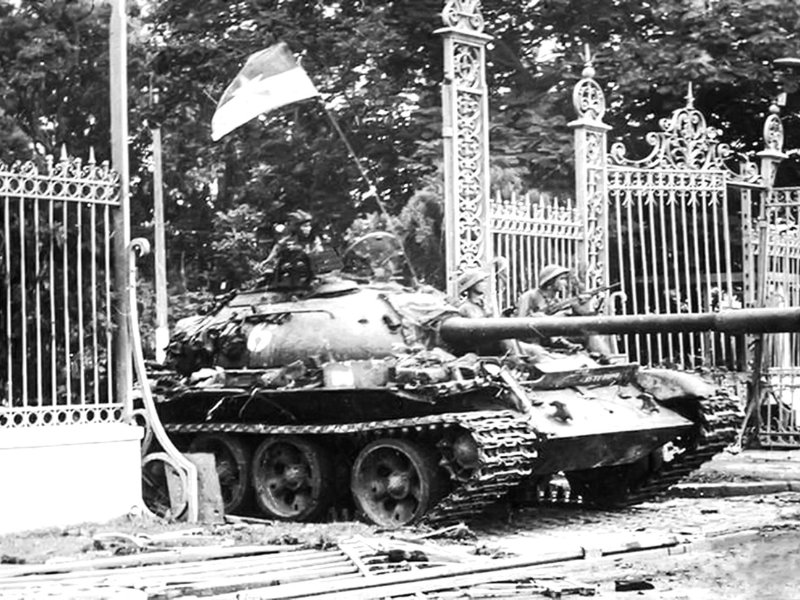
Victory of April 30, 1975 – The fall of Saigon ends the Vietnam War and marks the beginning of a new era of reunification, reconstruction and national defense.
The army tanks invaded the presidential palace, while the last president of the South, Dương Văn Minh, announced unconditional surrender. This historic day marks the fall of Saigon and the victory of the North, opening the way to the reunification of the country.
The Exodus of the “Boat People” and the Reunification of Vietnam (1976)
The exodus of the “boat people” and the reunification of Vietnam (1976). The end of the war does not immediately end the suffering. Hundreds of thousands of Vietnamese, fearing reprisals or fleeing poverty, leave the country by sea. These refugees, called the “boat people,” undertake a perilous crossing toward Malaysia, Thailand, the Philippines or the United States.
In 1976, the Socialist Republic of Vietnam is officially proclaimed. Hanoi becomes the capital of the reunified country, while Saigon takes the name of Hồ Chí Minh City. The country then comes under a unified communist regime, initiating a new era marked by reconstruction and international isolation.
From 1975 to the Present Day (1975 – 2025)
The Difficult Years of the Postwar Period (1975 – 1986)
After the reunification of Vietnam in 1976, the country enters a period of profound economic and social difficulties. From 1975 to 1982, more than one million people are sent to reeducation camps or relocated to new economic zones. Personal property — homes, businesses, lands and enterprises — are often confiscated or nationalized. In parallel, hundreds of thousands of Vietnamese flee the country, often by sea.
Known by the name of “boat people,” these refugees seek asylum in Malaysia, Thailand, the Philippines, United States, Canada or France. According to the United Nations High Commissioner for Refugees (UNHCR), nearly three million people leave Indochina between 1975 and 1997.
In January 1979, Vietnam enters the Third Indochina War, fighting on two fronts:
- In the South, against Cambodia of the Khmer Rouge, in order to liberate this country from the pro-Chinese genocide regime;
- In the North, against People’s China, during a brief but violent border conflict.
Vietnamese occupation in Cambodia would last until 1989, before the implementation of a UN peacekeeping mission.
Economic Reforms and International Opening (1986 – 2000)
In 1986, Vietnam launches a series of economic reforms known by the name Đổi Mới (“Renewal”). This turning point marks the transition from a centralized economy toward a socialist market economy, encouraging private initiative and foreign investment.
Starting in the 1990s, the country opens on the diplomatic level:
- 1992: reestablishment of diplomatic relations with the United States and normalization with People’s China;
- 1994: lifting of the American embargo, opening the way to foreign investment;
- 1995: official accession of Vietnam to ASEAN, symbol of its return to the regional scene.
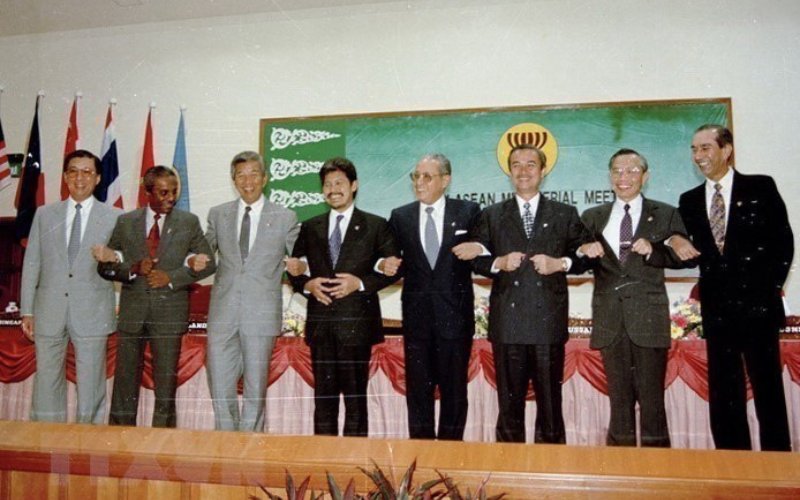
1995 – Vietnam joins ASEAN. This event symbolizes a decisive stage in diplomatic renewal and the opening of the country toward its neighbors and the world.
These reforms initiate a period of rapid growth, accompanied by a perceptible improvement in the standard of living.
Vietnam in the XXI Century (2000 – 2025)
At the beginning of the XXI century, Vietnam continues its integration into the world economy. It becomes a member of the World Trade Organization (WTO) in 2007, a sign of its commitment to globalization. The economy has since experienced average annual growth of 6–7%, supported by exports, tourism and the technology industry.
The country remains a socialist republic with a single party. The Vietnamese Communist Party (VCP) retains the monopoly on power, directing the State, the government and the army.
The supreme body, the National Assembly, elects:
- the President of the Republic,
- the Prime Minister,
- and the General Secretary of the Communist Party, considered as the most powerful leader of the country.
Leaders of Vietnam in 2025:
- President of the Socialist Republic of Vietnam: Lương Cường
- Prime Minister: Phạm Minh Chính
- General Secretary of the Communist Party of Vietnam: Tô Lâm
On the international front, Vietnam today maintains balanced relations with the great powers: the United States, China, Japan, South Korea and the European Union. The country is recognized for its political stability, its skilled workforce, and its growing role in global supply chains, particularly in the sectors of electronics, textiles and renewable energies.
In 2025, Vietnam positions itself as one of the most dynamic countries of Southeast Asia, while preserving its cultural identity and its historical heritage.