+84 9 75 46 33 10 (Whatsapp)
  info@horizon-vietnamtravel.com
  Français
  Español
  Português
  Deutsch

Lunar and Solar Calendars in Vietnam
Table of contents
Calendars in Vietnam, Origins and Influences
Before explaining the specifics of the Lunar and Solar Calendars in Vietnam, it is useful to remind you of their origin and use throughout the world.
Calendars and zodiac signs have always influenced civilizations worldwide. Throughout the world, numerous calendars are used to measure time, but the main ones are: the solar calendar, the lunar calendar, and the lunisolar calendar.
The solar calendar is based solely on the annual cycle of the Sun; the lunar calendar on the phases of the Moon; the lunisolar calendar, meanwhile, is based on both the annual solar cycle and the phases of the Moon. The Sun and Moon are the two celestial bodies that contribute to the construction of most calendars.
In this article, Horizon Vietnam Travel offers you a general overview of the 3 types of calendars and also the corresponding zodiac signs. Let’s explore them!
How Is a Solar Year Formed?
One revolution of the Earth around the Sun takes 365.2422 days (365 days, 5 hours, 48 minutes, and 46 seconds). To simplify calculation, 365 days are taken for a solar year. Within these 365 days, the full moon is observed a total of 12 times, so a year is divided into 12 months. Because 365 is not divisible by 12, a year must be divided into complete months (31 days) and incomplete months (30 days). February is also an incomplete month, but it has only 28 days.
And the 5 hours, 48 minutes, and 46 seconds that remain? Over 4 consecutive years, this remainder forms nearly a full day, and this day is added to February of the fourth year. This fourth year is called a “leap year,” with 366 days. The February of a leap year has 29 days, and the 29th day of this month is called the “leap day.”
And a Lunar Year?
The Moon is important for measuring time. The lunar year is calculated based on the full moon phase. The full moon is the phenomenon during which this celestial body appears most luminous to us. Ancient peoples discovered that the full moon phase lasts 29.53 days. They took this phase as a means to calculate time and called it a “month,” comprising complete and incomplete months.
A year contains 12 full moons, so ancient peoples divided it into 12 months. A lunar year has 354 or 355 days. A complete month has 30 days, while an incomplete month has 29.
The Chinese calendar is often confused with the lunar calendar. In reality, the calendar used by the Chinese is a lunisolar calendar. The lunar calendar is officially used by Muslims, who use only this type of calendar – based on a year of 12 lunar months of 29 to 30 days each.
Understanding the Lunisolar Calendar Better
Time changes because the Earth rotates on its tilted 23-degree axis and orbits the Sun. We speak of full seasons to characterize summer and winter, and half-seasons to qualify spring and autumn. A period of change from warm to cold weather spans 364 days. A lunar year has only 354 – 355 days, so each year a gap of 10-11 days is created between the solar calendar and the lunar calendar.
After 3 years, the gap is more than a month. So after three consecutive years, in accordance with the climate change cycle, ancient peoples would add a month to the third year. This year would have 13 months (384 or 385 days), and the added month is called an “intercalary month” or “leap month.” The method of using an intercalary month to adapt to the climate change cycle is actually a combination of the lunar calendar and the solar calendar. Such a calendar is called a lunisolar calendar.
The lunisolar calendar is also known as the traditional Chinese calendar. This type of calendar is widely used to define traditional holidays. Another purpose is to help choose an auspicious day for important events such as marriage, moving to a new home, etc.
Calendars in Vietnam
In Vietnam, two types of calendars are used: the solar calendar and the lunisolar calendar. The solar calendar is used for international holidays, while the lunisolar calendar is used for traditional holidays and rituals such as marriages, ancestor worship, etc.
The festival of Têt or Vietnamese Lunar New Year (more accurately: the Vietnamese Lunisolar New Year) is the most important holiday in Vietnam. Because of the calculation made by the lunisolar calendar, Têt often occurs at the end of January, later than the regular New Year. Têt is a wonderful time for foreign tourists to spend their vacation in Vietnam while enjoying the festive atmosphere. For example, Têt 2020 fell on January 25, 2020.
Dates of Important Holidays in Vietnam
Besides Têt, there are other important holidays in Vietnam:
- Hung Kings’ Worship Ceremony (3/10 – lunisolar calendar): The veneration of the Hung Kings is a strong expression of the nation’s historical consciousness and the people’s respect for their ancestors.
- Buddha’s Birthday (4/15 – lunisolar calendar): The celebration of Buddha’s birthday is not only a religious holiday but also a national holiday.
- Reunification Day (4/30): The victory of the Vietnamese People’s Army over American armed forces with the capture of Saigon.
- President Ho Chi Minh’s Birthday (5/19): President Ho Chi Minh is a symbol of national spirit who dedicated his life to the liberation of the Vietnamese people (5/19/1890 – 9/2/1969).
- National Day (9/2): Vietnam’s National Day commemorates the proclamation of Vietnamese independence by Ho Chi Minh on September 2, 1945.
- August Revolution Day (8/19): The success of the August Revolution gave birth to the Democratic Republic of Vietnam.
- Vu Lan Festival (7/15 – lunisolar calendar): Literally “liberation of the dead” – a major Buddhist festival.
- Mid-Autumn Festival (8/15 – lunisolar calendar): During this harvest festival, Vietnamese people typically consume sticky rice cakes shaped like the moon, filled with lotus seeds, watermelon seeds, peanuts, duck egg yolk, raisins, and sugar.
- Kitchen God Festival (12/23 – lunisolar calendar): The family’s tutelary deity departs for Heaven on the night of the 23rd day of the last lunar month, riding a carp, to report on the family’s affairs to the Jade Emperor over the past year. On this day, the house is cleaned, especially the kitchen, and offerings are prepared to bid farewell to the deity.
12 Zodiac Signs and Their Use in Vietnam’s Calendars
Chinese astrology is based on a 12-year cycle. The cycle is based on the traditional Chinese calendar, and each year corresponds to an animal. The twelve zodiac animals are, in order: the Rat, the Ox, the Tiger, the Rabbit, the Dragon, the Snake, the Horse, the Goat, the Monkey, the Rooster, the Dog, and the Pig.
According to legend, when the Buddha was about to leave the Earth, he invited all his friends and animals to come and bid him farewell. Among his animal friends, only 12 responded to the Buddha’s invitation. To thank them, the Buddha decided to name the 12 animals who came to say goodbye after each year of the lunisolar cycle.
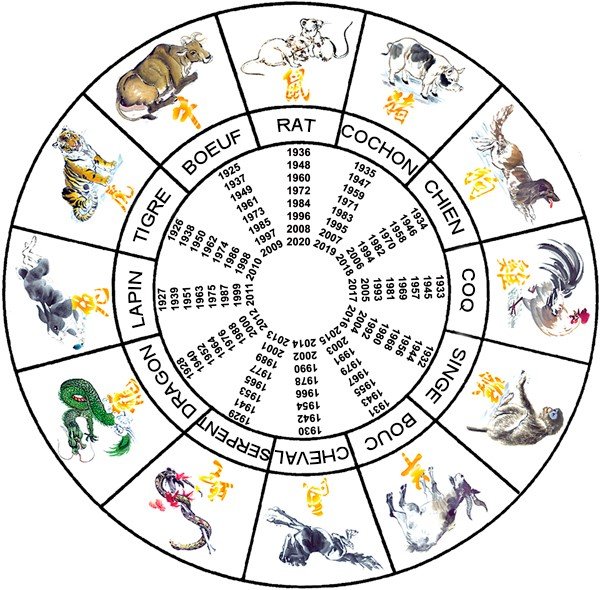
In this section, Horizon Vietnam Travel explains how to discover your own astrological sign. Find out everything about your lucky animal!
Correspondence Table
| Zodiac Sign | Personality | Lucky Numbers | Best Compatibility | Lucky Colors |
| Rat | Independent, intelligent, shrewd, and kind | 2, 3 | Ox, Dragon, Rabbit | Blue, gold, and green |
| Ox (or Water Buffalo) | Hardworking, honest, and patient | 1, 9 | Rat, Snake, and Rooster | White, yellow, and green |
| Tiger | Competitive, courageous, unpredictable, stubborn, and confident | 1, 3, 4 | Dragon, Horse, and Pig | Blue, gray, orange, and white |
| Rabbit (Hare or Cat) | Kind, elegant, calm, patient, cautious, and responsible | 3, 4, 9 | Goat, Monkey, Dog, and Pig | Red, pink, purple, and blue |
| Dragon | Courageous, intelligent, arrogant, and confident | 1, 6, 7 | Rooster, Rat, and Monkey | Gold, silver, white, and gray |
| Snake | Mysterious, intelligent, wise, elegant | 2, 8, 9 | Dragon and Rooster | Black, red, and yellow |
| Horse | Active, dynamic, and energetic, somewhat self-centered | 2, 3, 7 | Tiger, Goat, and Rabbit | Yellow and green |
| Goat (or Sheep) | Tender, sweet, shy, stable, likeable | 3, 4, 9 | Rabbit, Horse, and Pig | Green, red, and purple |
| Monkey | Intelligent, clever, well-mannered, curious | 1, 8, 7 | Ox and Rabbit | White, blue, and gold |
| Rooster (or Phoenix) | Honest and talkative, hardworking, open, and loyal | 5, 7, 8 | Ox and Snake | Gold, brown, and yellow |
| Dog | Loyal, lovable, kind, cautious, sincere | 3, 4, 9 | Rabbit | Red, green, and purple |
| Pig (or Boar, Wild Boar, Elephant) | Diligent, compassionate, kind, and patient | 2, 5, 8 | Goat, Rabbit, and Tiger | Yellow, gray, brown, and gold |
Horizon Vietnam Travel hopes this article has been helpful with the information provided about the calendars in Vietnam and the zodiac signs. Happy reading!