+84 9 75 46 33 10 (Whatsapp)
  info@horizon-vietnamtravel.com
  Français
  Español
  Português
  Deutsch

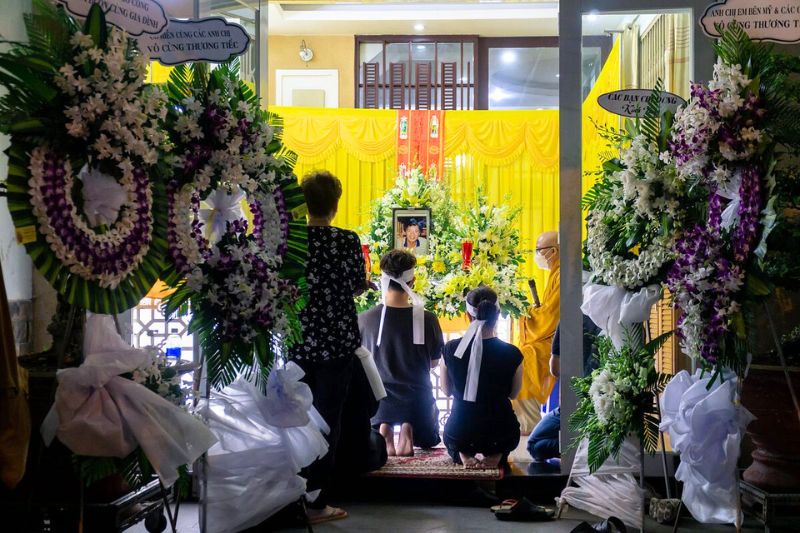
Mourning in Vietnam
Table of contents
The mourning rites in Vietnam allow people to express two conflicting sentiments: the grief for a loved one and the desire to properly prepare them for the journey to the other world.
The belief in the parallel existence within a person of a material body and an intangible soul that, after death, would go “to the other world,” and the habit of living for the future (a consequence of the Yin-yang philosophical way of thinking), mean that the Vietnamese await death with calm and serenity.
People prepare meticulously and scrupulously to welcome their own death or that of a loved one and to bid them farewell at the moment of the journey to eternity. Dying old is thus considered a happiness. People say: Trẻ làm ma, già làm hội (for the young, funerals; for the old, banquets). In some places, when an elder dies, firecrackers are set off, and the great-grandchildren and great-great-grandchildren wear mourning in red and yellow.
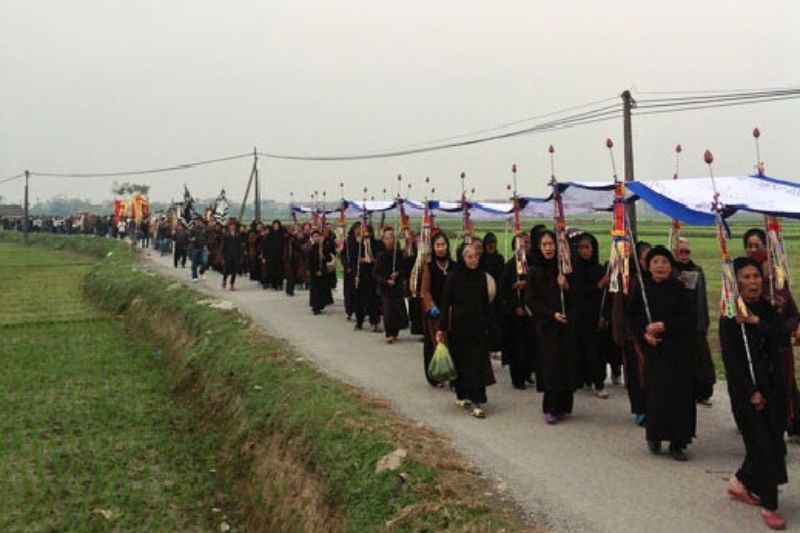
Mourning ceremony in northern Vietnam
The Ceremony
In general, the elderly themselves buy the cỗ hậu (set for the last journey) or cỗ thọ (longevity set). In Vietnam, the coffin is a parallelepiped with a square cross-section, symbolizing the yin world, that is, the afterlife according to yin-yang philosophy. In the West, the coffin is a hexagon with two non-identical ends, following the morphology of the body.
Some take the precaution of making a quách, that is, an additional casing for the coffin. The expression « trong quan ngoài quách » in Vietnamese means « coffin inside and quách outside ». It is used to speak of the meticulousness with which a funeral has been prepared.
In a person’s final moments, the most urgent thing is to give them a nôm hèm or thụy, that is, a posthumous name. It will be the last name that the deceased designated for themselves during life, or chosen by their descendants. This posthumous name is then known only to the dead person, their heirs and the protector god of the household. This is to prevent wandering souls from mingling with or replacing that of the deceased during commemorative ceremonies. During rice offerings, for example, when the heir responsible for the worship invokes the soul of the deceased, they call it by its hèm name. The tutelary god lets in only the one that responds to this appellation. That is why this name is also “the rice offering.”
Before the wrapping in the shroud, there is the ceremony of washing the deceased. A pinch of glutinous rice is placed in the mouth for nourishment. Money is also given to the deceased to pay for the boat crossing to the afterlife. During the operation, a piece of cloth is placed over the deceased’s face to spare them from seeing the sadness of their loved ones. In the coffin, ever since the time of the Hung kings, there has been a custom of sharing belongings with the departed in the form of real or symbolic objects. Currently, the Vietnamese have the habit of placing small personal objects in the coffin such as combs and mirrors….
Once this ceremony is over, on the tomb is placed a bowl of rice topped with a hard-boiled egg, with a pair of chopsticks (planted in the rice). In some places, a small core of straw is added. This custom has as its deep meaning a vow, a wish: the core of straw symbolizes the chaos from which the Great Pole is formed, represented by the rice. The Great Pole generates the Two Powers (the yin and the yang). Finally, life is symbolized by the egg.
The whole, based on the philosophy of the origin of life as written in the Book of Changes, proclaims the desire to see the soul of the departed reincarnate quickly.
After the mourning period (three years, but in practice 27 months), for the serenity of the soul of the dead, who will be able to watch over the descendants and ensure their health and prosperity, there is the custom of changing the burial. After opening the coffin, the bones are collected, cleaned with scented water and transferred into a small ceramic vessel that is placed back in the ground in a location chosen in advance according to precise geomantic criteria.
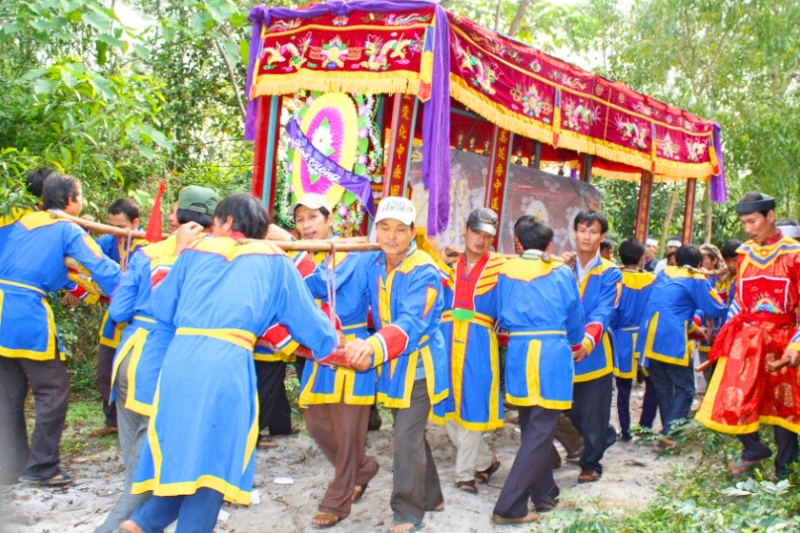
An ethnic minority funeral
In mourning, Vietnam is torn between two extremes: On one side, the philosophical viewpoint that considers death as the passage into another world, another life, and the funeral ceremony is merely a kind of farewell, the procession serving to accompany the dead on the road of their journey. On the other side, it is simply the prosaic viewpoint of the loss of a loved one, and the funeral serves to express grief and pain.
The grief that drives the descendants to want to hold the dead back: this tendency is symbolized by the custom of calling the soul of the deceased. People climb onto the roof of the house with a jacket of the departed and their three souls and their vital supports (seven if it is a man and nine if it is a woman).
The mourning rites testify to the importance of grief and the feelings of family members according to the degree of kinship with the departed. The colors of mourning are white and black: the worst colors according to the “five principles” (for the peoples of Southeast Asia). The sons wear very loose clothes; the boys also have a straw hood and lean on a stick; the daughters and daughters-in-law keep their hair loose, with a mũ mấn (a kind of hemp-cloth headdress) on the head and a piece of cloth over the face. During the procession, there is the custom of rolling on the ground. The grandchildren and relatives wear white turbans. After the burial, during the mourning, the descendants continue to wear the turban, with unhemmed clothes, the seam on the outside. People no longer comb their hair and walk barefoot…
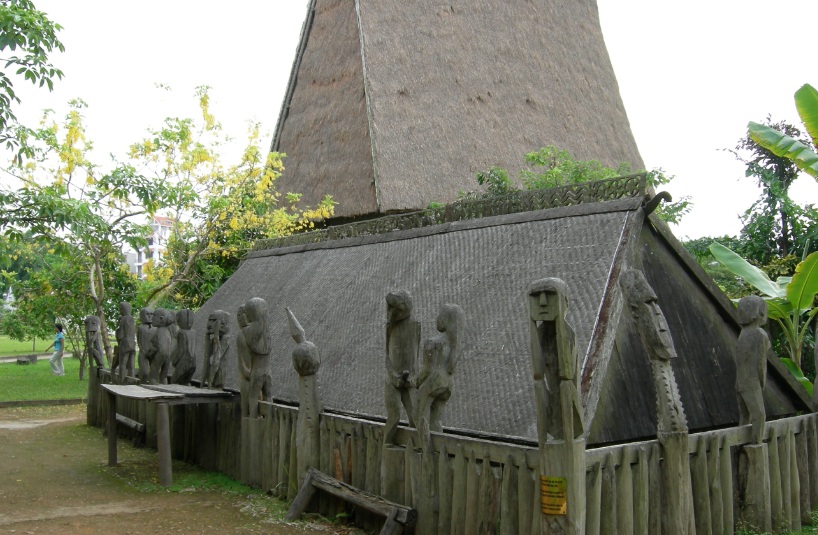
A tomb of the central highlands ethnic groups
Community life
In the realm of funeral ceremonies, the communal character also emerges clearly: on these occasions, the people of the neighborhood never fail to come and lend a hand or give advice, including with the formalities, since the family members, often blinded by grief, no longer know which way to turn. In Vietnam, people often say: “Bán anh em xa không bằng mua láng giềng gần” (it is better to sell distant relatives to buy close neighbors). This is true, and it happens that people from the neighborhood mourn the deceased ‘‘Họ đường ba tháng, láng giềng 3 ngày” (among relatives, one mourns for at least 3 months; among neighbors, it is at least 3 days). The farmer, who is very close to the land, has close relationships with nature, which is why, sometimes, at the death of the master of the place, the trees are made to mourn by hanging white ribbons on them.