+84 9 75 46 33 10 (Whatsapp)
  info@horizon-vietnamtravel.com
  Français
  Español
  Português
  Deutsch

Rice in Vietnam: An Ancestral and Sacred Culture
Table of contents
In Vietnam, rice is far more than a simple food. It is at the heart of daily life, traditions, and the country’s economy. Present at every meal, from breakfast to dinner, it accompanies Vietnamese people throughout their lives: from early childhood, through family celebrations, religious festivals, to funeral rites. Rice is also found in proverbs, legends, and even in the simplest gestures of daily life. But rice does not only shape habits: it also shapes landscapes. From the terraced rice paddies of the North to the vast plains of the Mekong Delta, it is cultivated in all regions of the country using techniques that are sometimes ancestral, sometimes modern. This close bond between land, water, and people has enabled Vietnam to become the world’s third-largest rice exporter, behind India and Thailand.
Through this article, we invite you to discover all the richness of Vietnamese rice: its cultural importance, its emblematic cultivation areas, its numerous varieties, its place in local cuisine, and its role on the international stage. Because in Vietnam, every grain of rice carries within it a story, a craft knowledge, and a national pride.
Rice cultivation in Vietnam
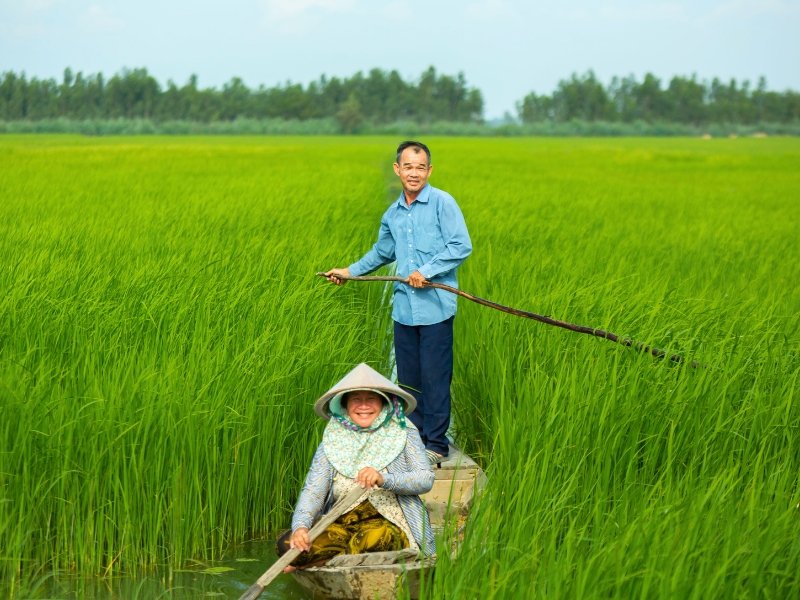
Rice field in the Mekong Delta
In Vietnam, rice is cultivated in all regions of the country, with agricultural landscapes as varied as they are spectacular. In the south, the Mekong Delta, with its fertile soil and intricate network of canals, allows up to three harvests per year. This territory is the beating heart of national production. Further north, the Red River Delta offers similar conditions, though slightly less intensive.
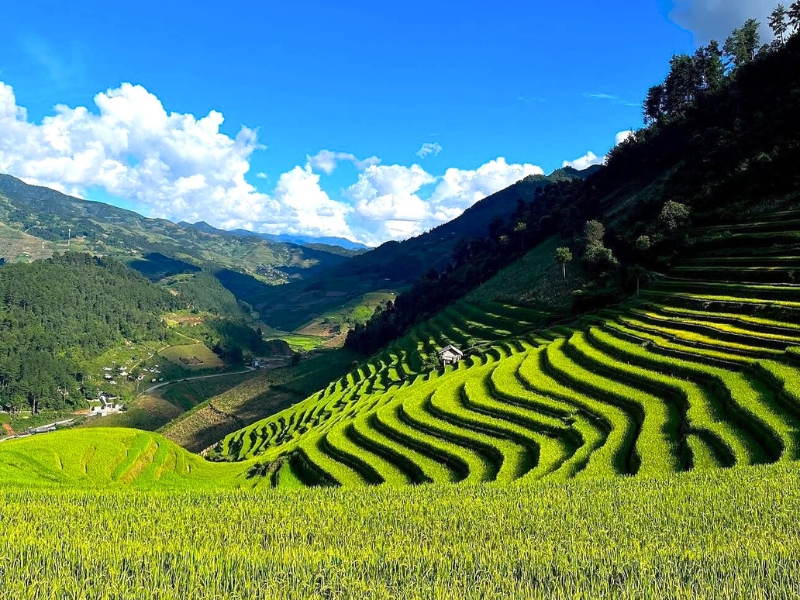
Terraced rice field at Mu Cang Chai
In mountainous regions of the North such as Sapa, Ha Giang, and Mu Cang Chai, the rugged terrain does not allow traditional flooded rice cultivation. The ethnic minorities have developed an ingenious system of terraced rice paddies over centuries, carved into the hillsides. These emblematic landscapes, beyond their beauty, testify to a remarkable adaptation to the environment.
Cultivation methods vary by region. In the plains, mechanization is progressing, facilitating the stages of plowing, planting, and harvesting. But in many rural areas, particularly in mountainous regions, work remains largely manual. Rice is planted, transplanted, and harvested by hand, in mud, under often oppressive sun. This demanding and meticulous work is passed down from generation to generation.
Rice cultivation remains closely tied to the rhythm of seasons, river floods, and the lunar calendar. For millions of Vietnamese, it is not merely an agricultural activity, but a lifestyle, a daily bond with the earth, and a living heritage.
The diverse varieties of Vietnamese rice
The diversity of rice varieties in Vietnam reflects both the richness of its terroirs and the complexity of its culinary culture. Depending on regions, soil types, and local traditions, the country produces a vast range of rice, each with its own qualities, specific uses, and gastronomic value.
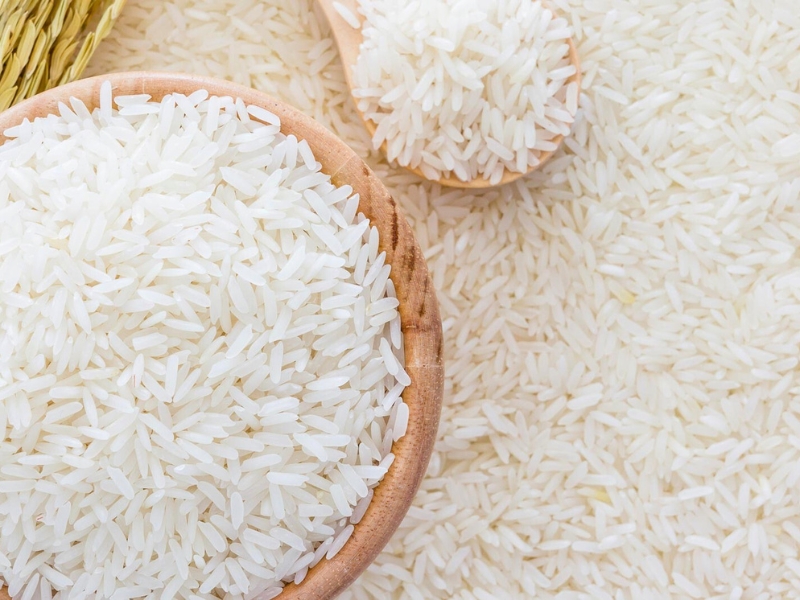
Rice, essential base for preparing Com, present at every Vietnamese meal
White rice (gao te) is the most commonly consumed. It serves as the basis for daily meals in all regions. Some varieties are particularly renowned for their subtle taste and balanced texture, such as Tam Xoan Hai Hau, with its fine grain and slightly fragrant aroma, or Bac Huong, appreciated for its softness after cooking. Tai Nguyen, cultivated in the Mekong delta, delights with its high yield and versatility.
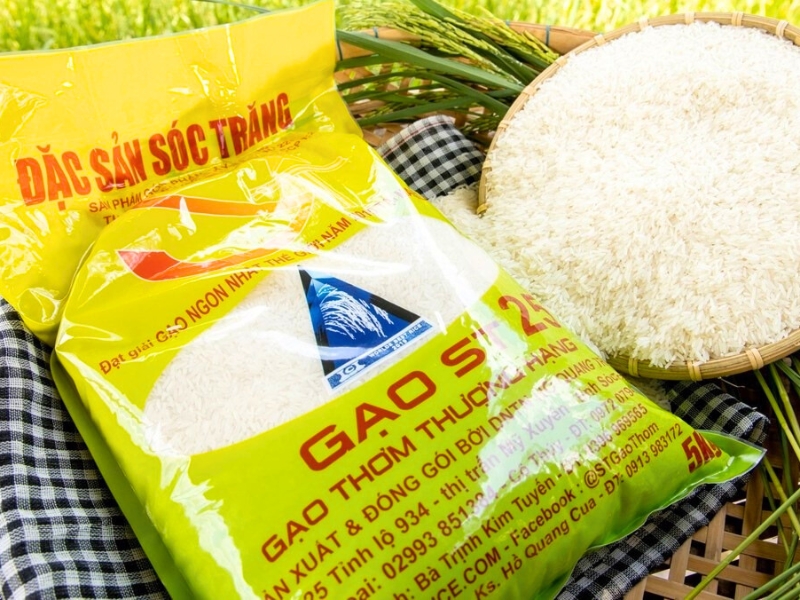
ST25 Rice – the excellence of Vietnamese rice
Alongside these traditional varieties, fragrant rice is occupying an increasingly important place, both in the domestic market and in exports. ST25, developed in Soc Trang province, won the award for the world’s best rice in 2019 and 2023, thanks to its natural aroma, its lightness, and its perfect consistency when cooked. It embodies today the Vietnamese craft knowledge of high quality, capable of competing with the finest Thai or Cambodian varieties.
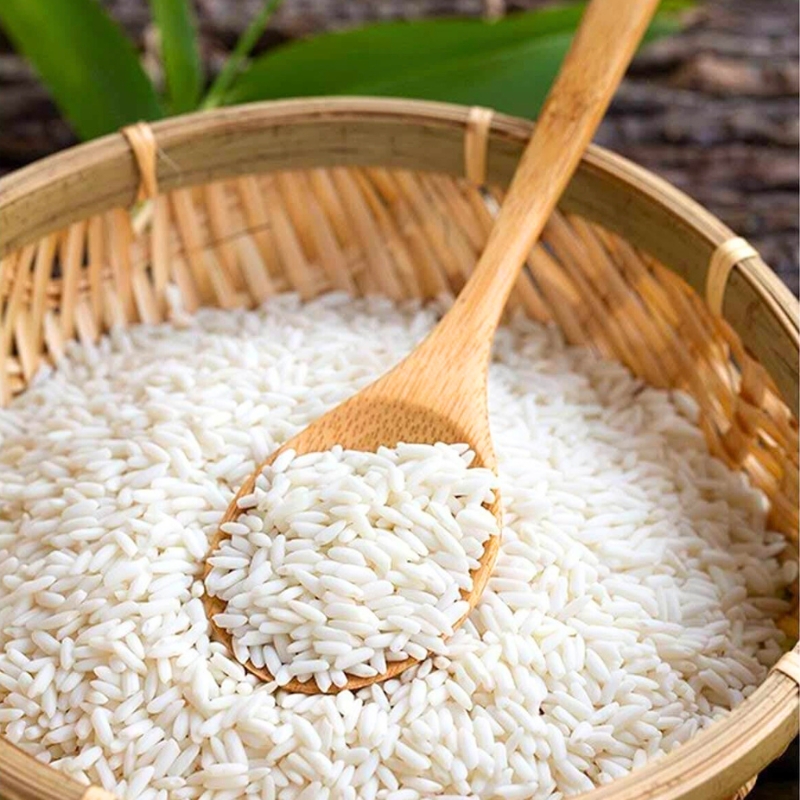
Sticky rice, with round grains and milky white color, is distinguished by its sticky texture after cooking.
Sticky rice (gao nep), on the other hand, is reserved for other uses. Its sticky consistency makes it ideal for festive preparations, desserts, or ritual offerings. It is found in emblematic dishes such as xoi (steamed sticky rice), or traditional sweets like banh chung and banh tet. Among the most renowned varieties, we cite Nep cai hoa vang, with its sweet taste and characteristic fragrance, and Nep Sap Ngong, appreciated for its melting consistency.
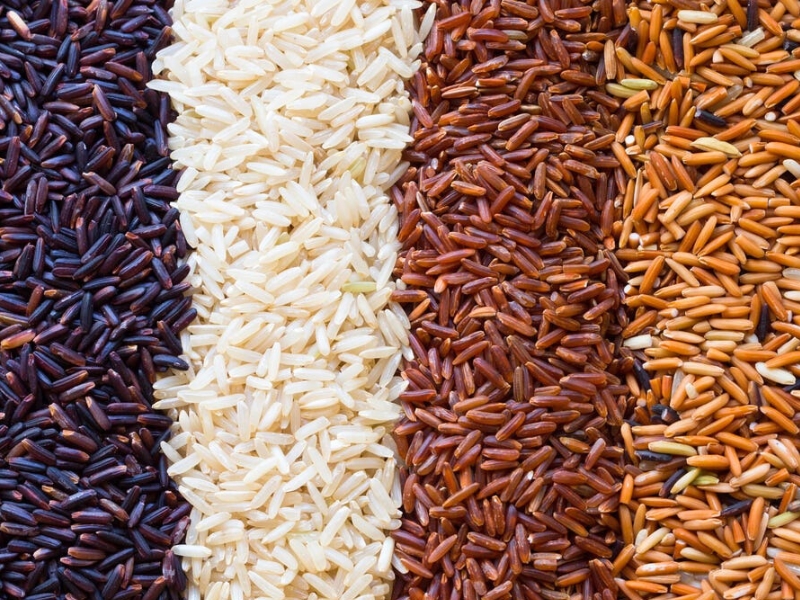
Brown rice comes in several varieties
Finally, in a context of seeking healthier eating, brown rice (gao lut) is experiencing renewed interest. Unlike white rice, it retains its bran layer, which gives it a richness in fiber, minerals, and antioxidants. Huyet Rong, with its intense red color, and Tim Than, with its dark purple, are the two main local varieties. They are often consumed boiled, mixed with legumes, or incorporated into specific diets.
Rice in Vietnamese cuisine
In Vietnam, rice is the central element of food. It is often said that “a meal without rice is not a real meal.” This phrase alone summarizes the importance of this grain in daily life: rice is not just an accompaniment, it is the foundation, the heart, the norm.
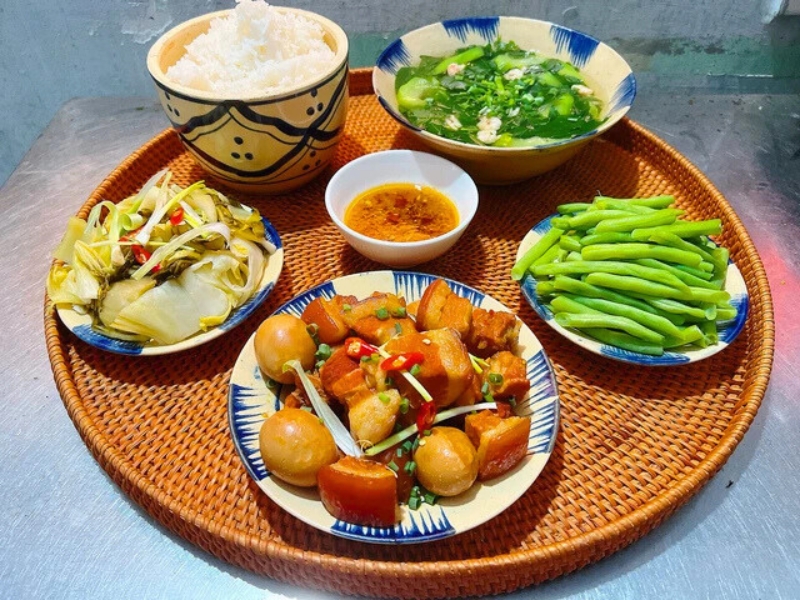
Steamed rice (Com trang) is essential in every Vietnamese meal
In Vietnamese cuisine, rice is found in multiple forms, both in savory dishes and in desserts. The most common remains steamed rice (Com trang), served at every meal with sautéed vegetables, meats, or fish. It forms the fundamental balance of the family meal.
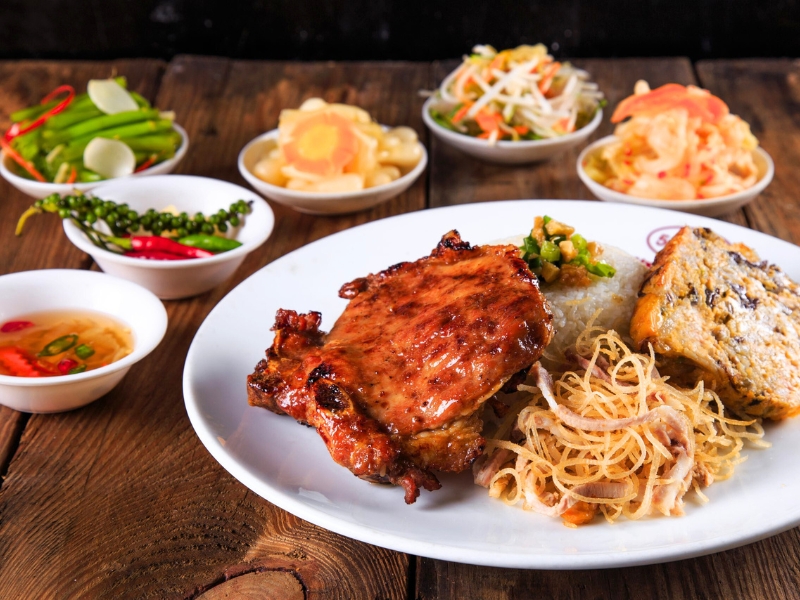
Tender grain, delicate taste: broken rice makes the difference
An emblematic dish of the south is Com Tam, or broken rice, often accompanied by grilled pork, a fried egg, steamed pate (Cha trung), and marinated vegetables. Long considered a popular food, it is now appreciated throughout the country for its simplicity and wealth of flavors.
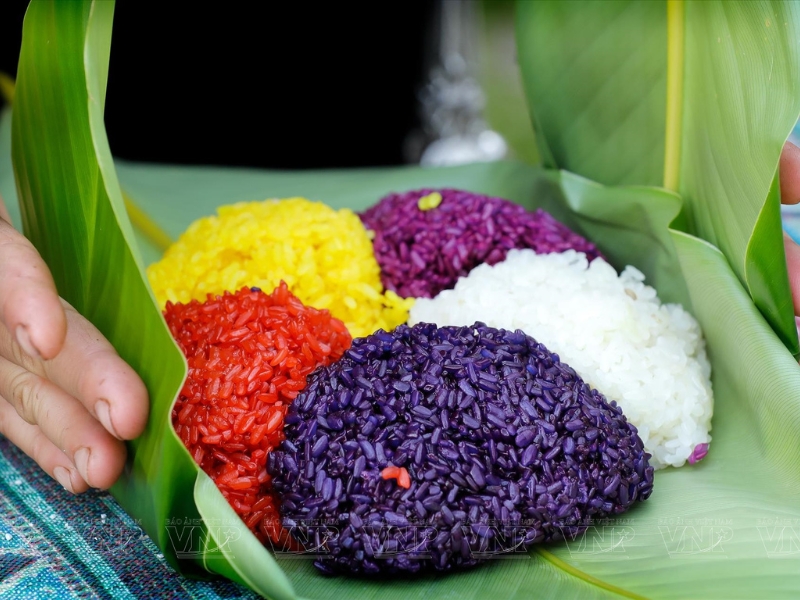
Xoi ngu sac (steamed sticky rice in five colors), a symbolic dish of the northern ethnic groups, tinted with the colors of nature
Sticky rice (gao nep) is used for more festive or specific preparations. Xoi – steamed sticky rice – can be savory (with chicken, pate, fried onions…) or sweet (with corn, mung beans, coconut). It is eaten at breakfast, during celebrations, or as a snack. Some colored types of Xoi, such as Xoi ngu sac (in five colors), are typical of traditional festivals.
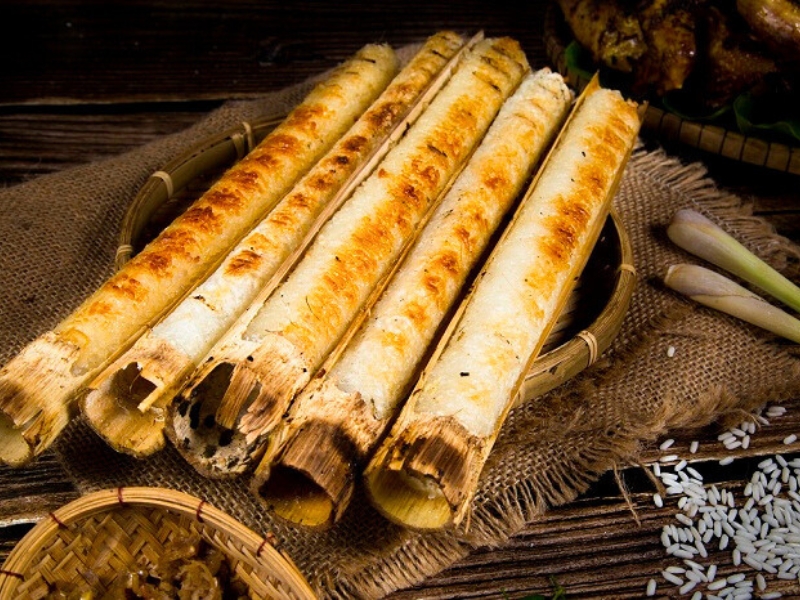
Com lam – sticky rice and bamboo, the essence of mountain cuisine
In mountainous regions, another much-appreciated specialty is found: rice cooked in bamboo (com lam). Prepared with sticky rice and sometimes a bit of coconut or beans, it is placed in a bamboo tube, then roasted on embers. This natural cooking method gives the rice a soft consistency and a unique woody aroma. Com lam is often enjoyed with sesame salt or grilled meats, especially during outdoor meals or community celebrations.
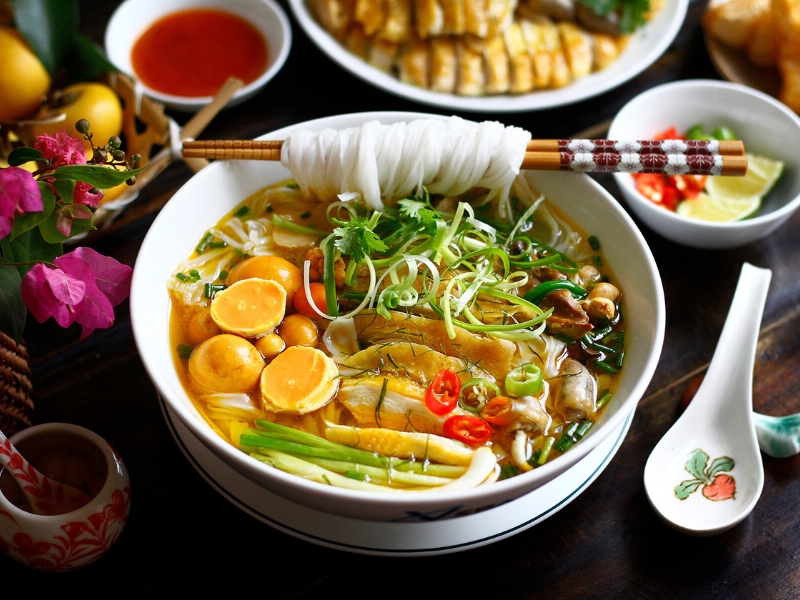
From breakfast to dinner, rice noodles rhythm Vietnamese cuisine
Rice noodles, in various forms and consistencies, also occupy a central place. They serve as the base for a multitude of emblematic dishes: pho, a noodle soup with beef or chicken; bun cha, grilled pork served with bun (rice vermicelli) and fresh herbs; or hu tieu, a southern specialty with Chinese influences. Elastic, light, gluten-free, rice noodles are omnipresent in street food as well as in family meals.
Among the specialties made from rice paste, Banh Cuon (rice crepe filled with ground meat and mushrooms) is another culinary pride, light and refined. Served hot with fresh herbs and nuoc mam sauce, it is an essential part of breakfast or street markets. Rice is also present in liquid form, as in Chao (rice porridge), a comforting dish consumed when one is sick, or simply for its sweetness.
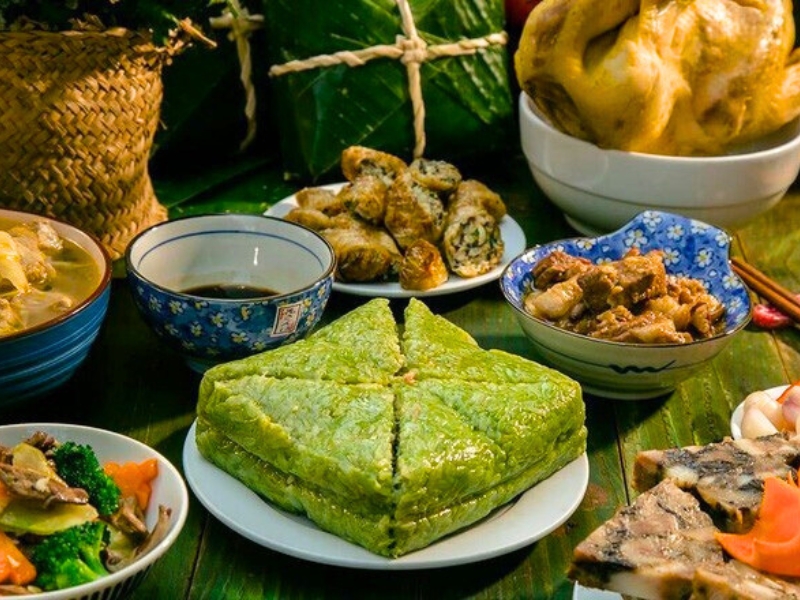
Sticky rice, central ingredient of banh chung, emblematic dish of Tet
But these are only the most emblematic: in reality, the majority of traditional Vietnamese sweets are made starting from rice, in the form of paste, flour, or whole grains. One can cite for example banh it, banh gio, banh day, or even the numerous sweets such as banh bo, banh duc, or banh da lon, all elaborated starting from rice or sticky rice, sometimes combined with coconut, mung beans, or palm sugar. These sweets, sweet or savory, are an integral part of Vietnamese culinary culture and mark both festivals and daily life.
In Vietnam, every grain of rice concentrates the memory of agricultural gestures, family transmission, the deep relationship between man and earth. It structures meals, accompanies rituals, nourishes both the body and collective identity. Present in all regions, in all forms – steamed, sticky, broken, in noodles, in sweets – it crosses seasons, social classes, generations. It links the countryside to the cities, traditions to contemporary culinary creations. Rich in meanings, forms, and flavors, rice is not a food like any other. It is a living matter, cultural, symbolic. Understanding its uses means drawing closer to Vietnam in what it has most intimate, most essential.