+84 9 75 46 33 10 (Whatsapp)
  info@horizon-vietnamtravel.com
  Français
  Español
  Português
  Deutsch
Traditional Vietnamese house in Hoi An


In Vietnam, the traditional house occupies an essential place in daily life. It is a place where multiple generations come together, where meals, celebrations, and important family moments are shared. Whether made of wood, bamboo, earth, or built on stilts, each house reflects the lifestyle of its region and the ingenuity of those who built it. Discovering traditional Vietnamese houses means entering the intimacy of the country, understanding its relationship with nature, with family, and with traditions that have been transmitted for centuries.
Located in a region of rivers and waterways, the architecture of the Vietnamese house is strongly linked to this humid environment; people who depend on waterways for their livelihood (fishermen, ferrymen, etc.) habitually dwell in their boats: they are boat-houses, raft-houses that, bringing together multiple families, form floating villages, fishing villages, fishing hamlets. Hundreds of tribes of ethnic minorities live in stilt houses to escape the perpetual flooding; for English diplomat Finlayson, in Saigon at the beginning of the 20th century, there were “many houses high on stilts, with wooden floors, well-aligned along canals, rivers, or along the main roads, spacious and well-ventilated”. The Vietnamese stilt house is precisely the most widespread residential model in Vietnam. It is still widespread in the countryside and in the high mountainous regions. It allows one to simultaneously confront a constantly difficult environment, to fight against torrential and sudden mountain rains and against periodic flooding of low-lying areas, responding to a very humid climate, to limit insect and beast attacks (parasites, reptiles, tigers, etc.).
Traditional Vietnamese house in Hoi An
Life is so linked to this world of rivers and waterways that even the roof of the Vietnamese house is curved to imitate a boat.
The formula Nha cao cua rong (high house, wide opening) summarizes the norm of the Vietnamese house.
The term “high” of the Vietnamese house has two connotations: firstly, the place through which a person enters inside must be high, well above ground level to deal with water surges, flooding, humidity, insects. Subsequently, “high” refers to the ceiling height which must create a spacious, ventilated, and cool volume to fight against heat. This produces a more pronounced slope that allows faster water runoff, sometimes torrential, and prevents too rapid deterioration of materials. This requirement has been closely followed at all times, from the houses of the Dong Son era to the “earth houses”. The images of Dong Son houses show us roofs always very high compared to the floor.
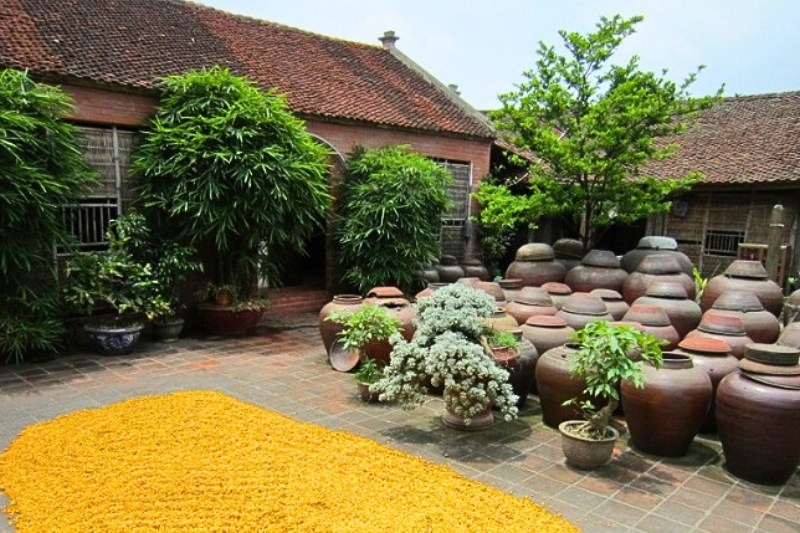
Why, for high houses, make openings not high, but wide? A small height of doors and windows avoids oblique sun rays and rain gusts. Against sun rays, bamboo woven panels are also arranged to shield direct and indirect radiation from the courtyard. Similarly, to avoid solar rays, a shaded belt has been created around the foot of the wall, and the lower edge of the roof, called giot gianh (straw drip), is often extended far beyond the veranda. Some stilt houses in the mountains have their giot gianh almost at floor height.
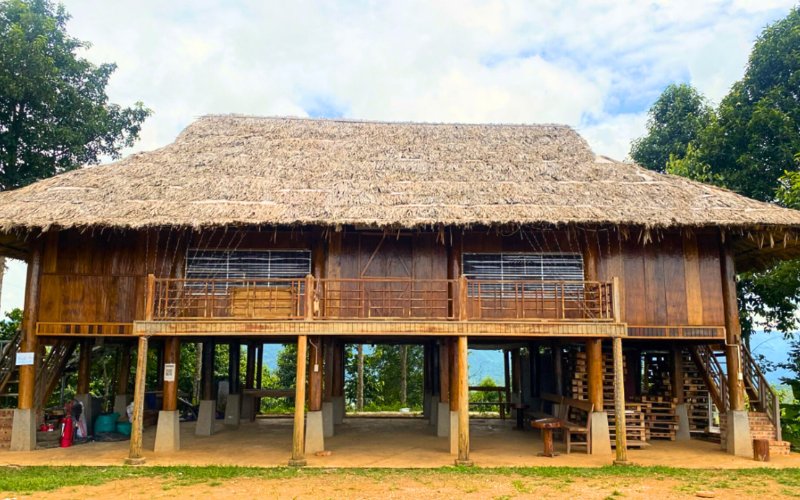
Stilt house, traditional Vietnamese architecture designed to withstand flooding and humidity
Openings must be wide to allow maximum air circulation, thus freshness. On a gable, a small triangular empty space is often left (popularly called khu di = cul-de-sac) to let heat and cooking fumes escape. This small opening forms, together with the set of lower doors and windows, an adequate ventilation system. But at the same time, one must avoid bad, too strong winds (air currents). This is why, through experience, one avoids aligning gate and entrance door. The main door must be at the center and the gate offset, while one should never access the house via a straight and direct path. At the base of the Vietnamese house, one must plant a hedge of shrubs or build a small wall that prevents the wind from blowing directly, deflecting it to the sides. It is believed that wind blowing directly into the house is a carrier of disease, infertility, and death.