+84 9 75 46 33 10 (Whatsapp)
  info@horizon-vietnamtravel.com
  Français
  Español
  Português
  Deutsch

Vietnamese Embroidery
Table of contents
Vietnamese embroidery is a craft practiced for several centuries. Although it is acknowledged that this artisanal knowledge finds its origin in China, Vietnamese embroiderers are no less talented. They would even be considered better than the Chinese “in making threads run through fabric and combining colors,” observed a French researcher specializing in Oriental cultures.
As for Charles-Édouard Hocquard, a French explorer passionate about Indochina, noted: “Vietnamese embroiderers are very skilled when arranging colors on fabric, to create embroidered patterns with delicate harmonies.”
A Brief History of Vietnamese Embroidery:
The history of introducing this craft dates back to the first half of the 16th century. Under the reign of Emperor Lê Chiếu Tôn (1518-1523), the Vietnamese ambassador Lê Công Hành was sent on a mission to China, to the province of Kouang Toung where he stayed for several years. This is how he discovered and admired the embroidery on court clothes, umbrellas, wall panels created by artisans in this province.
Having succeeded in observing them while they worked, he was able to reveal their secrets. Upon returning to his country, he made a detailed report to the King who ordered him to return to his village, located in Hà Đông province, to pass on these precious secrets to the inhabitants. Lê Công Hanh began teaching the women and men of Thuong Phuc the technique of Chinese embroiderers. Later, he taught the inhabitants of the neighboring village, Hien luong, the procedures for manufacturing umbrellas.
This was the beginning of establishing this craft in Vietnam. But to develop into a true activity bearing the soul of the country, before becoming an art, Vietnamese embroidery went through several periods marking its different stages of evolution.
During the first period, lasting even several centuries, while Vietnamese embroiderers mastered the techniques well, the motifs remained very influenced by Chinese cultural references. Moreover, the products were stereotyped models: flags and banners, altar curtains, parallel sentences, wall panels as decorations of religious or public buildings, and the motifs were inspired by Taoism. The fact that the Imperial Court imposed rules limiting artisans’ freedom of innovation or possession of large quantities of embroidery was the cause of this situation: Chinese motifs and colors with their symbols were passed down from generation to generation.
A new era of embroidery with new technical applications really began only towards the end of the 19th century and the beginning of the 20th century: the use of new fabrics such as local satin silk or Chinese silk, silk crepe, colored flannel; the use of bamboo frames for fixing the fabric, or again the application on the fabric of a very thin paper sheet to draw the motifs to be reproduced… Then, the products gradually gained Hanoi, rising to the rank of highly sought-after products in the capital. French influence was also felt on these products. A new clientele with different aesthetic tastes pushed Vietnamese embroidery to renew its activities: change of motifs, use of new procedures, French and Japanese especially. It was from this moment that Vietnamese embroidery entered the private sphere: table linens, sheets, decorative panels, cushions, curtains, drapes, women’s lingerie, evening dresses, kimonos…
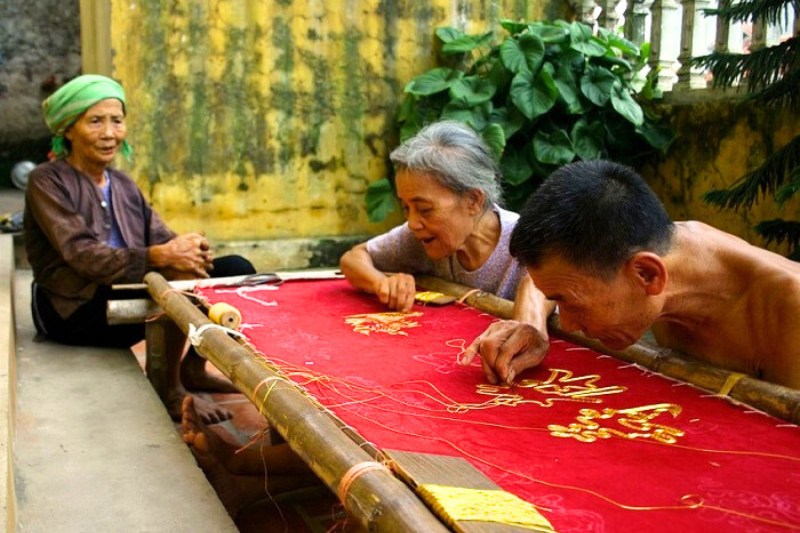
The two wars followed by a long period of planned economy were a break for this craft in Vietnam. In recent years, fortunately, with the development of fine arts in life and the appearance of new aesthetic needs, and new requests coming from abroad, Vietnamese embroidery has found new vitality. If villages practicing embroidery survive with difficulty, as happens with many other craft villages, new private or family workshops have managed to make themselves known throughout the country, and even outside Vietnam. Embroidered frames, for example, continue to seduce foreign tourists, while high-end embroidered products are increasingly seen in salons, alongside the most expensive decorative furniture.